
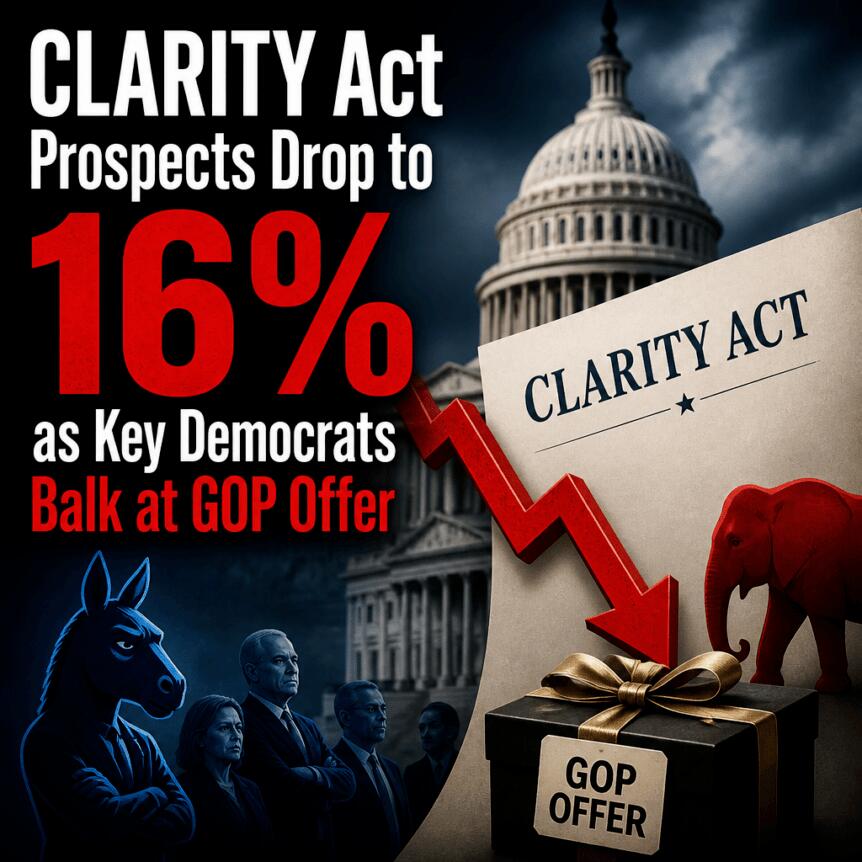
Betting markets are cooling fast on the odds that the US Senate will move the CLARITY Act forward this year, after Polymarket participants briefly pushed the probability higher following a newly revised Republican proposal—only to cut back sharply once Democrats signaled they were still not satisfied with the ethics language.
According to Polymarket’s tracker for the event “CLARITY Act signed into law in 2026,” the odds rose to as high as 35% after the GOP circulated a revised draft the previous day, including expanded ethics provisions. By Monday, the probability had fallen again, reportedly dipping as low as 16% as reservations about the updated text intensified. The bill would require 60 votes to advance, and a failure to clear procedural hurdles on Tuesday could delay the legislation that would shape how US regulators—specifically the SEC and CFTC—divide oversight for crypto-related products.
Key takeaways
- Polymarket odds for the CLARITY Act passing this year fell from around 35% to about 16% after renewed Democratic pushback on ethics provisions.
- Several Senate Democrats reportedly say the revised draft’s safeguards are still not strong enough to prevent corruption “in real time.”
- Republicans likely need 60 votes to advance the bill procedurally; losing momentum could stall the SEC/CFTC oversight framework for crypto.
- Outside groups—tribal interests, state attorneys general, and banking trade associations—are adding pressure by arguing the latest draft still has gaps.
Why Polymarket odds reversed so quickly
The turn came after a revised Republican “final” proposal was circulated to Democrats, with the update described as strengthening ethics provisions. For Polymarket traders, that appeared to be a constructive signal—leading to the short-lived jump in odds to 35%. But on Monday, multiple reports and comments pointed to continued friction over whether the ethics changes adequately address concerns about conflicts and enforcement credibility.
US Senator Mark Warner, a central figure in the negotiations, was among those weighing in, with reported comments that the revised ethics wording was not “near enough.” At the same time, Democrats involved in the talks were said to be preparing a counterproposal, indicating that the GOP draft did not fully close the gap on what they consider acceptable guardrails.
That combination—public skepticism from Democratic negotiators and an apparent move toward further bargaining—helped explain why bettors quickly re-priced the likelihood of near-term Senate progress.
Democrats push for stronger protections—while not every member is aligned
Reporting from Punchbowl News’ Brendan Pedersen highlighted the growing sense among some Democratic senators that the revisions still fall short. Pedersen reported that Senator Raphael Warnock said Democrats should not advance legislation that does not address corruption opportunities “in real time.” He also reported that Senator Ruben Gallego described the latest ethics offer as leaving “much to be desired” and indicated he planned to work on a counterproposal.
Pedersen further reported that talking points circulated by staff for Senator Elizabeth Warren on the Senate Banking Committee argued that a proposed mechanism for state AG enforcement could be overridden by a determination from White House ethics officials. Separate reporting from Politico’s Jasper Goodman, citing three people familiar with the matter, said Democrats have already sent their counterproposal to Republican negotiators.
Still, the opposition within the Democratic caucus is not uniform. Politico reported that Senator Kirsten Gillibrand has privately urged colleagues to support the procedural motion, suggesting at least some Democrats see a path to advancing the measure even if they remain dissatisfied with parts of it. On the Republican side, Senator Cynthia Lummis said President Donald Trump had accepted two significant ethics provisions and claimed “nothing left to give,” framing the remaining debate as unlikely to produce further concessions.
Together, these reports underscore a key asymmetry: while Republicans appear to believe ethics changes are already substantial, parts of the Democratic side seem focused on tightening specific enforcement or conflict-of-interest concerns before allowing the bill to proceed.
External pressure mounts: tribal gaming and banking groups raise distinct objections
Beyond Senate negotiations, the CLARITY Act’s latest language is facing challenges from multiple outside constituencies, each arguing from a different policy angle.
The Indian Gaming Association—representing tribal gaming interests—urged member tribes to press senators to vote against the bill. In its action alert, the group argued that proposed decentralized finance changes do not address concerns in Indian Country relating to prediction markets. The association specifically called for explicit language affirming that federal commodities law does not preempt tribal or state gaming laws, including protections under the Indian Gaming Regulatory Act. The group’s intervention matters because it suggests the bill’s definitional and regulatory reach could have ripple effects for how prediction-market-like activities are treated across jurisdictions.
In parallel, eight banking trade groups also criticized the revised text. According to a joint statement published by the American Bankers Association, the groups argued the proposal did not close loopholes that could allow stablecoin rewards functioning similarly to deposit interest. The banks also contended that a proposed “circuit breaker” mechanism would activate only after substantial deposit flight from community banks had already occurred—meaning the measure could be less protective in the early stages of any shift in consumer behavior.
Meanwhile, the crypto industry has continued to lobby for Senate action. In a statement released Monday, Blockchain Association CEO Summer Mersinger argued that the industry has made significant concessions to build bipartisan support and urged every senator to vote yes. She also claimed the bill would establish clearer rules, protect consumers, deter illicit activity, and reduce incentives for crypto-related jobs, development, and innovation to relocate overseas.
These competing pressures—tribal and banking concerns on one side, industry arguments on the other—highlight that the CLARITY Act is not only a regulator-jurisdiction question (SEC vs. CFTC), but also a broader policy fight over market design, enforcement mechanisms, and consumer protections.
What happens next depends on the vote math
Republicans require 60 votes to advance the bill. With Polymarket odds falling again and multiple Democratic negotiators reportedly preparing counter-language, the immediate risk is that the Senate cannot assemble the necessary procedural support this week. For investors and crypto market participants, that matters because the bill is intended to clarify how US regulators oversee crypto assets and related trading products, potentially reducing uncertainty that can affect policy expectations and compliance planning.
Watch whether Democrats unite behind the procedural motion and whether negotiators converge on ethics wording acceptable to key holdouts. The unresolved question is whether the revised draft’s safeguards are “near enough,” or whether further concessions will be required before the bill can clear the 60-vote threshold.
https://www.cryptobreaking.com/clarity-act-prospects-drop-to/?utm_source=blogger%20&utm_medium=social_auto&utm_campaign=CLARITY%20Act%20Prospects%20Drop%20to%2016%%20as%20Key%20Democrats%20Balk%20at%20GOP%20Offer%20
Comments
Post a Comment