
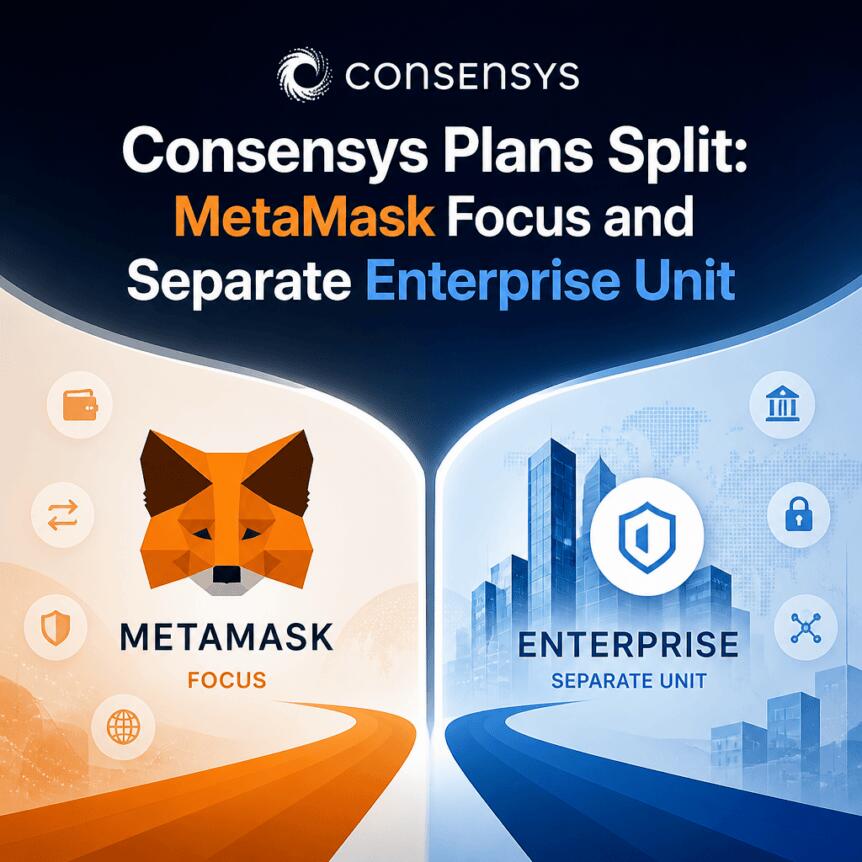
Consensys Software Inc., the Ethereum-focused company best known for MetaMask, plans to split into two standalone businesses—separating its consumer-oriented MetaMask platform from its institutional infrastructure and protocol operations. The company says the restructuring is expected to be completed by the end of 2026, with MetaMask led by Joe Lubin as chairman and CEO of the consumer company and Lubin also serving as executive chairman of the reorganized Consensys.
In the new structure, the remaining Consensys entity will focus on Ethereum protocols and institutional infrastructure. Its portfolio includes Linea, Besu, and Teku, and leadership will be handled by CEO Mike Kriak and President David Cunningham. The company frames the move as a response to diverging priorities between consumer products and enterprise blockchain deployment.
Key takeaways
- Consensys will split into two independent companies by the end of 2026, separating MetaMask’s consumer business from institutional infrastructure and protocols.
- MetaMask will stay focused on self-custody for users, while expanding into broader finance use cases such as payments, savings, and investing products.
- The new institutional Consensys will concentrate on Ethereum infrastructure and enterprise adoption, including tokenization and stablecoin-related services.
- Consensys says the consumer and institutional units have increasingly “different priorities,” a key justification for the corporate restructuring.
How the split reshapes Consensys’ operating model
According to Consensys’ announcement released via Business Wire, the company’s planned separation aims to give each business line room to pursue distinct strategies. In practice, the restructuring divides what has historically been one integrated Ethereum software ecosystem into two corporate entities with separate leadership teams and clearer mandates.
Consensys says the institutional company will house its protocols and enterprise infrastructure businesses, explicitly including Linea, Besu, and Teku. The stated focus goes beyond protocol development alone, extending to helping financial institutions deploy onchain capabilities for tokenization, stablecoins, and other onchain financial services.
Meanwhile, MetaMask is positioned as the home for consumer self-custody and a widening set of products meant to interact with mainstream financial activities. The company’s framing suggests a continued push for MetaMask to operate as more than a wallet—an interface through which users can access payment and investment-like functionality—while the enterprise-focused Consensys entity advances infrastructure and institutional use cases.
MetaMask’s expansion beyond a browser extension
MetaMask began in 2016 as an Ethereum browser extension for accessing decentralized applications and managing crypto assets, according to Consensys’ own historical account of the platform’s evolution. Over the past year, the company says MetaMask has added products that extend its role into payments, yield, and tokenized traditional assets.
One of the most notable developments described in the company’s coverage is the launch of MetaMask Money Account in June. The feature allows users to earn “up to 4% variable APY” on eligible mUSD stablecoin balances and spend those funds using the MetaMask Card. Consensys indicates that the yield is sourced from decentralized finance lending strategies rather than interest paid by MetaMask itself or by the stablecoin issuer.
In February, Consensys also pointed to MetaMask adding access to tokenized US stocks, exchange-traded funds, and commodities through Ondo Global Markets for eligible users outside the United States, referencing coverage that discussed the availability of 200 tokenized instruments. Later in February, it expanded MetaMask’s Mastercard-enabled spending card across 49 US states, building on earlier availability in other regions including Europe, Canada, Mexico, Brazil, and Argentina.
Taken together, these product moves help explain why Consensys’ leadership appears to be treating the consumer business as something that increasingly looks like a retail financial application layered over Ethereum infrastructure, rather than a pure crypto tooling product.
Why Consensys says the separation makes sense now
Consensys states that the restructuring reflects increasingly different priorities between its consumer and institutional businesses. While the announcement is explicit about what each company will contain and what each will pursue, the underlying implication for investors and industry observers is that the risks, regulatory pressures, and product timelines for consumer finance features may differ sharply from those tied to enterprise protocol infrastructure.
The institutional unit’s focus—helping financial institutions deploy blockchain technology for tokenization and stablecoins—suggests a nearer-term path centered on integrations, enterprise adoption cycles, and infrastructure reliability. By contrast, MetaMask’s consumer roadmap described in the company’s rollout includes yield-bearing stablecoin access and card-based spending, areas that typically demand a strong user experience and careful alignment with payment rails and consumer-facing compliance expectations.
Separating the companies could therefore reduce internal tradeoffs: product teams can pursue roadmaps optimized for their user segments without competing for shared corporate bandwidth. It also creates a more straightforward way to evaluate each business line independently once the split is completed at the end of 2026.
What to watch as the companies operate independently
With completion targeted for the end of 2026, the most immediate question for users and builders is how the split affects product continuity—especially for MetaMask features that rely on Ethereum infrastructure and for institutional tools such as Linea, Besu, and Teku.
For the consumer side, attention will likely focus on whether MetaMask’s card, savings/yield functionality, and access to tokenized traditional assets continue expanding on a timeline comparable to the past year’s rollouts. For the enterprise side, the market will watch whether the reorganized Consensys institution continues to accelerate its work on deploying Ethereum infrastructure for tokenization and stablecoin use cases in collaboration with financial institutions.
In the months ahead, readers should look for clarifications from Consensys on how assets, roadmaps, and leadership responsibilities will transition through the separation process—because the core operational details will determine how smoothly both MetaMask’s consumer ambitions and the institutional unit’s infrastructure focus can scale after the split.
https://www.cryptobreaking.com/consensys-plans-split-metamask-focus/?utm_source=blogger%20&utm_medium=social_auto&utm_campaign=Consensys%20Plans%20Split:%20MetaMask%20Focus%20and%20Separate%20Enterprise%20Unit%20
Comments
Post a Comment