
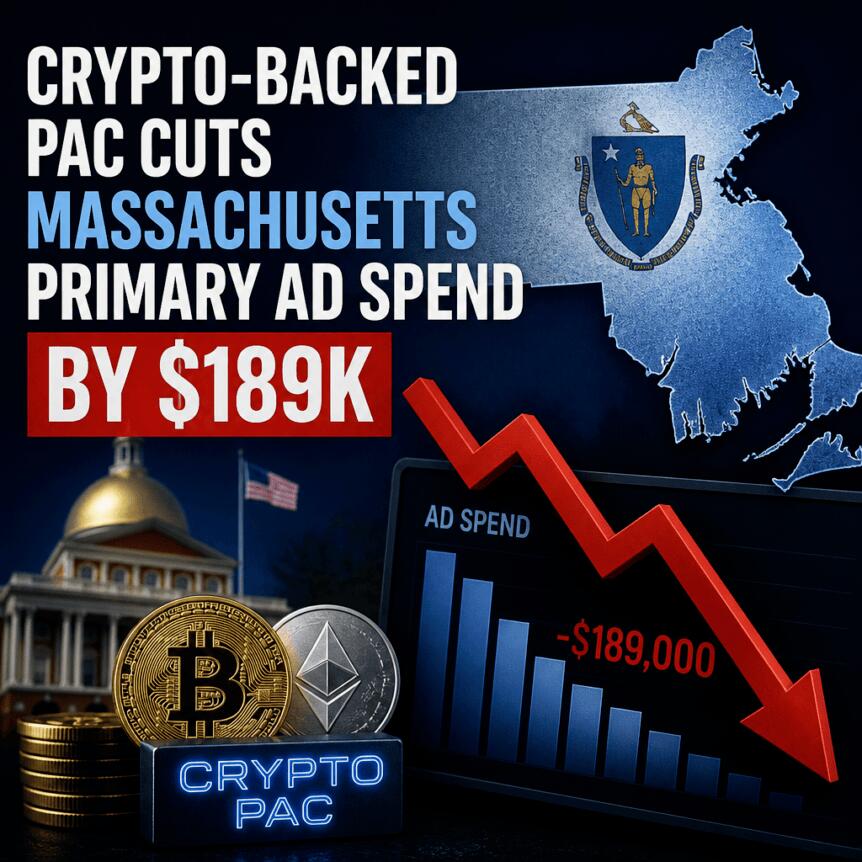
A Fairshake-linked political committee is spending on media support for incumbent U.S. Representative Jake Auchincloss ahead of Tuesday’s Massachusetts primary, according to Federal Election Commission (FEC) records. The activity comes as crypto-focused political spending groups continue to expand their influence beyond narrowly defined policy debates.
FEC filings show Protect Progress PAC—a Fairshake affiliate—spent just over $189,000 on media to back Auchincloss’s reelection campaign in Massachusetts’ 4th congressional district. Democratic challenger Jason Poulos, in a letter made public on Aug. 16, accused the incumbent of being influenced by the crypto industry and criticized the PAC’s efforts as potentially improper election interference.
Key takeaways
- FEC records indicate Protect Progress PAC spent just over $189,000 on media in support of Jake Auchincloss ahead of Tuesday’s Massachusetts primary.
- PAC spending is not tied to policy position votes in the reporting; Poulos argues the media activity is meant to influence voter perceptions during the primary.
- Poulos alleges Auchincloss accepted $77,500 from “crypto-industry sources” since 2020 and links that to crypto legislation votes.
- Fairshake’s broader election push continues into 2026, with the group citing large cash reserves and multiple prior race efforts earlier in the cycle.
Protect Progress PAC spending in Massachusetts
The FEC data, as of Tuesday, points to Protect Progress PAC’s media spend targeting Auchincloss in the Massachusetts 4th district primary. While the filings confirm the existence and scale of the spending, the underlying communications content is disputed politically, with the campaign message becoming part of Poulos’s attack on the incumbent.
According to Poulos, some of the PAC’s resources were used to produce what he described as “AI-generated slop mailers” supporting Auchincloss ahead of the Massachusetts primary, which took place Tuesday.
Poulos presses Auchincloss to renounce the PAC’s efforts
In the Aug. 16 letter, Poulos urged the incumbent to “publicly renounce” Protect Progress PAC’s involvement, framing the PAC’s activity as a way to influence both the primary and the eventual general election.
Poulos also raised campaign-finance and legislative-history allegations. He claimed Auchincloss accepted $77,500 directly from “crypto-industry sources” since 2020. He further pointed to Auchincloss’s voting record on the Digital Asset Market Clarity Act in July 2025—described in the article as a market-structure bill that has not yet been signed into law and is pending consideration in the Senate.
The core of Poulos’s argument appears to be that Auchincloss’s legislative behavior aligns with donors and industry pressure, and that the PAC’s media campaign—especially if it relies on AI-generated materials—underscores the influence he believes is operating behind the scenes.
Fairshake and affiliates keep targeting 2026 elections
This Massachusetts spending is part of a broader pattern of political activity from Fairshake and its affiliates. The reporting notes that Fairshake’s election efforts have included significant ad and media spending in the 2024 cycle—over $130 million—and that its affiliated PACs are continuing to pursue race-by-race influence during the 2026 midterm election period.
Earlier in August, Fairshake reported spending roughly $3.6 million on House and Senate races across Alaska, Florida, and Wyoming, as described in coverage linked within the article. The same reporting states that Fairshake had $122 million in cash on hand ahead of the 2026 midterms.
In an August statement quoted in the article, a Fairshake spokesperson, Geoff Vetter, said the organization would not slow down heading into November—connecting the group’s persistence to its cash reserves and the number of prior race wins.
What this means for voters and upcoming primaries
Massachusetts’ primary timing makes it one of the final major state nomination contests before the general election, with the general election still ahead and only a little over two months remaining, as cited in the article. The reporting also notes that New Hampshire, Rhode Island, and Delaware are slated to hold their primaries in September, placing additional pressure on political committees seeking momentum during the late-stage primary window.
For market participants and crypto policy watchers, the significance is less about any single congressional district and more about how crypto-aligned political organizations are operationalizing influence—using media spending to shape voter perceptions while also tying their efforts to the legislative outcomes they want to encourage or defend.
As more FEC disclosures and campaign messaging circulate, readers should watch how the Massachusetts primary debate evolves—particularly whether opponents escalate scrutiny of AI-generated campaign materials and donor ties, and whether PAC spending patterns continue to mirror earlier 2026 efforts in other states with upcoming primaries.
https://www.cryptobreaking.com/crypto-backed-pac-cuts-massachusetts-2/?utm_source=blogger%20&utm_medium=social_auto&utm_campaign=Crypto-backed%20PAC%20cuts%20Massachusetts%20primary%20ad%20spend%20by%20$189K%20
Comments
Post a Comment