
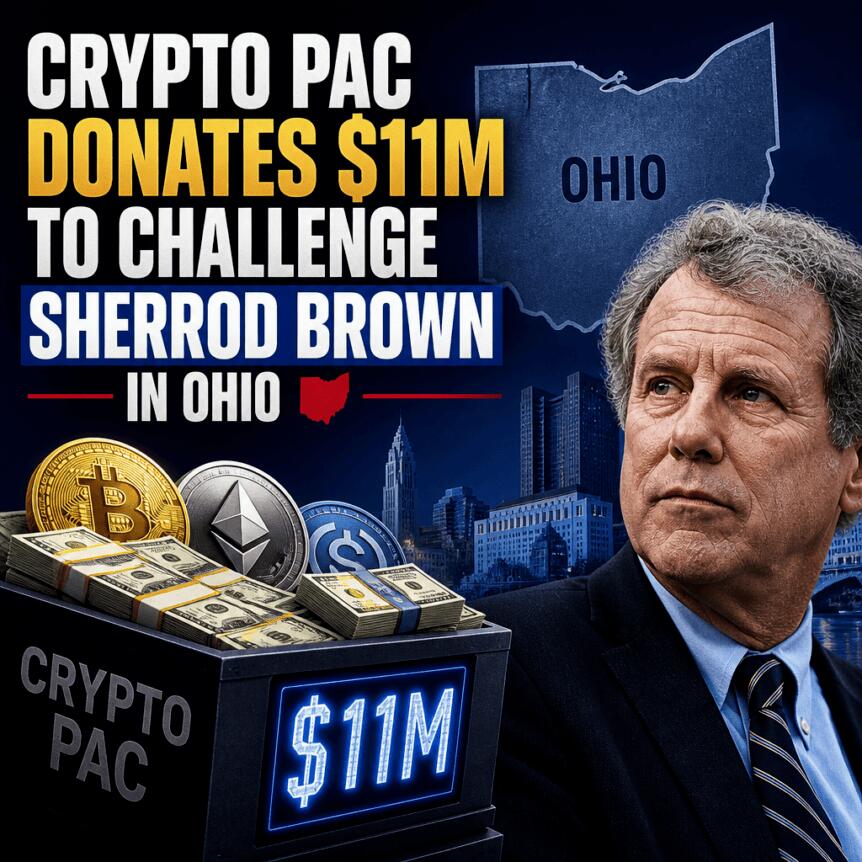
A cryptocurrency-industry–aligned political action committee has disclosed more than $11 million in ad spending for an Ohio U.S. Senate race, backing Republican Jon Husted while attacking Democrat Sherrod Brown’s possible return to the chamber.
In a Thursday filing with the U.S. Federal Election Commission (FEC), Defend American Jobs PAC—an entity affiliated with Fairshake, a pro-crypto group backed by companies including Coinbase and Ripple Labs—reported $11.4 million spent on media supporting Husted and opposing Brown. The advertising commitments appear to align with Fairshake’s earlier plan to put substantial resources into the Ohio contest as a way to limit Brown’s influence, given his long-standing criticisms of pro-crypto policy.
Key takeaways
- Defend American Jobs PAC reported $11.4 million in FEC filings for Ohio Senate ads backing Jon Husted and opposing Sherrod Brown.
- The PAC is affiliated with Fairshake, a crypto-industry–linked political effort backed by Coinbase and Ripple Labs.
- The spending comes amid a broader pattern of crypto-aligned political groups pouring money into Ohio races.
- Brown previously served as chair of the Senate Banking Committee and has been among the more prominent critics of pro-crypto legislation.
- Readers should watch whether crypto-aligned PAC spending in Ohio reaches or surpasses the scale seen in the 2024 cycle.
Crypto-aligned PAC spending surfaces in FEC filing
According to the FEC paperwork, Defend American Jobs PAC’s reported $11.4 million in Ohio advertising is focused on two goals: supporting Republican Jon Husted and opposing Democrat Sherrod Brown’s return to the Senate. The PAC’s disclosure references media buys that appear to be part of Fairshake’s larger pledge to spend heavily in the state.
Cointelegraph previously reported that Fairshake had indicated it would initially spend $30 million in the Ohio race in an effort to block Brown. The new disclosure does not confirm whether the committee has met or will meet that $30 million target, but the $11.4 million figure shows the effort is already well underway.
Why Brown remains a key target
Brown’s political profile has made him a focal point for pro-crypto advocacy groups. He previously chaired the U.S. Senate Banking Committee and has been a prominent voice questioning how crypto legislation and market structure could affect consumers and broader financial stability.
In an inquiry Cointelegraph pursued in August 2025 after Brown’s Senate race launch, Brown said that cryptocurrency is increasingly part of America’s economy and that, as adoption grows, his objective is to ensure it “expands opportunity and lifts up Ohioans and they are not put at risk.”
That stance reflects a more cautious approach than many crypto industry supporters prefer—particularly in an environment where industry-linked political spending is rising and donors and PACs are trying to shape which lawmakers set the rules for digital assets.
Ohio’s recent election cycle shows the scale of outside spending
The new disclosures arrive after a high-spending Ohio contest in 2024 involving Brown and Republican Bernie Moreno. In that cycle, Cointelegraph reported that the race drew more than $300 million in spending from outside groups such as Fairshake.
FEC records cited by Cointelegraph indicated that the crypto-aligned PAC and its affiliates alone spent roughly $41 million to oppose Brown and support Moreno. Moreno ultimately won with 50.2% of the vote to Brown’s 46.4%.
That earlier Ohio result matters for investors and market participants because it signals the kind of political leverage crypto-aligned groups are willing to pursue. If the current spending pace continues, it could further intensify the competitive push to influence who controls committees and legislative priorities tied to digital-asset regulation.
Other crypto-backed political efforts in Ohio
Ohio politics is also drawing funding from crypto-adjacent figures beyond Senate races. Vivek Ramaswamy, a Republican and co-founder of the digital asset management firm Strive, ran for U.S. president in 2024 and has repeatedly expressed positive views on crypto and blockchain. After not serving in the Trump administration, Ramaswamy announced plans to run for Ohio governor following the president’s 2025 inauguration, winning the Republican nomination in May 2026. He is set to face Democrat Amy Acton in November.
As a gubernatorial candidate, Ramaswamy’s campaign has received backing from several co-founders of World Liberty Financial, a crypto company associated with the Trump family. The three named donors—Chase Herro, Zak Folkman, and Zachary Witkoff—each contributed the maximum amount of $16,615 to the campaign. Additionally, Ramaswamy’s PAC, “V-PAC: Victors, Not Victims,” included donations totaling $20 million from Susquehanna International Group co-founder Jeff Yass, $6 million from NYDIG founder Ross Stevens, and $5,000 from the Bitcoin Voter Project, according to FEC committee data referenced by Cointelegraph.
With Defend American Jobs PAC already reporting $11.4 million in Ohio ad spending, the next question for voters and crypto market observers is whether crypto-aligned outside spending in this cycle will expand further—and how effectively it can shape outcomes as Brown and other key figures draw scrutiny from both sides of the digital-asset policy debate.
https://www.cryptobreaking.com/crypto-pac-donates-11m-to/?utm_source=blogger%20&utm_medium=social_auto&utm_campaign=Crypto%20PAC%20Donates%20$11M%20to%20Challenge%20Sherrod%20Brown%20in%20Ohio%20
Comments
Post a Comment