
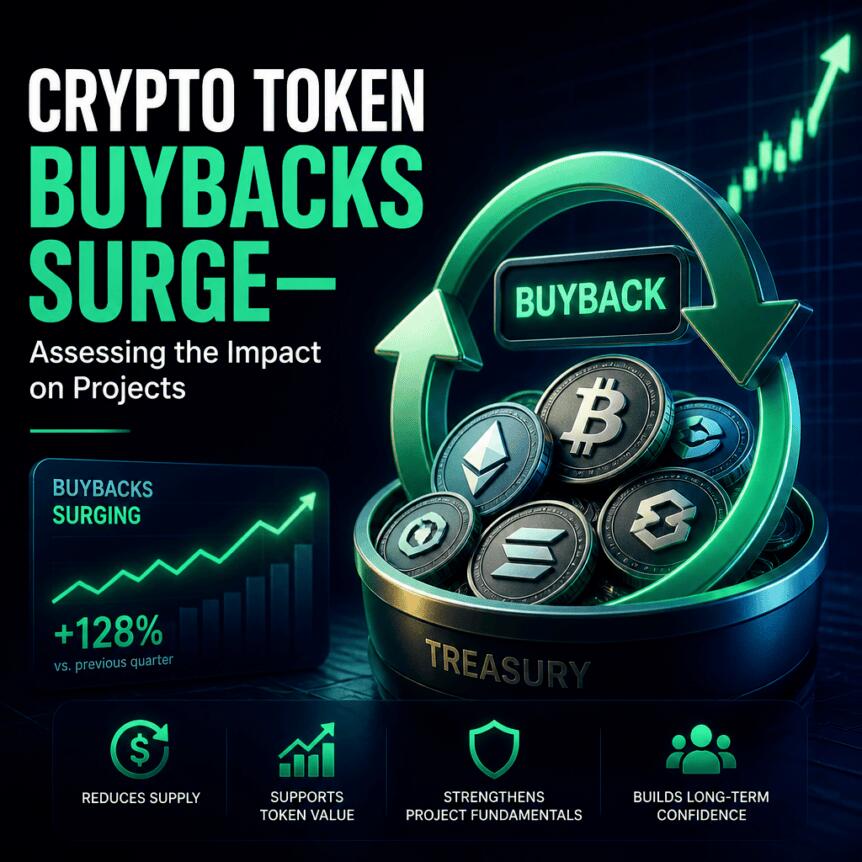
In 2026, token buybacks have become one of crypto’s most visible tokenomics moves, as more projects use protocol-generated revenue to repurchase their own tokens—often followed by holding or burning. Early-year data points to a rapid shift in how teams try to connect token value to economic activity, borrowing a familiar idea from TradFi while adapting it to on-chain mechanics.
According to Cointelegraph’s reporting, projects have spent roughly $640 million on token buybacks so far in 2026, about 17% higher than the comparable period in 2025. The same reporting also notes that the current spending is dramatically above the $366,000 figure recorded in 2024, with Hyperliquid and Pump.fun accounting for nearly 90% of the total.
Key takeaways
- Revenue-funded buybacks are increasingly used to create market demand and, when paired with burns, reduce circulating supply.
- Legal experts argue the main appeal is often simpler messaging—“bought and burned” is easier to explain than governance mechanics.
- Buybacks can improve tokenholder alignment, but they cannot fix weak fundamentals if the protocol’s surplus is limited.
- Investors are watching whether buybacks are genuine value capture or mostly financial engineering that props up prices temporarily.
- Regulators are focusing on what actually underpins token value, which could reshape how these programs are framed.
Why buybacks—and burns—are catching on
The basic logic behind token buybacks is straightforward. When a project uses revenue to repurchase its own token, it creates additional demand in the open market. If repurchased tokens are then burned, supply contracts, which can increase scarcity and put upward pressure on price under favorable conditions.
Beyond the market mechanics, supporters say buybacks give tokenholders a clearer line of sight to how the protocol is doing economically. Orest Gavryliak, chief legal officer at decentralized exchange aggregator 1inch, told Cointelegraph Magazine that revenue-funded buybacks and burns typically reflect one of two objectives: reducing the circulating token supply or demonstrating a rationale for investing in protocol revenues.
“When projects implement revenue-funded buybacks and burns, they typically have one of two objectives in mind: either to decrease the token supply in circulation or to demonstrate the rationale for investing in protocol revenues.”
Gavryliak also highlighted the communication advantage. Telling users that a project has “bought and burned tokens” is, in his view, more direct than explaining how governance rights work, how fees are set, or how protocol usage translates into value.
That appeal matters in a market where many tokens have historically struggled to make a simple economic case. Buybacks attempt to address that gap by linking tokenholder outcomes to the protocol’s revenue rather than relying only on narrative or speculative momentum.
From “narratives” to value capture—what’s changed
The adoption of buybacks reflects a broader trend: some token models are trying to behave less like pure stories and more like systems that steadily capture value for holders. Max Shannon, senior research associate at Bitwise Europe, argued that buybacks and burns remain one of the clearer ways to accrue value to tokenholders because they create a continuous bid for tokens tied to protocol adoption.
“Buybacks and burns remain an effective way to accrue value to tokenholders: they create a continuous bid in the open market for the token, directly tethering token success to the platform’s adoption.”
This is a notable shift from earlier phases of crypto’s growth, when many participants leaned on narratives—buying tokens because of expected upside rather than a detailed economic mechanism.
Cointelegraph Magazine cites specific examples to show how aggressive some programs have become. Hyperliquid, it reports, has used 99% of its revenue to buy back and burn HYPE, and Pump.fun reportedly directs 50% of its revenue toward buying and burning PUMP. The same piece states that $446.65 million worth of PUMP has already been removed from circulation.
Spark takes a different approach. According to Cointelegraph Magazine, Spark has acquired more than 143 million SPK via open-market buybacks funded by protocol surplus, but those tokens have not been burned. Co-founder and CEO Sam MacPherson told Magazine the intent is not just supply reduction; instead, Spark is using buybacks to keep long-term economic participation aligned with the protocol’s success. He said the goal is to avoid turning the mechanism into a simplistic “dividend mechanism,” emphasizing flexibility over how acquired tokens are deployed.
Are buybacks the best use of surplus?
Even if buybacks are effective at returning value, the bigger investment question is whether they are the highest-value use of a protocol’s next dollar of capital.
MacPherson framed the issue in terms of opportunity cost: a project should ask what it can do with surplus that creates the most durable value. If a protocol can reinvest at attractive returns, reinvestment may outperform distributing value immediately via token repurchases.
“The question should be: what is the highest-value use of the next dollar of surplus?”
There is also a practical limit: buybacks do not automatically improve the underlying business. For projects that generate little real surplus, repurchases may become a way to temporarily influence token prices without addressing operational constraints.
Cointelegraph Magazine points to examples where strong buyback and burn activity did not prevent tokens from underperforming relative to earlier highs. Pump.fun has reportedly been aggressively buying and burning PUMP since July 2025, yet the token remains around 50% below its September 2025 all-time high. The piece also notes that UNI has given back roughly half of the gains after Uniswap unveiled its UNIfication proposal in November 2025.
Shannon cautioned that multiple factors can drive price changes, so these outcomes do not prove buybacks “failed.” Still, he said investors have started debating whether startups should dedicate less revenue to buybacks and burns and instead invest more in teams and product delivery.
“They have prompted investors to debate whether these startup-like projects would be better served by reducing the share of revenue committed to buybacks and burns and reinvesting more in the team and the project itself.”
In other words, investors are increasingly distinguishing between token programs that boost token economics in parallel with business improvements, and programs that primarily function as price support.
When tokens start to look like stocks—and why regulators care
Although buybacks resemble corporate share repurchase programs, tokenholders generally do not receive the same legal entitlements as shareholders. Gavryliak stressed this distinction, saying token buybacks are “a market mechanism, not a legally enforceable entitlement.”
Shannon and Spark’s leadership describe the goal differently: they frame tokens as a kind of on-chain participation mechanism rather than an equity substitute. MacPherson called Spark’s SPK acquisitions “pseudo-equity,” not in a legal sense, but economically—trying to reproduce characteristics like long-term alignment, participation in governance, and the ability for committed community members to benefit from protocol success.
As regulators revisit how tokens should be classified, buybacks could become a flashpoint—not because they automatically make tokens into securities, but because they may influence how markets interpret the “source of value.” Cointelegraph Magazine discussed the proposed Digital Asset Market Clarity (CLARITY) Act of 2025, noting it remains a draft and should not be treated as settled law.
Gavryliak’s view is that the question regulators may prioritize is whether token value primarily comes from the network’s functionality or from the project’s efforts to market and deliver returns. He warned against relying on stock-like framing without addressing what actually drives value.
“If it stems from the functionality of the network itself, then the asset looks like a commodity. But if the value is based on the efforts of the project’s team in matters of shipping, marketing, or providing returns to token holders, then it is already a security. In the end, don’t put the clothes of a stock on the token and expect it to be a commodity.”
There is also a deeper investor test implied by that logic: if buybacks were to stop, would holders still have a reason to hold? As Gavryliak put it, the mechanism may be cosmetic if the protocol’s value proposition is not durable.
“If the buybacks stopped, would there still be a reason to hold the token? If the answer is no, the problem runs deeper than tokenomics.”
With buybacks spreading, the next phase for investors is likely to focus less on the headline figure of repurchases and more on what they replace internally—how much surplus is left for development and whether token economics can survive without constant financial engineering. Regulators are also signaling that the narrative around “where value comes from” may matter as much as the program itself.
https://www.cryptobreaking.com/crypto-token-buybacks-surge-assessing/?utm_source=blogger%20&utm_medium=social_auto&utm_campaign=Crypto%20Token%20Buybacks%20Surge—Assessing%20the%20Impact%20on%20Projects%20
Comments
Post a Comment