
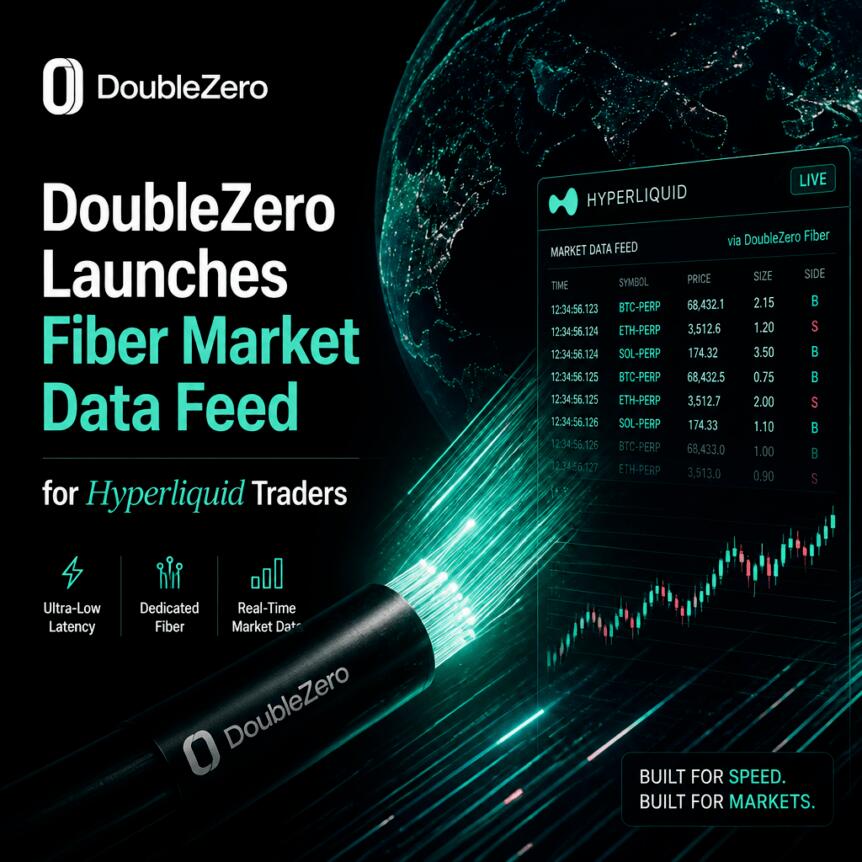
DoubleZero has launched a dedicated market data feed for Hyperliquid, aiming to give professional trading firms a more reliable and complete view of the decentralized exchange’s order book. The service delivers Hyperliquid’s market data over fiber, rather than relying on the exchange’s public APIs.
According to DoubleZero, the feed provides an ordered, continuous stream of order book data for market makers, quantitative traders, and proprietary trading firms that depend on consistent update frequency and depth.
Key takeaways
- DoubleZero’s Hyperliquid feed distributes full order book data via a dedicated fiber network instead of public APIs.
- The service supports Hyperliquid’s native perpetual futures and also markets run through trade, a venue using Hyperliquid infrastructure for asset-linked perpetuals.
- DoubleZero says public API changes have reduced both the frequency and the depth of order book updates available to external consumers.
- The initiative broadens DoubleZero’s “Edge” market-data offering, which already includes Solana and the prediction market Kalshi.
A fiber-based order book for professional traders
For firms that need a full and timely order book, pulling liquidity data from a public interface can introduce inconsistency. DoubleZero’s new feed is designed to address that by providing market data as a continuous stream, with ordering guarantees intended to help automated systems interpret changes quickly and predictably.
DoubleZero positioned the launch around a practical problem: before this release, companies seeking a complete view of Hyperliquid’s order book typically had to reconstruct it themselves from public API responses or run their own Hyperliquid nodes. DoubleZero now offers a third path—an outsourced, purpose-built distribution layer.
The company also attributes the need for a dedicated feed to changes in Hyperliquid’s public APIs. DoubleZero said those updates have lowered the cadence and reduced the depth of information available through the public routes, making it harder for data consumers that require more frequent, comprehensive updates.
What’s included: native perps and Hyperliquid-powered markets
DoubleZero said the feed covers Hyperliquid’s native perpetual futures markets, alongside markets operated by trade provides perpetual contracts linked to assets including oil, gold, and silver, using Hyperliquid’s underlying infrastructure.
DoubleZero added that the feed was developed in collaboration with validator operators and ecosystem partners, including Hyperion DeFi, MAVAN, and Kinetiq. That matters because fiber-based delivery depends not just on software integration but also on reliable distribution pathways across network participants.
Why this matters: convergence with traditional exchange data workflows
The launch also highlights a broader trend in onchain market infrastructure: professional trading firms are increasingly looking for data distribution patterns similar to those used by large traditional exchanges.
Hyperion DeFi CEO Hyunsu Jung told Cointelegraph that major exchanges such as CME and Nasdaq distribute professional market data over dedicated networks. The point is to deliver a consistent stream of ordered information at high speeds to automated trading systems.
Jung argued that Hyperliquid’s market data can now be consumed through a similar model. In his words, the approach is effectively “publish once, distribute simultaneously over dedicated fiber,” echoing the logic behind how institutional infrastructure treats market data as a specialized distribution problem.
That said, Jung emphasized there are meaningful differences. Traditional exchanges allow firms to reduce latency further by placing trading infrastructure close to the venue’s execution systems. Hyperliquid, by contrast, executes trades onchain, which changes where latency is incurred and how it can be optimized.
He also noted that physical geography still matters. A firm based in Tokyo, for example, will maintain a speed advantage over one in New York regardless of how the data is delivered—an important reminder that fiber distribution can improve consistency and reduce certain bottlenecks, but it does not eliminate real-world network and distance effects.
Jung summarized the relationship as not a claim that Hyperliquid is becoming “CME,” but rather that onchain markets are borrowing the market-data infrastructure layer that professional firms already rely on in conventional finance.
Expanding “Edge” market data beyond crypto venues
DoubleZero’s Hyperliquid feed is the third venue available through its Edge market-data service. The company previously deployed similar services for Solana and for Kalshi, a prediction market. With this expansion, DoubleZero is effectively positioning Edge as a cross-venue distribution platform aimed at professional-grade data consumption.
For market makers and quantitative firms, the practical value of an Edge-style service is straightforward: fewer gaps in update streams, less reliance on reconstructing order books from partial public feeds, and a single distribution layer designed for automation.
For the broader Hyperliquid ecosystem, it may also signal a shift toward treating market data as critical infrastructure in its own right. Instead of forcing each data-heavy firm to build bespoke ingestion and normalization systems, venues can increasingly support dedicated distribution pipelines that align with how trading desks already operate.
Investors and traders will likely watch next how widely institutions adopt the feed and whether other onchain venues respond with similar dedicated distribution layers, particularly as more market participants push for predictable, ordered depth updates beyond what public APIs can provide.
https://www.cryptobreaking.com/doublezero-launches-fiber-market-data/?utm_source=blogger%20&utm_medium=social_auto&utm_campaign=DoubleZero%20Launches%20Fiber%20Market%20Data%20Feed%20for%20Hyperliquid%20Traders%20
Comments
Post a Comment