
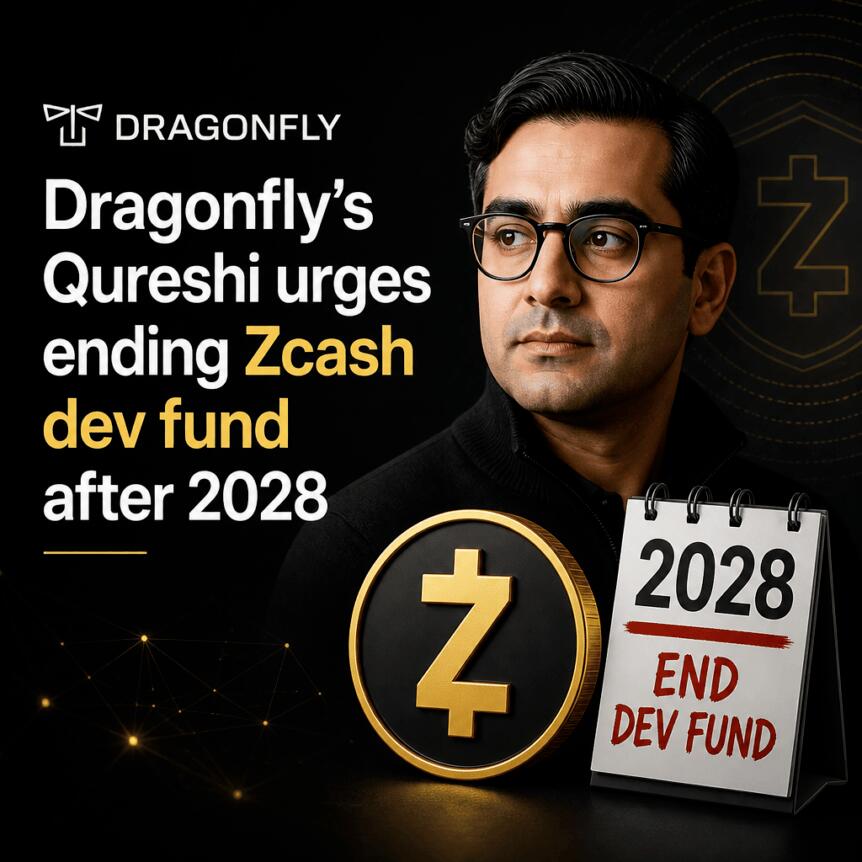
A debate inside the Zcash ecosystem is intensifying as the protocol’s development fund continues to grow in value. Dragonfly managing partner Haseeb Qureshi has argued that the Zcash developer fund should be wound down after it expires under the current rules in 2028—calling it unnecessary to continue once the remaining work can be covered.
According to ZecStats, the Zcash development fund held 63,962 ZEC tokens at press time, worth roughly $95 million. Qureshi said the fund is large enough to support remaining development and warned that as it approaches a potential $100 million size, it could become “politicized.” The proposal has sparked disagreement over whether the fund should stay intact and, crucially, over who should ultimately govern it.
Key takeaways
- Dragonfly’s Haseeb Qureshi says the Zcash development fund should be treated as the “final” one and wound down when current rules expire in 2028.
- ZecStats data shows the fund holds 63,962 ZEC, valued at about $95 million at the time of reporting.
- Backers argue the fund remains important in an environment shaped by rapidly advancing AI and evolving cyber threats.
- The dispute isn’t only about funding size—it also centers on whether governance should be token-holder-driven, delegated, or hybrid.
- Zcash founder Zooko Wilcox has pointed to the role of the Community Grants Committee, clarifying it represents about 40% of the fund.
Why the fund is at the center of a bigger governance fight
The Zcash development fund is designed to accrue protocol-level resources specifically for development. It earns 0.1875 ZEC per block—described as representing 12% of the block subsidy under the NU6 upgrade. The balance is held outside regular circulation and can only move via governance disbursements.
As the ZEC token has rallied, the economic weight of those locked tokens has drawn increased attention. Qureshi’s argument is rooted in the idea that a larger, still-runnable fund can attract more contentious political bargaining, even if the underlying purpose remains technical and constructive.
In his view, continuing the fund past its natural end point risks making development spending a proxy for broader community power struggles rather than a disciplined mechanism for funding specific engineering work. That concern frames why his “final Dev Fund” proposal matters: the discussion is moving from whether development money is needed to how it should be handled and who gets to decide.
Competing views on whether Zcash needs ongoing development funding
Not everyone agrees that winding down is the right step. Paradigm founder Matt Huang publicly pushed back, arguing that the fund has special value “in this age of AI cyber capabilities” and rapid progress in quantum-related work. His point suggests that the technical baseline for maintaining Zcash may require sustained investment even if the debate over governance becomes uncomfortable.
Other participants have raised concerns from a different direction. Maxime Desalle, an investment analyst at Winklevoss Capital, suggested the community should “completely get rid” of the development fund as a way to eliminate governance disputes entirely. Desalle has previously argued that a fund of this structure could harm Zcash’s security while reproducing governance inefficiencies he likened to the dependencies and bureaucracy seen in welfare states.
These positions highlight a core tension: one side views the fund as a necessary buffer for long-term protocol security and innovation, while the other sees it as a source of governance friction that could introduce new risk profiles as it accumulates value.
Who should control the lockbox: token voting, delegation, or hybrid governance
Beyond the question of whether the fund should exist, participants are also disagreeing on governance design. Qureshi said control should not shift toward “pure token holder voting.” Instead, he supported a partial model in which token holders elect temporary councils—aiming to keep legitimacy while reducing day-to-day unpredictability.
Huang aligned with the view that purely token-holder-driven governance could create “unpredictability” that may limit long-term trust in Zcash as a monetary asset. He proposed a hybrid approach combining token involvement with other governance mechanisms, suggesting that legitimacy and stability both need to be engineered rather than assumed.
At least one critique comes from the opposite end: Desalle argued for removing the fund altogether, which would remove the governance problem by eliminating the object that triggers it. That framing effectively treats governance risk as inseparable from the existence of the lockbox—whereas the hybrid camp sees governance redesign as a solution.
Clarifications from Zcash founder Zooko Wilcox
As the discussion broadened, Zcash founder Zooko Wilcox weighed in on the role of the Community Grants Committee. In an earlier post dated Sept. 1, he cited the committee as one of the main reasons Zcash has “survived and grown” over time.
Wilcox later clarified that the Community Grants Committee represents only 40% of the development fund. That detail matters for the argument about how “politicized” the funds may become: if a significant share of the money is already channeled through a defined committee structure, then supporters of the fund may argue that governance disputes don’t affect all disbursements equally—while opponents may still contend that the remaining portion could be vulnerable to shifting coalition dynamics.
The back-and-forth also underlines that the community is not simply choosing between “fund” and “no fund.” It is deciding how different parts of a single mechanism should be distributed, evaluated, and audited through governance.
What to watch next
With current rules pointing to an expiration in 2028, the immediate question for Zcash participants is whether discussions will converge on a specific governance model—such as Qureshi’s partial or Huang’s hybrid approach—or whether the community will push toward a more radical outcome like full elimination. Readers should watch how proposals address both disbursement structure and stability, because the dispute is ultimately about protecting Zcash’s long-term development process while maintaining trust as the fund’s market value grows.
https://www.cryptobreaking.com/dragonflys-qureshi-urges-ending-zcash/?utm_source=blogger%20&utm_medium=social_auto&utm_campaign=Dragonfly’s%20Qureshi%20urges%20ending%20Zcash%20dev%20fund%20after%202028%20
Comments
Post a Comment