
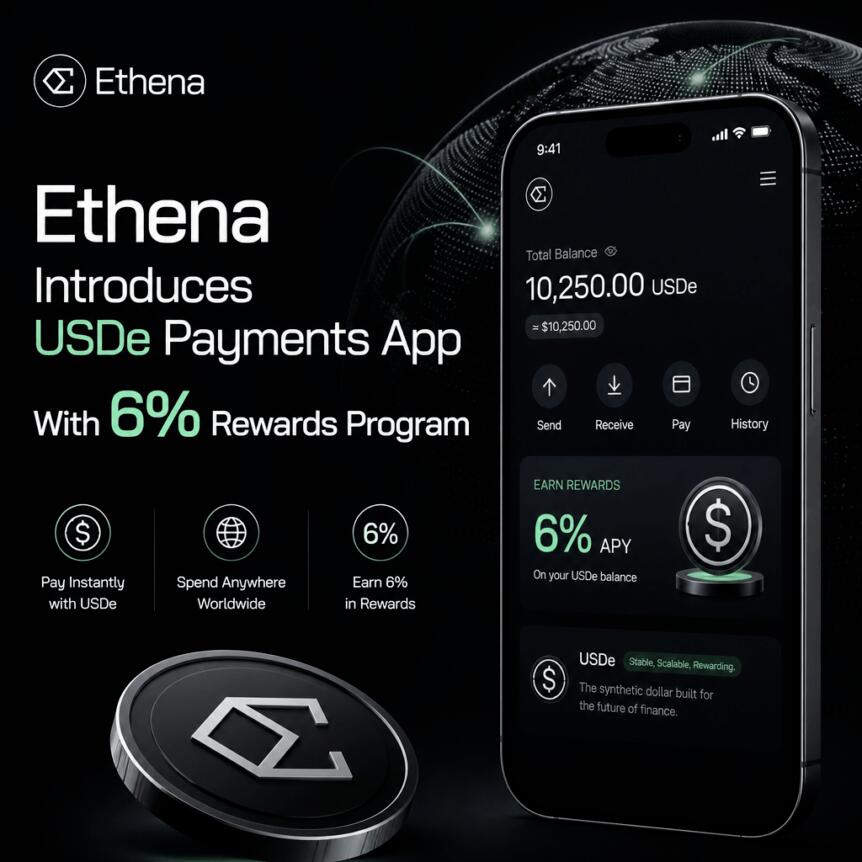
Ethena has rolled out Ethena Pay, a global “money app” designed to bring its USDe synthetic dollar into everyday use—covering payments, savings and cross-border transfers. The announcement positions USDe less as a tradeable stablecoin and more as a mechanism for day-to-day value storage and movement.
According to Ethena’s update posted on X, the self-custodial app will let users hold USDe via a dollar-denominated balance, earn up to 6% annualized rewards, and spend using a payment card. The beta rollout is set to begin with limited access—initially 400 users—before expanding weekly across a broad set of regions.
Key takeaways
- Ethena Pay is a self-custodial app built around USDe for payments, savings and transfers.
- Users can deposit fiat or crypto, with funds converted into USDe (USDe) for a dollar-denominated balance.
- The beta begins with 400 users and expands weekly; Ethena targets 48 countries at launch.
- Avalanche is named as the exclusive settlement layer for payment and transfer flows.
- Ethena Pay is not initially available in the US, EU, Canada, Taiwan, or South Korea, with expansion tied to regulatory approval.
Ethena Pay turns USDe into a daily-use wallet
Ethena’s pitch with Ethena Pay is straightforward: users should be able to hold USDe like a cash-like balance and use it for commerce and transfers without relying on traditional banking infrastructure. In the beta, Ethena says users can deposit fiat or crypto, after which funds are converted into USDe (USDe).
The app also supports movement between external banking systems. Ethena states that the product can use IBAN details to move money to and from external bank accounts into local currencies, effectively framing USDe as the routing layer for cross-border activity.
Infrastructure for the onramp/offramp components is partly handled by Iron, which Ethena describes as being owned by MoonPay. This is relevant for users because it points to a practical bridge between conventional fiat rails and a synthetic stablecoin-based balance rather than requiring fully crypto-native onboarding for everyone.
Beta geography and rollout pace
Ethena says the beta rollout will cover 48 countries, spanning Latin America, the Caribbean, Africa, Asia and other regions. However, the initial distribution is narrow: access is limited to 400 users at the start.
That staged approach matters for risk management and operational testing, particularly for a product combining self-custody, fiat conversion, card-based spending and cross-border transfer workflows. The weekly expansion schedule suggests Ethena intends to validate demand and reliability while broadening coverage gradually.
There is also clear geographic constraint in the initial release. Ethena states that Ethena Pay is not initially available in the US, EU, Canada, Taiwan or South Korea. Ethena expects to expand to those markets during the beta period, but only “subject to regulatory approval,” highlighting that the technical rollout is not the only gating factor.
Avalanche settlement for payments and transfers
One of the more concrete architectural decisions in Ethena’s announcement is the choice of Avalanche as the exclusive settlement layer for payments and transfers within Ethena Pay. For users, that implies that while USDe is the value unit being held and moved, the underlying settlement mechanism for the app’s transaction flows will be handled through Avalanche, not directly through Ethereum’s base layer.
For developers and investors, this signals an intent to treat USDe as a payments-focused asset that can interoperate with non-Ethereum execution environments at the settlement layer. It also reduces a common friction point—where stablecoin-based payment products often get bogged down in settlement throughput, latency, or cost considerations tied to a single blockchain choice.
USDe growth and what it means for Ethena’s expansion
Ethena is an Ethereum-based protocol underpinning USDe, a synthetic dollar designed to keep its value close to $1 without depending on traditional banking reserves. USDe maintains its peg using a combination of crypto collateral and hedging strategies, including derivatives positions, according to Ethena’s documentation.
As USDe expands beyond trading and into payments, size and adoption become more than marketing talking points. DefiLlama data shows USDe has reached a market capitalization of approximately $4.1 billion, which DefiLlama ranks as the sixth-largest stablecoin.
Ethena’s growth story is paired with movement in its governance token. Ethena operates ENA, which has a market capitalization of roughly $1.5 billion, according to the figures cited in the underlying reporting. ENA has reportedly rallied sharply over the past month, up about 68%, though it remains below earlier highs.
On Friday, the Ethena Foundation proposed directing 95% of the net revenue it receives from Ethena’s core businesses toward ENA buybacks once USDe’s circulating supply reaches $7.5 billion. After that proposal was made, ENA rose more than 10%, and was reported to gain 27% over the week.
Market activity around ENA has also been notable. The article notes ENA trading volume of about $595 million over the past 24 hours, up 16% from the previous day, with CoinGecko data placing its price around $0.16 on Tuesday.
While Ethena Pay is about real-world utility for USDe, the token mechanics matter because they can shape investor expectations around how Ethena may fund growth and align token incentives. The buyback proposal, tied to a specific USDe supply threshold, also creates a clear milestone that readers can watch as a proxy for how quickly the ecosystem is scaling.
What to watch as Ethena Pay expands
For now, the biggest open question is how quickly Ethena can convert a crypto-native stablecoin economy into mass-friendly payment and transfer usage while operating within regulatory limits. As the beta expands weekly from the initial 400 users across the planned 48 countries, the rollout to excluded markets—particularly the US, EU, Canada, Taiwan and South Korea—will likely be the next major indicator of whether Ethena can scale Ethena Pay beyond the initial geography.
https://www.cryptobreaking.com/ethena-introduces-usde-payments-app/?utm_source=blogger%20&utm_medium=social_auto&utm_campaign=Ethena%20Introduces%20USDe%20Payments%20App%20With%206%%20Rewards%20Program%20
Comments
Post a Comment