
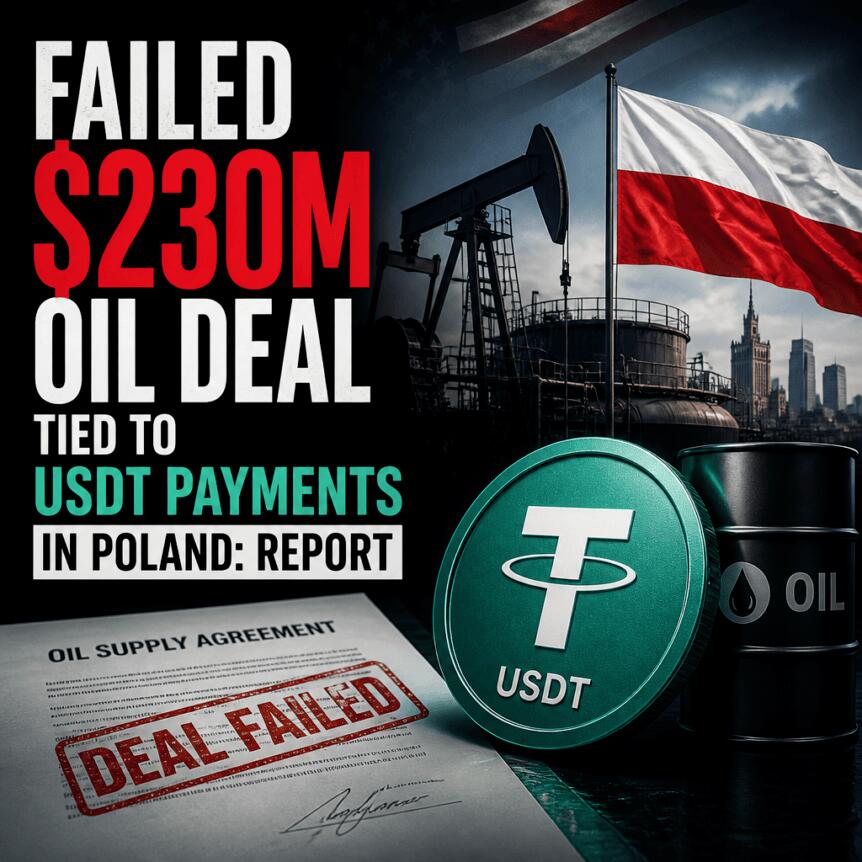
Tether’s USDt (USDT) has surfaced again in an international finance dispute: the Financial Times reported that the largest stablecoin by market capitalization was used in a Venezuelan oil trade that ultimately left Poland’s largest energy firm Orlen facing a $230 million loss in late 2023.
According to the FT, the episode traces back to sanctions pressure on Venezuela. PDVSA, the state oil company, reportedly began asking for partial payments in USDT as a way to reduce reliance on the US-dominated banking system. Orlen’s trading unit then advanced $230 million tied to a contract for 6 million barrels of Venezuelan crude, before receiving only a small portion of the oil.
Key takeaways
- Financial Times links Tether’s USDt to a $230 million advance payment connected to a Venezuelan crude oil deal.
- PDVSA’s reported move toward USDT payments was framed as a workaround to US financial sanctions.
- Multiple crypto intermediaries were involved, and the reported shortfall centered on missing USDT after several transfers.
- Poland later moved to investigate Orlen Trading Services-related contracts; separate reporting says former Orlen-linked executives were indicted.
- Legal representatives for the Dubai-based seller told Cointelegraph that their client was not responsible for the failure, while indicating efforts to recover funds.
How sanctions pressure reportedly pushed oil payments toward stablecoins
Earlier coverage cited by Reuters indicated that Venezuela was accelerating a shift toward cryptocurrency-linked payments for oil as sanctions persisted. In line with that broader pattern, the Financial Times reported that PDVSA began demanding partial USDT payments.
That context matters for investors and users because it illustrates how stablecoins can be pulled into real-world settlement flows under geopolitical constraints—yet also how the risks of intermediated custody and transfer chains can compound when multiple parties touch the funds.
In the reported Orlen transaction, the $230 million advance was associated with a trade arranged through Samer Awad, described by the FT as a former Orlen Trading Switzerland (OTS) executive. The deal targeted acquisition of 6 million barrels of Venezuelan crude in November 2023 from PDVSA.
The $230 million advance, and why Orlen only received a fraction of the cargo
The Financial Times reported that Orlen wired the $230 million advance payment to Hannon International Middle East, a Dubai-based seller, on Dec. 4, 2023. From there, Hannon allegedly approached crypto brokers and intermediaries to obtain the USDT needed to complete the purchase from PDVSA.
The FT says most of the funds were lost during subsequent crypto transfers, and that Orlen ultimately received only about $29 million worth of oil before the contract was terminated. The same reporting described a slow breakdown in execution, including partial load events and further USDT handoffs to brokers.
Cointelegraph also reported approaching Tether and Orlen for comment.
ADG Legal Abu Dhabi, acting as the legal representative for Hannon, disputed Hannon’s responsibility for the failure. David McCoy told Cointelegraph that “Hannon became involved in the transaction at Orlen’s request” and that it was not responsible for the transaction’s failure. McCoy said Hannon has taken steps to recover the funds and remains open to resolving the matter amicably.
“Hannon has since taken significant steps, at its own expense, to recover the funds paid in connection with the transaction and remains open to a constructive dialogue with Orlen about resolving this matter amicably.”
Tracing missing funds across a chain of crypto intermediaries
According to the Financial Times, after Orlen’s $230 million transfer in December 2023, Hannon reportedly obtained $80 million in USDT, paying a $400,000 commission, from a Dubai-based financial services company it previously dealt with.
The FT then described further movement of USDT through additional counterparties:
- Hannon reportedly sent $135 million to Dubai-based Horizon Global, but claimed it only received $85 million in USDT, creating a $50 million shortfall. Horizon disputed Hannon’s account.
- Hannon reportedly transferred $30 million to Gold Mar International Trading, expecting a USDT conversion and onward payment to PDVSA. Hannon later said it recovered $21 million of the USDT from Gold Mar in February 2024.
- In January 2024, Hannon employees allegedly delivered USB sticks containing $60 million and $50 million in USDT to a Caracas broker, and later granted access to another Caracas broker for $11 million in USDT.
The FT also reported that by March 8, Orlen’s ship was loaded with about 500,000 barrels of fuel oil valued around $28.8 million, and that another $11 million in USDT was allegedly handed to a broker that same day. Orlen Trading Services eventually terminated the contract with Hannon on March 28, 2024.
The episode highlights a structural issue that frequently follows stablecoin adoption in cross-border deals: stablecoins may function as the “payment rail,” but the practical execution still depends on intermediaries, conversion steps, and custody arrangements. Each additional hop can shift the risk from settlement mechanics to counterparty performance and recordkeeping.
Poland’s investigation and later indictments tied to oil-deal losses
Beyond the commercial fallout, the story moved into the enforcement arena. In January 2025, the Warsaw Regional Prosecutor’s Office announced an investigation involving Orlen Trading Services-related oil contracts, seeking damages of 1.5 billion Polish zloty (about $378 million).
McCoy told Cointelegraph that Hannon is not involved in the Poland investigation and therefore could not comment on it.
Later, Reuters reported that in August 2026, three former managers connected to Orlen and Orlen Trading Services were indicted over crude oil contracts tied to the $378 million damages figure. Reuters said the individuals—identified under Polish privacy laws by their last initial—denied wrongdoing and faced up to 25 years in prison.
While the criminal proceedings are separate from the stablecoin payment mechanics, they underscore how quickly a sanctions-driven payment workaround can escalate into long-running legal exposure, particularly when the chain of custody for value is fragmented across multiple entities and jurisdictions.
What to watch next for stablecoin-linked settlement risk
For readers, the main uncertainty is not whether USDT can clear in a payment workflow, but how responsibility and recoverability play out when stablecoins are moved through layered intermediaries under sanctions constraints. As the Polish case develops and any civil or commercial claims proceed, it will be crucial to track what parties document about fund flows, conversions, and custody—because that evidence will likely determine whether the loss is treated as counterparty failure, operational breakdown, or something closer to fraud.
https://www.cryptobreaking.com/failed-230m-oil-deal-tied/?utm_source=blogger%20&utm_medium=social_auto&utm_campaign=Failed%20$230M%20Oil%20Deal%20Tied%20to%20USDT%20Payments%20in%20Poland:%20Report%20
Comments
Post a Comment