
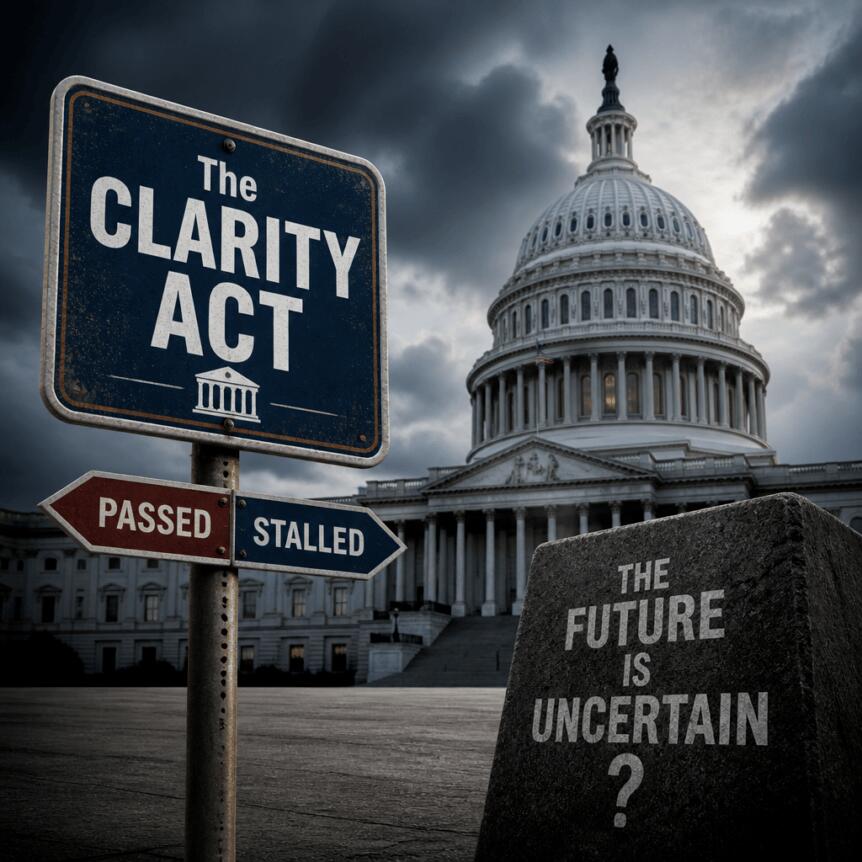
After a week of intense momentum, the U.S. Senate failed to advance the proposed CLARITY Act, a major market-structure bill aimed at bringing clearer rules to digital-asset activity. The setback came via a failed cloture vote—49-50—leaving supporters scrambling to preserve any remaining path forward in a Congress that is steadily running out of time.
Even as the bill appears “walking wounded” rather than formally dead, the procedural route opened by a key Republican senator raises questions about how much can realistically be renegotiated before the legislative calendar tightens. Crypto policy watchers are now focused on whether CLARITY can still assemble the 60 votes needed in the Senate, and what changes would be required to win broader backing—particularly on the ethics provisions tied to President Donald Trump.
Key takeaways
- The CLARITY Act lost the Senate cloture vote 49-50, meaning it did not reach the 60-vote threshold required to move toward a final vote.
- Sen. Thom Tillis switched his vote from yes to no on procedural grounds, filing a motion to reconsider that could reopen debate during the current session.
- Supporters face a tight timeline: the Senate is scheduled to leave for recess on October 2, and there are limited legislative days remaining after the midterms.
- The votes that supported advancing CLARITY came entirely from Republicans, while Democrats split, even as several Democratic senators say they remain committed to passing the bill.
- Even if CLARITY stalls in Congress, industry representatives argue U.S. regulators can still move on guidance, rulemaking, and exemptions under existing authorities.
Tillis’s procedural move keeps one door open
CLARITY’s immediate problem was procedural. A cloture vote—used to end debate and allow a bill to move toward a final vote—fell short. According to earlier reporting linked in the article, the failed advance effectively jammed CLARITY into a Senate-shaped hurdle.
But the week didn’t end with a clear “no” that closes the book. Sen. Thom Tillis changed his vote at the last minute from yes to no, then used parliamentary strategy to file a motion to reconsider. The stated purpose, as described by the Crypto Council for Innovation (CCI) director of U.S. federal affairs Ryan Eagan, is to preserve an opportunity to revisit the cloture vote during the session.
“Senator Tillis’s motion to reconsider would provide an opportunity to revisit CLARITY’s cloture vote at any point this session. Specific timing regarding next steps is not clear, but that desire to preserve that opportunity is in part due to the progress made over the past week.”
Still, preserving an option is not the same as solving the underlying vote math. The same dynamics that drove Democrats and Republicans into a late-stage impasse remain, particularly around the ethics provisions in the bill.
The calendar may decide the bill more than the arguments
Beyond politics, the Senate’s schedule is now a central constraint. The article notes that the Senate plans to head to recess on October 2 before returning after the midterm elections, while the House has already recessed for the election period. That combination makes it harder to coordinate movement through both chambers before the year ends.
Rep. Shri Thanedar, a Democrat who supported CLARITY when it passed through the House in July 2025, described the timing as a “major barrier.” In the article, he cites that there are only 20 legislative days left in the current Congress—all after the midterms—making a 2026 compromise “very low” from his perspective.
The article also points to a prior example from stablecoin legislation: the GENIUS bill missed cloture by a narrow margin in May 2025 before clearing a second cloture vote 66-32 just days later, and eventually passed the Senate the following month. However, the analogy may be imperfect. The same reporting includes Kyle Chassé, founder of MV Global, arguing that the difference this time is not the procedural mechanics but the lack of a ready-to-go deal and the potential for the process to reset under a different political landscape.
As lawmakers shift toward election-adjacent negotiations and reduced legislative bandwidth, the question becomes whether CLARITY can be brought back with enough changes to satisfy swing points without triggering a fresh cycle of opposition.
Ethics provisions are the fault line; Democrats still signal interest
One reason CLARITY’s path looks complicated is that the coalition that supported cloture was narrowly partisan. The article states that none of the 49 votes came from Democrats. Chassé is quoted saying that “every one of the 49 was a Republican” and that “zero Democrats voted to even open debate.”
Yet the story does not end with Democratic disengagement. The article references a statement from seven Democratic senators—who voted against advancing the bill—saying they “remain committed” to enacting CLARITY. Among them is Sen. Angela Alsobrooks, who supported moving the bill out of the Banking Committee earlier in the process and, according to the article, later voted no on cloture while still emphasizing the need to regulate digital assets.
Alsobrooks is quoted saying lawmakers were “ready to strike a deal” close to the vote, but that Republican leadership shut down negotiations at the last minute once it became clear a successful cloture outcome was likely. The quote underscores a key dynamic: CLARITY’s supporters and opponents may agree on regulatory direction, but not on how the package handles ethics.
Tillis, meanwhile, is described in the article as wanting to “convince the Democrats to get on board” and applying pressure so Democrats feel ownership of the outcome. His comments in the piece link the procedural switch to his view that the market needs guardrails.
If CLARITY must be rewritten, what could stay?
For CCI’s Ryan Eagan, the negotiating challenge has moved beyond technical drafting into something more politically sensitive. Chassé is quoted asserting that the failed cloture became “a referendum on the President’s crypto holdings” and that “the text as written can’t survive that.”
Before Tuesday’s vote, Republicans requested a large number of changes—described in the article as 126 substantive alterations—responding to Democratic demands. Those adjustments included tighter restrictions intended to prevent public officials from profiting from crypto ventures, and involving state attorneys general in enforcing parts of the ethics framework.
Still, Thanedar argues Democrats want additional limitations specifically on the President’s ability to use office for personal gain, pointing to reported crypto income in annual financial disclosures. The article cites Reuters coverage about Trump reporting at least $1.4 billion in crypto-related earnings for 2025.
Importantly, Chassé suggests lawmakers and industry participants should not treat ethics alone as the decisive hurdle. He points to stablecoin rewards, arguing for “some kind of cap or circuit breaker on yield” as a potential tradeoff needed to win support from “bank-side senators and a chunk of Democrats,” alongside tighter language on illicit finance and enforcement at the state level.
At the same time, the article says crypto stakeholders view certain protections as non-negotiable. Chassé highlights reluctance to give up self-custody and developer protections, which have been defended throughout negotiations during discussions over how far the bill should shield non-custodial developers from financial and anti-money-laundering obligations.
That mix—ethics and yield-linked mechanics on one side, custody and developer protections on the other—may determine whether CLARITY can regain momentum without collapsing into a wholesale rebuild.
Regulators can keep moving even if Congress stalls
Even with CLARITY stuck, industry voices in the article argue that the U.S. regulatory process does not need to wait for new legislation. Eagan says the SEC and CFTC have already shown an intention to reduce uncertainty through guidance, rulemaking, no-action relief, and exemptions.
The article also notes that implementation work related to stablecoin policy continues outside the CLARITY track—citing ongoing activity at Treasury and banking regulators for the GENIUS Act after its progress in Congress.
Michael Saylor is quoted in the article emphasizing that “Progress need not wait for Congress,” suggesting that existing legal authorities can still produce regulatory movement. That point is likely to resonate with market participants who have grown accustomed to a patchwork approach: agencies can advance piecemeal, but statutory clarity typically takes longer and is harder to unwind once passed.
In practical terms, traders and builders may continue to plan around agency actions and enforcement posture while waiting to see whether CLARITY can return to the Senate floor with enough votes.
For now, the critical watch items are straightforward: whether the motion to reconsider leads to a renewed cloture attempt, what amendments (if any) are deemed sufficient to bring Democrats into the coalition, and whether legislative timing allows a final push before the next session dynamics take over.
https://www.cryptobreaking.com/future-of-the-clarity-act/?utm_source=blogger%20&utm_medium=social_auto&utm_campaign=Future%20of%20the%20CLARITY%20Act%20Faces%20Uncertainty%20in%20Congress%20
Comments
Post a Comment