
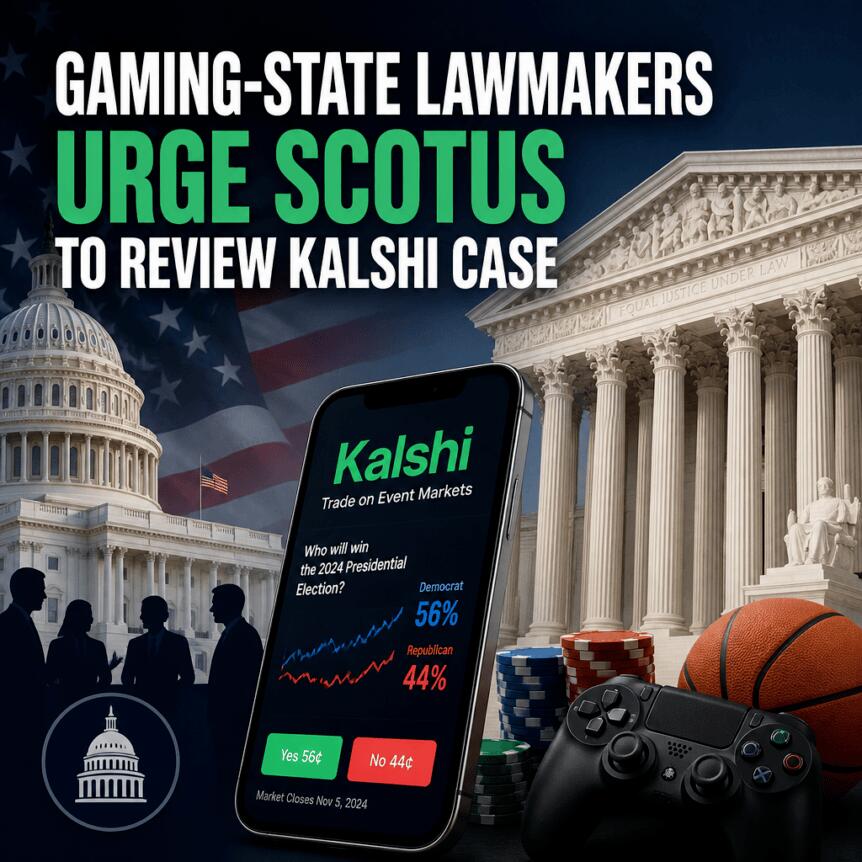
A coalition of US state lawmakers has asked the US Supreme Court to step into a jurisdictional fight involving Kalshi, a prediction markets platform, and New Jersey gaming regulators. In an amicus brief filed this week, the National Council of Legislators from Gaming States (NCLGS) argues that a ruling favoring Kalshi could severely restrict state authority over sports betting-like products offered through prediction markets.
The filing supports a petition by New Jersey’s Attorney General and gaming authorities seeking a writ of certiorari. According to the court documents, the petition—submitted on Sept. 2—asks the Supreme Court to consider whether state authorities or federal agencies have control over prediction market companies. The dispute stems from an appeal after a decision by the US Court of Appeals for the Third Circuit.
Key takeaways
- NCLGS filed an amicus brief urging the Supreme Court to uphold New Jersey’s position in the Kalshi case.
- The lawmakers warn that a ruling for Kalshi could “render[] states powerless” to regulate sports betting conducted via prediction markets.
- The brief frames gaming regulation as a state responsibility, while not directly settling the argument about federal CFTC jurisdiction for federally regulated event contracts.
- Kalshi has not filed an official response yet, though the company has previously indicated it should not be subject to a patchwork of state regulators.
NCLGS asks for Supreme Court intervention
On Tuesday, the NCLGS submitted its amicus curiae filing to the US Supreme Court. The group backed New Jersey’s request for the nation’s highest court to take up the case, which centers on how far state governments can regulate prediction market platforms that offer contracts tied to real-world events.
The lawmakers’ argument is grounded in the practical impact that they say could follow from a Supreme Court outcome. In their view, if Kalshi’s “self-described ‘sports betting’ activities” are treated as outside the scope of state oversight, other entities operating in heavily regulated gambling markets would likely seek the same legal classification.
In a passage included in the brief, NCLGS warned that businesses could change their offerings to obtain similar treatment, forcing states to reconsider the regulatory frameworks they currently use to govern this “vice activity.” The brief also emphasizes potential “substantial harm and confusion,” characterizing the prospect of reduced state power as disruptive to existing regulatory regimes.
What’s at stake: state power vs. federal oversight
At the heart of New Jersey’s petition is a jurisdictional question: whether regulation should be determined primarily by state gaming authorities or by federal regulators—particularly the Commodity Futures Trading Commission (CFTC). The Supreme Court has been asked to resolve an uncertainty that affects how prediction market products fit within existing legal categories.
NCLGS’s filing takes a broad position that “gaming-related matters” should remain with individual states. However, the brief does not fully engage with a competing line of reasoning raised in the dispute: that certain event contracts may be covered by the CFTC’s exclusive jurisdiction when traded on federally regulated markets.
That tension matters for market participants because it goes beyond the Kalshi case. If the legal boundaries are redrawn in a way that favors federal preemption, states could lose much of their ability to regulate not only prediction market platforms but also the surrounding ecosystem of operators that might attempt to structure offerings under the same umbrella.
Timeline and procedural posture
New Jersey’s petition for certiorari was filed on Sept. 2. It follows an appeal decision from the US Court of Appeals for the Third Circuit—an appellate step that typically signals a case has already raised substantial legal questions in lower courts.
In the Supreme Court, Kalshi has not yet issued an official response in the docket. The company has until Nov. 9 to file its brief setting out its position. In a statement provided after the initial filing, a Kalshi spokesperson told Cointelegraph that the company could not be “regulated by 50 different regulators,” pointing to concerns about inconsistent oversight across states.
While that comment does not resolve the legal question before the Supreme Court, it highlights the operational reality that accompanies the regulation of prediction markets: compliance regimes can vary significantly from jurisdiction to jurisdiction, and firms may argue that federal standards should govern where federal oversight is already implicated.
Why the case could shape the future of prediction markets
Prediction markets have grown into a broader sector that sits at the intersection of finance, sports, and consumer wagering. That makes jurisdictional clarity especially important. Without it, platforms may face uncertainty over licensing, product design, and whether their contracts are treated as gaming or as something else under federal commodities law.
The NCLGS brief suggests that states view the uncertainty as a direct threat to the ability to manage gambling-related conduct. If the Supreme Court were to adopt a reading that limits state authority, lawmakers argue states would need to rework their regulatory systems—and other operators could try to “amend their business and products” to capture whatever legal advantages come from that interpretation.
Conversely, the federal-jurisdiction argument reflected in the case poses a different concern: that event contracts traded through federally regulated structures may not be subject to separate state regulation, which could otherwise conflict with the CFTC’s regulatory framework.
For traders, developers, and investors watching the space, the outcome could determine how prediction market platforms plan for expansion. It may affect whether firms prioritize state-by-state compliance strategies or rely more heavily on federal frameworks when structuring products.
With the Supreme Court now considering whether to review the dispute, the key next step is Kalshi’s formal Supreme Court brief due by Nov. 9. Readers should watch closely for how the company frames the jurisdictional boundary—especially in relation to federal CFTC oversight—and whether the arguments on state preemption and federal exclusivity converge or remain sharply divided.
https://www.cryptobreaking.com/gaming-state-lawmakers-urge-scotus/?utm_source=blogger%20&utm_medium=social_auto&utm_campaign=Gaming-State%20Lawmakers%20Urge%20SCOTUS%20to%20Review%20Kalshi%20Case%20
Comments
Post a Comment