
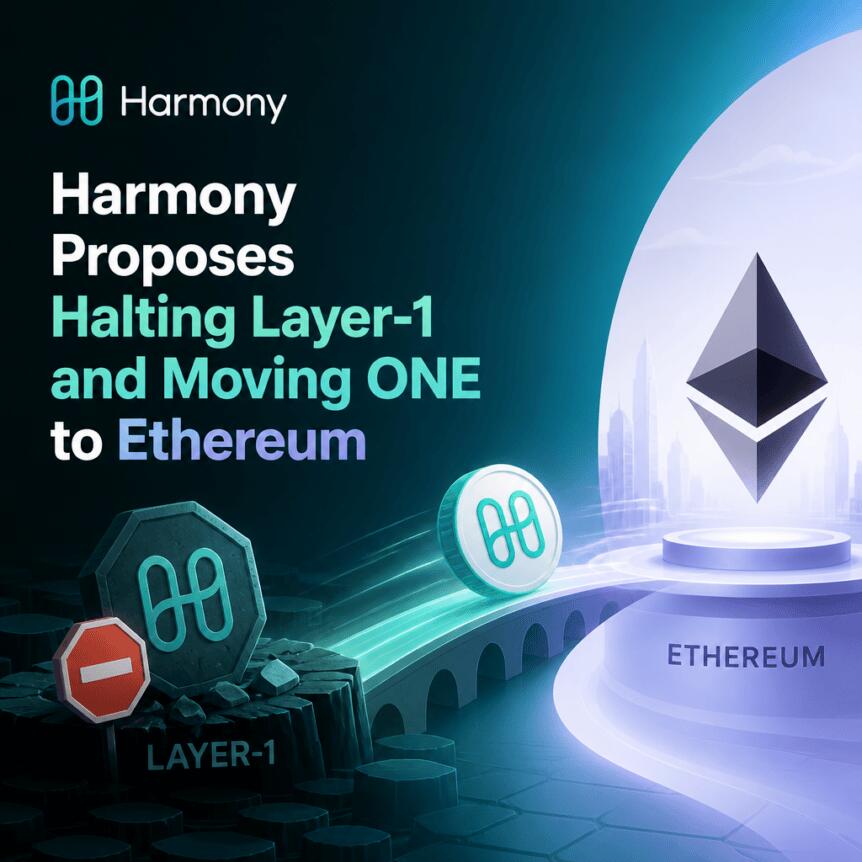
Harmony, the Ethereum-compatible blockchain protocol, has outlined a plan to sunset its own network and migrate its native ONE token to Ethereum. The proposal—seven years after Harmony launched its mainnet—calls for a final blockchain snapshot, an ERC-20 ONE token issuance on Ethereum, and coordinated steps for validators and users to wind down activity on the original chain.
Harmony says the move is intended to be orderly and non-binding, with a migration built around on-chain balances at the final block. However, the proposal leaves key execution details unclear—most notably whether the plan will be formally submitted through Harmony’s validator-led governance process and when the last block would be produced.
Key takeaways
- Harmony proposes a network sunset after taking a final snapshot and issuing ERC-20 ONE tokens on Ethereum to the same addresses.
- Balances would be recorded automatically at the final block, with ERC-20 ONE airdropped to those addresses on Ethereum without requiring users to file claims.
- Governance and timing are not fully specified: Harmony describes the proposal as non-binding and does not state when the final block would be produced.
- Validators would be offered options to stop nodes, continue as governors, or join a new AI-video initiative.
- Certain on-chain components—such as multisig safes, liquidity pools, and deployed applications—cannot be migrated, and users are told to exit smart contract positions before Sept. 10.
A proposed migration from Harmony to Ethereum
In a post on Sunday, Harmony said it is considering taking a final network snapshot and then migrating ONE to Ethereum as an ERC-20 token. According to the proposal, validators and participants would be able to select different paths: shut down their nodes, remain involved as governors, or move into Harmony’s newly described AI-video initiative.
Harmony emphasized that the proposal is non-binding and did not specify when the “final block” would be produced. It also did not confirm whether the shutdown itself would be brought under Harmony’s validator governance workflow.
Under Harmony’s published governance framework, elected validators can create proposals, while unelected validators are also able to vote with voting power weighted by total stake. A proposal requires 51% of total stake weight to participate and then 66.7% support after a seven-day introduction and a 14-day voting period. (Harmony’s proposal does not yet clarify whether it will follow this full procedure before execution.)
How the ONE token migration would work
The core of Harmony’s plan is the handling of ONE balances. Harmony states that all ONE balances would be recorded at the network’s final block and that new ERC-20 ONE tokens would be airdropped to the same addresses on Ethereum.
Harmony’s snapshot coverage is broad. It says the snapshot would include wallets, staking delegations, validator rewards, smart contracts, and centralized exchanges. In addition, Harmony states that there would be no claims process—meaning eligible balances should be reflected via the snapshot and subsequent airdrop rather than requiring users to take action to register.
Still, the migration is not presented as a full “lift and shift” of the Harmony ecosystem. Harmony cautioned that multisig safes, liquidity pools, and on-chain applications cannot be migrated. To reduce the risk of stranded positions, Harmony urged users to exit smart contracts before Sept. 10.
Harmony also suggests the shutdown cadence would include validator action around that date. It said validators may begin shutting down on Sept. 10, and pointed to a compensation pool of $1.372 million set aside to reimburse validators that stop on time, retain their stakes, and agree to serve as governors.
Unfinished details—and why they matter
The proposal’s most consequential uncertainty is not the token mechanics, but the network wind-down itself. Harmony did not provide a specific date for when the last block would be produced, nor did it make clear whether the shutdown plan would be submitted through governance as defined by the network’s rules.
For holders and market participants, those gaps determine how much operational risk remains during the transition. If a final snapshot is taken quickly without full governance clarity, exchanges, bridges, custody providers, and liquidity venues may face compressed timelines to support the migration—particularly if they must reconcile Harmony-origin ONE holdings with Ethereum-based ERC-20 balances.
Harmony’s snapshot approach—covering exchanges and staking delegations—appears designed to reduce fragmentation. But the stated inability to migrate liquidity pools and decentralized applications could still produce a mismatch between token availability and usable functionality on Ethereum. In practice, users may receive ERC-20 ONE yet still be unable to access the same on-chain services that previously depended on Harmony’s smart contract environment.
Context: the plan follows an exploit and proposed rollback
The sunset proposal arrives less than four weeks after a serious Harmony exploit that resulted in forged ONE tokens. Earlier coverage noted that the incident prompted Harmony to consider a rollback to reverse unauthorized minting activity, a path that—if implemented—would have wiped more than 109,000 transactions.
On Aug. 12, Harmony said it was considering a rollback after reports that an attacker had minted nearly 4 billion unauthorized ONE, claimed to be equivalent to roughly 26% of the supply. An outside account further alleged that about 2.8 billion tokens had reached exchanges, though Harmony had not confirmed those figures at the time.
On Aug. 17, Harmony said it planned to revert the blockchain to an Aug. 11 checkpoint. It reported that the rollback would discard 109,126 regular transactions and 315 staking transactions, and stated investigators had traced nearly all forged tokens to wallets or service boundaries while working with exchanges, bridges, and law enforcement.
Harmony’s current proposal marks a sharper pivot: instead of focusing solely on restoring the chain after an exploit, it suggests closing down the independent Harmony network altogether and relocating the token to Ethereum. That shift matters because it changes the recovery narrative from “repair and continue” to “migrate and end,” potentially leaving users to transition not only balances, but also the broader ecosystem footprint.
Whether Harmony’s governance process ultimately ratifies the plan will be the next key question for anyone holding ONE, running validator infrastructure, or depending on Harmony-based applications. If the network proceeds, market participants will likely watch for the details Harmony has not yet specified—especially the governance timeline, the exact block date for the snapshot, and how exchanges and custodians coordinate ERC-20 token support on Ethereum.
https://www.cryptobreaking.com/harmony-proposes-halting-layer-1/?utm_source=blogger%20&utm_medium=social_auto&utm_campaign=Harmony%20Proposes%20Halting%20Layer-1%20and%20Moving%20ONE%20to%20Ethereum%20
Comments
Post a Comment