
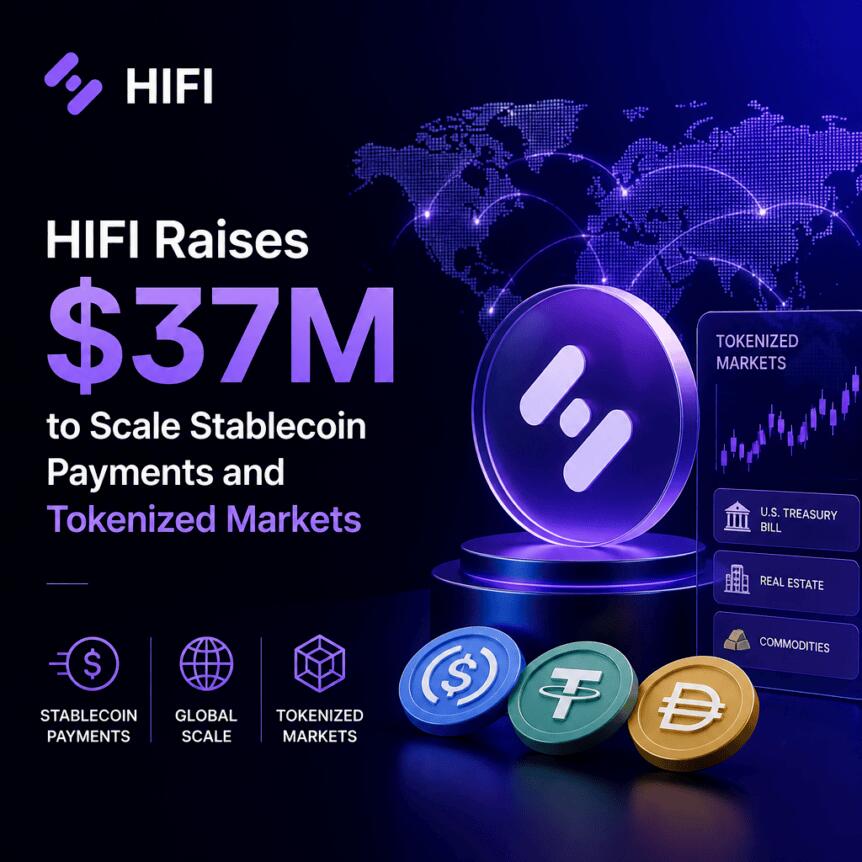
Stablecoin infrastructure provider HIFI has secured $37 million in Series A funding led by Left Lane Capital, underscoring continued demand for platforms that connect dollar stablecoins with traditional payments and banking rails. The deal arrives even as the broader crypto market has been under pressure.
According to Chainalysis, cross-border stablecoin flows rose 77.5% to $220.3 billion over the 12 months ending June 2026. During the same period, the wider crypto market contracted by more than a third, highlighting how stablecoin-related use cases have remained comparatively resilient.
Key takeaways
- HIFI raised $37 million in a Series A led by Left Lane Capital, with the company not disclosing a valuation.
- Chainalysis data shows cross-border stablecoin flows grew 77.5% to $220.3 billion in the year to June 2026 despite broader crypto weakness.
- HIFI says it processes about $7 billion in annualized volume through its platform.
- The company is expanding beyond payments into tokenized capital markets, including US-dollar settlement for tokenized repo and Treasury activity.
- HIFI also supports card-based payouts via Visa Direct using USDC, aligning with Visa’s reported growth in stablecoin-linked card programs.
Why stablecoin rails are still attracting capital
Stablecoins are increasingly viewed less as a trading vehicle and more as a settlement layer for moving value across borders and between regulated systems. That shift is reflected in the growth of cross-border stablecoin transfers, which Chainalysis reports surged to $220.3 billion during the year ending June 2026.
For investors, this matters because it points to durable infrastructure demand. Even when other segments of the crypto market slow, businesses building rails between stablecoin liquidity and real-world payment channels can benefit from ongoing enterprise adoption—particularly where speed, interoperability, and dollar settlement are required.
HIFI’s Series A and its role in dollar settlement
HIFI’s CEO Zach Walsh told Cointelegraph that the Series A is the company’s first priced funding round. While the startup did not share its valuation, it provided an operating datapoint: HIFI processes approximately $7 billion in annualized volume directly through its platform.
The funding will be used to scale HIFI’s “tokenized capital markets” infrastructure and extend its product suite, including stablecoin payments offerings, Walsh said. In practical terms, the platform enables customers to move funds into and out of stablecoins, route payouts through US banking rails and cards, and handle US-dollar settlement for the cash leg of tokenized repo and Treasury transactions.
From stablecoin payments to tokenized repo and Treasuries
HIFI’s push into tokenized capital markets comes alongside efforts from traditional market infrastructure providers. In July, the Depository Trust & Clearing Corporation (DTCC) conducted production trades using tokenized securities across multiple market functions, including US Treasury and repo settlement, equity transactions, securities lending, and collateral workflows.
DTCC noted that HIFI was among more than 30 participating firms. The exercise reportedly included organizations such as BlackRock, Goldman Sachs, and Nasdaq, and involved trades like US Treasury and repo delivery-versus-payment using assets held at the Depository Trust Company that were converted into tokenized representations.
DTCC also indicated it plans to launch its Tokenization Service in October. For companies like HIFI, that timeline is important: it suggests that market participants may soon need more standardized plumbing to connect tokenized assets and stablecoin-denominated or dollar-settled workflows to conventional settlement systems.
Visa Direct, USDC-to-card payouts, and growing card usage
Beyond institutional trading workflows, HIFI has been expanding into card-based payments. The company’s platform supports conversion of USDC and sending proceeds to eligible Visa debit and credit cards globally, according to HIFI’s website.
This expansion aligns with Visa’s reported growth in stablecoin-linked card activity. On Sept. 9, Visa said more than 160 stablecoin-linked card programs were live globally during its fiscal second quarter, with payment volume through those programs rising nearly 200% year over year. Visa also stated that its stablecoin settlement volume had surpassed a $20 billion annualized run rate—more than 15 times its level a year earlier.
For market participants, the significance is that stablecoin rails are increasingly being routed through consumer and merchant payment stacks, not just handled by exchanges or cross-border transfer desks. If that adoption continues, infrastructure providers that can reliably bridge stablecoin liquidity into regulated payment instruments could see sustained demand.
Investors and builders should watch for how DTCC’s planned Tokenization Service rollout intersects with stablecoin settlement capabilities—particularly whether more tokenized Treasury, repo, and lending workflows translate into higher usage of dollar-settling infrastructure like HIFI’s. The next signal to track is whether card-linked stablecoin programs keep scaling at similar rates as stablecoin-linked payouts expand beyond early adopters.
https://www.cryptobreaking.com/hifi-raises-37m-to-scale/?utm_source=blogger%20&utm_medium=social_auto&utm_campaign=HIFI%20Raises%20$37M%20to%20Scale%20Stablecoin%20Payments%20and%20Tokenized%20Markets%20
Comments
Post a Comment