
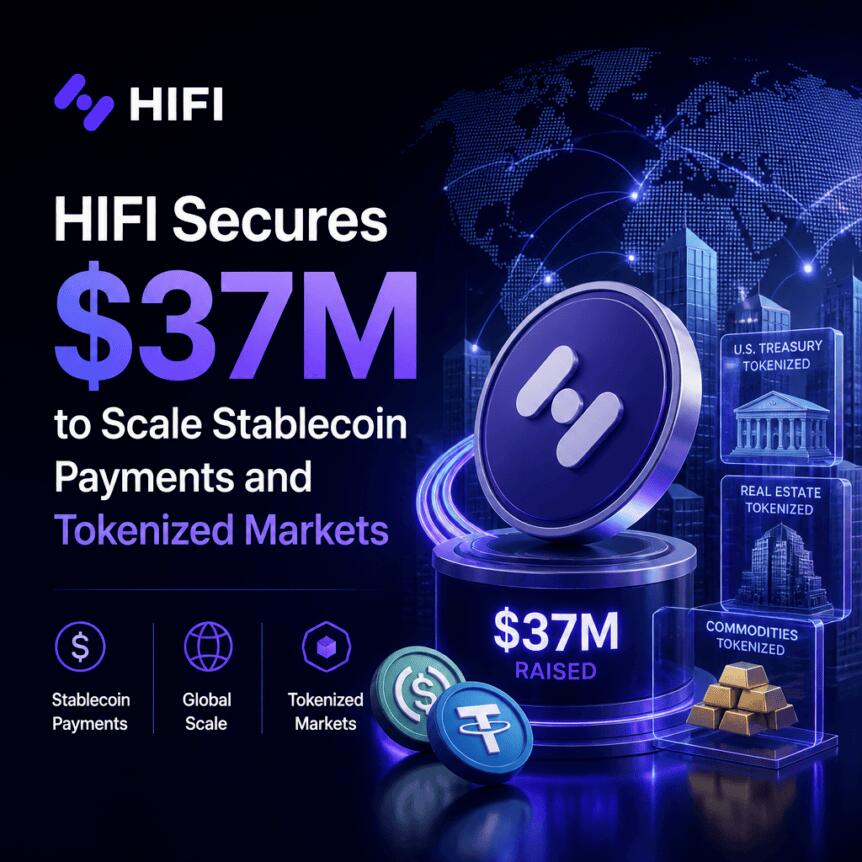
Stablecoin infrastructure firm HIFI has secured $37 million in a Series A funding round led by Left Lane Capital, underscoring how demand for rails that connect crypto stablecoins to traditional payment and capital-market workflows is holding up even as parts of the broader crypto market have cooled.
The round marks HIFI’s first priced financing, according to the company’s CEO Zach Walsh, who also said the platform is processing about $7 billion in annualized volume. The company did not disclose a valuation.
Key takeaways
- HIFI raised $37 million in a Series A led by Left Lane Capital, its first priced funding round.
- The company says it processes roughly $7 billion in annualized volume through its stablecoin infrastructure.
- Chainalysis data cited in the coverage shows cross-border stablecoin flows rose to $220.3 billion in the 12 months ending June 2026.
- HIFI is expanding beyond payments into tokenized capital markets, including settlement support for tokenized repo and Treasury transactions.
- HIFI is also pushing card-based payouts through Visa Direct using USDC-to-Visa debit/credit conversion.
Stablecoin rails keep attracting funding
While the wider crypto market contracted by more than a third over the same 12-month period referenced in the report, cross-border stablecoin activity continued to grow. According to Chainalysis, cross-border stablecoin flows rose 77.5% to $220.3 billion in the 12 months ending June 2026.
This divergence—stablecoin-specific usage strengthening while broader market metrics weaken—helps explain why infrastructure providers are still drawing investment. Stablecoins are increasingly used as a value-transfer layer for payments and settlement, which places infrastructure companies that integrate banking rails, card networks, and on-chain settlement mechanisms in a position to capture growing demand.
What HIFI’s Series A is expected to support
Walsh told Cointelegraph that the $37 million funding will support scaling HIFI’s tokenized capital markets infrastructure and expanding its product suite, including stablecoin payments offerings.
HIFI’s platform is designed to bridge fiat and stablecoins—helping customers move dollars into and out of stablecoins, send payouts through US banking rails and cards, and settle the cash side of tokenized repo and Treasury transactions in US dollars. For investors and fintech partners, the emphasis on cash settlement is important: tokenized assets often still require reliable linkage to regulated dollar systems, especially for delivery-versus-payment style workflows.
From payments to tokenized securities workflows
The funding comes as more traditional market infrastructure firms test or operationalize tokenization. In July, the Depository Trust & Clearing Corporation (DTCC) conducted production trades using tokenized securities across several market functions—covering US Treasury and repo settlement, equity transactions, securities lending, and collateral workflows. The trades involved US Treasury and repo delivery-versus-payment, equity activity, and collateral processes using assets held at the Depository Trust Company that had been converted into tokenized representations. DTCC also said it plans to launch its Tokenization Service in October, and HIFI was among more than 30 participating firms alongside entities including BlackRock, Goldman Sachs, and Nasdaq.
Within that context, HIFI’s positioning is straightforward: rather than limiting stablecoin use to consumer remittances or merchant payments, the company is building capabilities that can support the cash leg of tokenized capital-market transactions. That matters because tokenized capital markets typically require interoperability across custody, settlement, and payments—areas where stablecoin infrastructure can offer faster or more programmatic value movement, provided compliance and settlement integrity are maintained.
Visa Direct expansion and stablecoin-linked card programs
Beyond tokenized securities, HIFI is also expanding how stablecoins can flow into everyday payment rails. The company’s platform supports card-based payouts through Visa Direct. On its website, HIFI says customers can convert USDC and send proceeds to eligible Visa debit and credit cards globally.
This push aligns with Visa’s broader reporting on stablecoin-linked payment programs. The coverage notes that Visa reported increasing usage across its payments network, including more than 160 stablecoin-linked card programs live globally during its fiscal second quarter. Visa also said payment volume through those programs rose nearly 200% year over year, and that stablecoin settlement volume had surpassed a $20 billion annualized run rate—more than 15 times its level a year earlier.
For market participants, this is a useful signal: even as regulators and legacy financial systems grapple with how to integrate crypto responsibly, stablecoins are finding a path into mainstream card settlement and payout experiences. The practical benefit for users is that stablecoin conversion can be handled behind the scenes while still using card networks for end-user spending.
What to watch next
With HIFI scaling both tokenized capital markets infrastructure and stablecoin payments that plug into banking rails and card networks, the near-term question is how quickly tokenization pilots translate into repeatable, production-grade settlement workflows—and whether growth in cross-border stablecoin flows continues to outpace broader crypto market weakness into the next quarters.
https://www.cryptobreaking.com/hifi-secures-37m-to-scale/?utm_source=blogger%20&utm_medium=social_auto&utm_campaign=HIFI%20Secures%20$37M%20to%20Scale%20Stablecoin%20Payments%20and%20Tokenized%20Markets%20
Comments
Post a Comment