
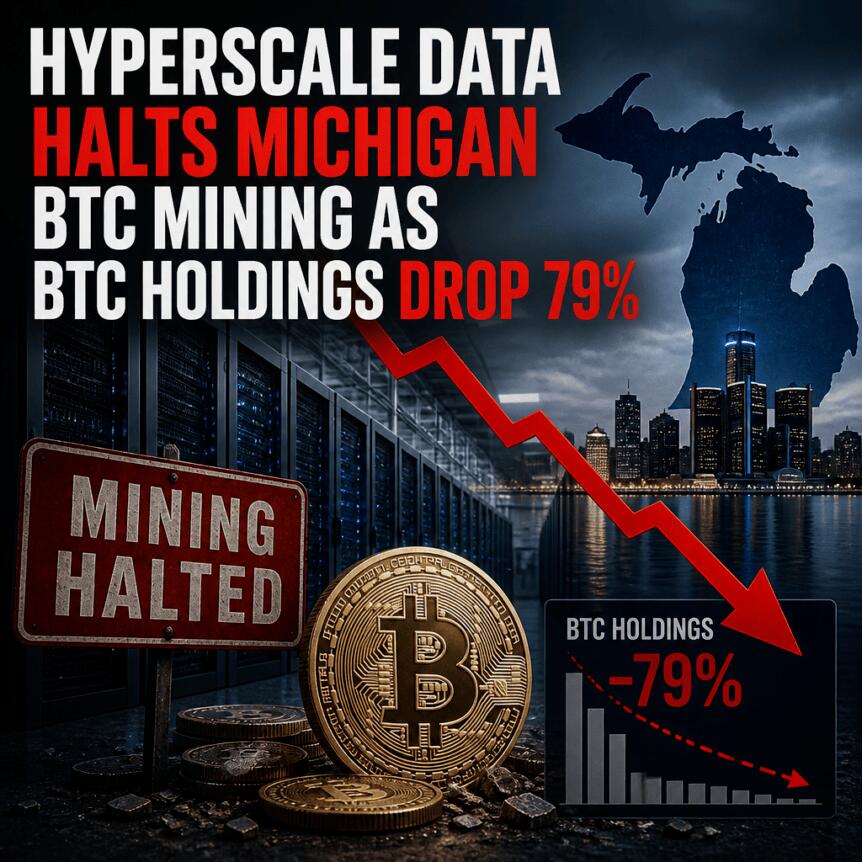
Hyperscale Data has shut down all Bitcoin mining at its Michigan facility as it moves forward with plans to repurpose the site for an artificial intelligence (AI) data center customer. The company said the change follows an inspection tied to the customer’s requirements, and it plans to sell the mining hardware once the transition is complete.
In the same period, Hyperscale has also been drawing down its Bitcoin holdings to fund the buildout. Shares, meanwhile, slid to a record-low level on Wednesday after a recent reverse stock split.
Key takeaways
- Hyperscale Data ended Bitcoin mining at its Michigan site to fulfill requirements for an AI data center agreement.
- The company said miners were switched off after an inspection by an unnamed California-based neocloud provider.
- Hyperscale expects the AI master services agreement to generate more than $1.2 billion over up to 20 years, with upside if additional capacity is taken.
- The firm cautioned that expansion economics depend on financing, approvals, and the customer exercising extension and capacity options.
- Hyperscale shares fell sharply to a split-adjusted record low following a one-for-five reverse split that became effective Aug. 25.
From mining to AI compute at the Michigan campus
Hyperscale Data said Wednesday that it has ceased Bitcoin mining operations at its Michigan facility and switched off all miners. The company tied the step to an inspection conducted for its AI data center master services agreement requirements, with the inspection carried out by an unnamed California-based neocloud provider, as described in its statement carried by PR Newswire.
According to Hyperscale, the firm intends to sell the mining equipment associated with the facility’s halted operations. The shutdown is part of a broader shift in which Hyperscale is converting the Michigan site from a mining-focused setup into AI infrastructure. It also indicated that the AI effort is being funded through proceeds from Bitcoin activity under its “Bitcoin treasury.”
The AI master services agreement: capacity, term, and revenue range
Hyperscale said the AI customer has contracted for 20 megawatts (MW) of computing capacity under a 10-year master services agreement. The deal includes two optional five-year extensions, giving the arrangement a possible 20-year maximum term.
In its estimate, Hyperscale projected that the agreement could generate more than $1.2 billion over the maximum 20-year period. The company also said an additional 32 MW option could push the potential revenue above $3 billion. On the infrastructure side, Hyperscale stated the facility is expected to support up to 340 MW, leaving room for scaling beyond the initial contracted capacity.
Importantly, Hyperscale emphasized that its expansion plans remain preliminary. The company said realized revenue figures depend on multiple conditions—specifically financing, approvals, and other risks that could affect how the project progresses. In addition, it noted that the $1.2 billion estimate assumes the customer exercises both extension options, while the higher $3 billion scenario requires the customer to take the additional capacity option.
Stock slump follows reverse split as Bitcoin holdings shrink
Alongside the operational shift, Hyperscale’s equity performance reflected investor skepticism about the pace and certainty of the AI transition. According to Yahoo Finance data, the company’s shares closed at $0.1984 on Wednesday, down about 17%, after trading as low as $0.1932 intraday. The close marked a split-adjusted record low for the NYSE American-listed stock.
Hyperscale’s decline came shortly after it completed a one-for-five reverse stock split. The SEC filing referenced in the report indicates the split-adjusted shares began trading on Aug. 25.
Hyperscale has also reduced its Bitcoin holdings while funding the Michigan buildout. Earlier coverage noted that as of July 30, the company held about 1,006 Bitcoin and had sold 100 BTC, while arranging a BTC-backed credit facility for the Michigan campus (as described in prior reporting on Cointelegraph).
More recently, Hyperscale said in a PR Newswire update that it sold about 65 BTC for roughly $5.1 million during the week ending Aug. 30, with proceeds intended to provide additional capital for the Michigan development. BitcoinTreasuries.NET now lists Hyperscale as holding 215 BTC, worth about $16.7 million—down roughly 79% from the amount cited in July, according to the listing.
Why the mining shutdown matters for investors
The immediate takeaway for shareholders is the tradeoff Hyperscale is making between steady-state mining revenue and long-duration AI infrastructure economics. By switching off mining and directing resources toward compute services, the company is effectively betting that contracted AI capacity will provide a more valuable path forward than ongoing Bitcoin production.
However, the company’s own revenue range highlights the uncertainty embedded in that bet. Hyperscale’s estimates are conditional on customer decisions (exercising extensions and taking additional MW capacity) and on execution factors such as financing and approvals. That means the timeline and realized profitability of the AI transition may diverge from the optimistic projections depending on how those conditions play out.
Meanwhile, the stock’s reaction following the reverse split underscores that investors are watching not only the operational shift but also whether the company can translate Bitcoin-treasury wind-downs into credible, funded, and approved construction milestones.
Going forward, market participants will likely focus on whether Hyperscale can convert its contracted 20 MW into the full extension and additional-capacity scenarios it cited—and whether financing and permitting stay on track, especially as Bitcoin holdings continue to fall in support of the AI buildout.
https://www.cryptobreaking.com/hyperscale-data-halts-michigan-btc/?utm_source=blogger%20&utm_medium=social_auto&utm_campaign=Hyperscale%20Data%20Halts%20Michigan%20BTC%20Mining%20as%20BTC%20Holdings%20Drop%2079%%20
Comments
Post a Comment