
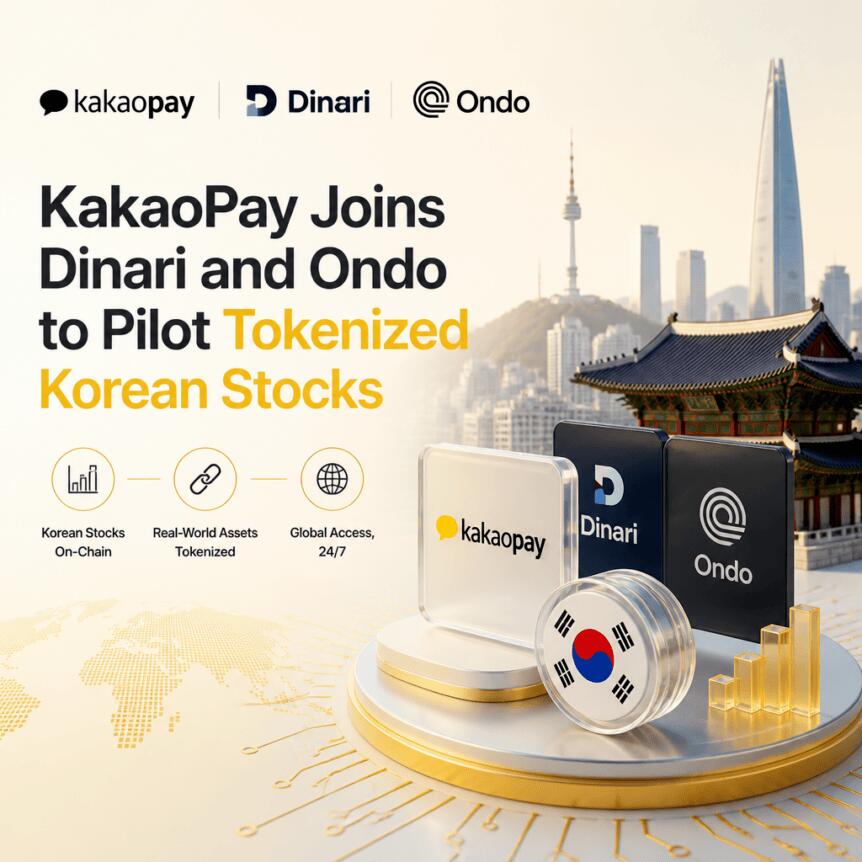
South Korea’s Kakaopay Securities has announced two separate partnerships with tokenization firms Dinari and Ondo Finance aimed at bringing tokenized access to Korean-listed stocks to investors, including those outside the country. The initiative focuses on the “plumbing” required to source, custody, and represent real underlying shares onchain—rather than simply creating tokens that mirror price movements.
According to announcements shared by the companies, Kakaopay will work with Dinari on a proof of concept tied to Dinari’s dShares framework for preserving shareholder rights. In parallel, Kakaopay and Ondo will examine how to structure sourcing and custody for Korean-listed equities and explore token issuance and redemption mechanics.
Key takeaways
- Kakaopay Securities is partnering with Dinari and Ondo to explore tokenized distribution of Korean-listed stocks to international investors.
- Dinari’s dShares approach is designed to preserve shareholder rights such as dividends and voting, and the project is expected to use locally listed Korean shares as underlying assets.
- Kakaopay’s collaboration with Ondo centers initially on a custody/sourcing framework, including the use of a foreign investor omnibus account to hold underlying shares.
- Commercial rollout timelines are not set; any move to tokenize Korean equities depends on legal and regulatory approvals in South Korea and abroad.
- The partnerships arrive as South Korea prepares to implement a regulatory framework for tokenized securities, with a take-effect date scheduled for February 2027.
Dinari dShares: rights-preserving tokenization as the target
Under its agreement with Kakaopay Securities, Dinari will run a proof of concept using Dinari’s dShares model. The core idea of dShares is to maintain applicable shareholder rights—explicitly including dividends and voting—rather than relying on synthetic exposure that only tracks the market price.
Dinari currently offers tokenized US stocks and exchange-traded funds through its dShares offering. Kakaopay’s partnership is intended to test whether the same model can be extended to Korean-listed equities.
Dinari CEO Gabe Otte told Cointelegraph that the proof of concept has not yet identified specific Korean-listed companies and that Dinari has not published a public timeline for commercial availability. Otte also described the proposed structure as using locally listed Korean shares as the underlying assets, as opposed to tokenized instruments that merely mirror price changes.
For investors, this distinction matters because “rights preservation” is often the main practical hurdle for tokenized securities. If dividends, voting, and other shareholder entitlements are not properly mapped to the token system, tokens may fail to deliver the governance and economic participation that regulated investors expect.
Ondo framework: sourcing and custody before token issuance
Kakaopay’s second initiative with Ondo Finance is initially focused on building a workable framework for sourcing and custodying Korean-listed shares, with tokenization viewed as a potential next step.
In the described structure, Kakaopay would operate a foreign investor omnibus account to hold and administer the underlying shares. This approach is intended to support how international investors can be connected to local share ownership while aligning the system with existing custody and administration practices.
The companies also plan to research token issuance and redemption mechanics. They emphasized that whether and when tokenized Korean equities are commercialized will depend on legal and regulatory requirements both in South Korea and in overseas markets.
That “regulatory gating” is a recurring feature of tokenized securities efforts globally, but the emphasis here on custody and operational readiness is a notable shift away from purely technical token experiments. The partnerships suggest Kakaopay and its partners are treating compliance, settlement integration, and investor administration as prerequisites for any onchain distribution.
South Korea’s regulatory push sets the backdrop
The Kakaopay announcements land amid South Korea’s move toward a formal regulatory framework for tokenized securities. In January, the country’s National Assembly approved amendments that recognize distributed ledger technology as a valid securities registry and allow issuance and circulation of token securities.
Earlier in June, South Korea’s Financial Services Commission linked the tokenized securities infrastructure to a broader capital market overhaul. The framework is scheduled to take effect in February 2027, while the Korea Securities Depository is developing infrastructure intended to connect the existing securities account system with blockchain-based data.
Those timelines help contextualize why the Kakaopay-related efforts are framed as proofs of concept and frameworks rather than immediate market launches. Even when tokenization technology exists, regulated securities distribution typically requires harmonization with depository operations, custody rules, and registry standards.
Where tokenized equities stand today—and what could change
Tokenized stocks have grown rapidly in 2026, with RWA.xyz reporting about $3.2 billion in distributed value as of late September. However, the same data indicates the market remains concentrated: many deployments are tokenized versions of US equities and ETFs.
Examples cited in the reporting include tokens tied to shares in Strategy, Circle, Nvidia and Tesla, along with major US stock ETFs. By comparison, tokenization of non-US listings—particularly those paired with local rights administration and voting/dividend preservation—has been less common.
Dinari’s Otte framed the opportunity as more than duplicating tokenized versions of Korean equities. In remarks shared with Cointelegraph, he said the firms are seeing institutional interest in South Korea, especially around tokenization as infrastructure for connecting Korean capital markets with global investors while preserving rights and protections tied to the underlying securities.
If South Korea’s upcoming regulatory framework reduces uncertainty around registries and token issuance/circulation, initiatives like Kakaopay’s could become a blueprint for how international investors gain access to local share ownership—without sacrificing the legal protections typically associated with traditional securities processes.
For now, the most important watch-items are whether the Dinari proof of concept identifies specific Korean issuers, how Kakaopay and Ondo structure custody and omnibus account administration, and—most crucially—how South Korean regulators interpret the operational details required for rights-preserving tokenized securities as implementation approaches in 2027.
https://www.cryptobreaking.com/kakaopay-joins-dinari-and-ondo/?utm_source=blogger%20&utm_medium=social_auto&utm_campaign=KakaoPay%20Joins%20Dinari%20and%20Ondo%20to%20Pilot%20Tokenized%20Korean%20Stocks%20
Comments
Post a Comment