
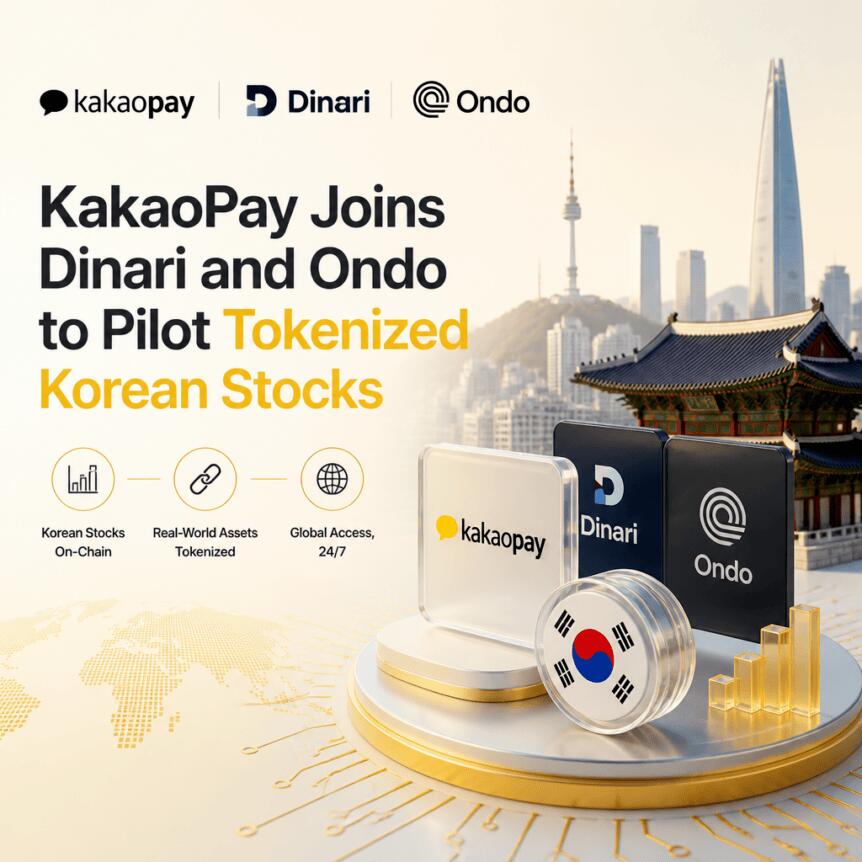
South Korea’s Kakaopay Securities has entered talks with tokenization firms Dinari and Ondo Finance to explore how Korean-listed stocks could be issued and distributed using tokenization technology. The initiative focuses on preserving shareholder rights while studying how such assets might reach investors beyond South Korea.
According to announcements from the companies, Kakaopay signed separate agreements with Dinari and Ondo on Tuesday covering (1) the sourcing of underlying Korean shares, (2) tokenization-related infrastructure, and (3) potential cross-border distribution paths.
Key takeaways
- Kakaopay Securities is testing whether tokenized Korean-listed equities can be structured to preserve shareholder rights such as dividends and voting.
- Dinari’s proof of concept would use locally listed Korean shares as underlying assets, not simple price-tracking tokens, and no specific companies have been selected yet.
- With Ondo, the initial work centers on establishing a framework for sourcing, custody, and later tokenization of Korean-listed shares held through a foreign investor omnibus account.
- Commercial rollout is explicitly tied to legal and regulatory requirements in South Korea and overseas markets.
- The agreements arrive as South Korea moves toward a formal tokenized-securities regime scheduled to take effect in February 2027.
Dinari: a rights-preserving model for Korean equities
Under the Dinari partnership, the companies plan to run a proof of concept using Dinari’s dShares model. The approach is intended to preserve applicable shareholder rights—particularly dividends and voting—rather than treating token holders as holders of a standalone synthetic instrument.
Dinari’s platform currently offers tokenized U.S. stocks and exchange-traded funds through dShares. In the Kakaopay test case, the firms are exploring whether the model can be extended to Korean-listed equities.
Dinari CEO Gabe Otte told Cointelegraph that the proof of concept has not yet identified specific Korean-listed companies and that no public timeline has been set for commercial availability. He also described the underlying design as using real, locally listed Korean shares as the assets that back the tokenization approach, instead of issuing tokens that merely mirror price movements.
Ondo: building the custody, issuance, and redemption framework
Kakaopay’s agreement with Ondo Finance initially targets the mechanics of sourcing and custodying Korean-listed shares prior to any token issuance. The companies said the work will help define how those underlying shares could later be tokenized.
As part of the planned structure, Kakaopay would operate a foreign investor omnibus account to hold and administer the underlying Korean shares. Ondo and Kakaopay will also research token issuance and redemption processes.
In their statements, the firms emphasized that the decision on whether and when to commercialize tokenized Korean equities will depend on legal and regulatory requirements both in South Korea and in the jurisdictions where tokens could ultimately be offered.
Why South Korea’s tokenized-securities rules matter here
The Kakaopay agreements land amid South Korea’s preparations for a new regulatory framework for tokenized securities. In January, the country’s National Assembly approved amendments that recognize distributed ledgers as valid securities registries and allow the issuance and circulation of token securities.
Further policy work is underway. In June, South Korea’s Financial Services Commission linked token-securities infrastructure to a wider capital-market overhaul. The framework is scheduled to take effect in February 2027. Meanwhile, the Korea Securities Depository is developing infrastructure designed to connect its existing securities account system with blockchain-based data.
For investors and market participants, the practical significance is straightforward: without a compliant securities registry and operating model, tokenized products can struggle to move beyond pilots. These Kakaopay-led explorations appear aimed at preparing the operational groundwork—custody, rights handling, and issuance/redemption workflows—so that a future compliant rollout can be scaled more quickly once the rules take effect.
Institutional interest and what remains uncertain
Dinari CEO Gabe Otte said the company is seeing “meaningful institutional interest” in South Korea, particularly around tokenization as infrastructure to connect Korean capital markets with global investors. He framed the opportunity as more than creating tokenized versions of Korean equities, arguing that the bigger goal is building distribution and infrastructure that can expand how Korean stocks are offered internationally while preserving protections associated with the underlying securities.
Tokenized stocks have grown rapidly in the broader market. RWA.xyz data cited in the original coverage put tokenized-stock distributed value at about $3.2 billion as of late September 2026. However, the same dataset indicates that growth has remained heavily concentrated in tokenized versions of U.S. equities and exchange-traded funds—such as shares linked to Strategy, Circle, Nvidia and Tesla—along with major U.S. stock ETFs.
That concentration underscores why Korean-specific pilots could be consequential: if rights-preserving issuance and cross-border distribution can be operationalized for non-U.S. listings, it could diversify what tokenized equity exposure looks like in practice. Still, key uncertainties remain, particularly the regulatory timing and the question of which markets will accept tokenized securities structures that rely on foreign investor custody arrangements and rights handling.
Investors should watch the next steps closely—whether Kakaopay, Dinari, and Ondo finalize the specific Korean listings (if any) for their proof of concept, and how they align custody, issuance, and redemption mechanics with South Korea’s February 2027 tokenized-securities framework.
https://www.cryptobreaking.com/kakaopay-joins-dinari-and-ondo-2/?utm_source=blogger%20&utm_medium=social_auto&utm_campaign=KakaoPay%20Joins%20Dinari%20and%20Ondo%20to%20Pilot%20Tokenized%20Korean%20Stocks%20
Comments
Post a Comment