
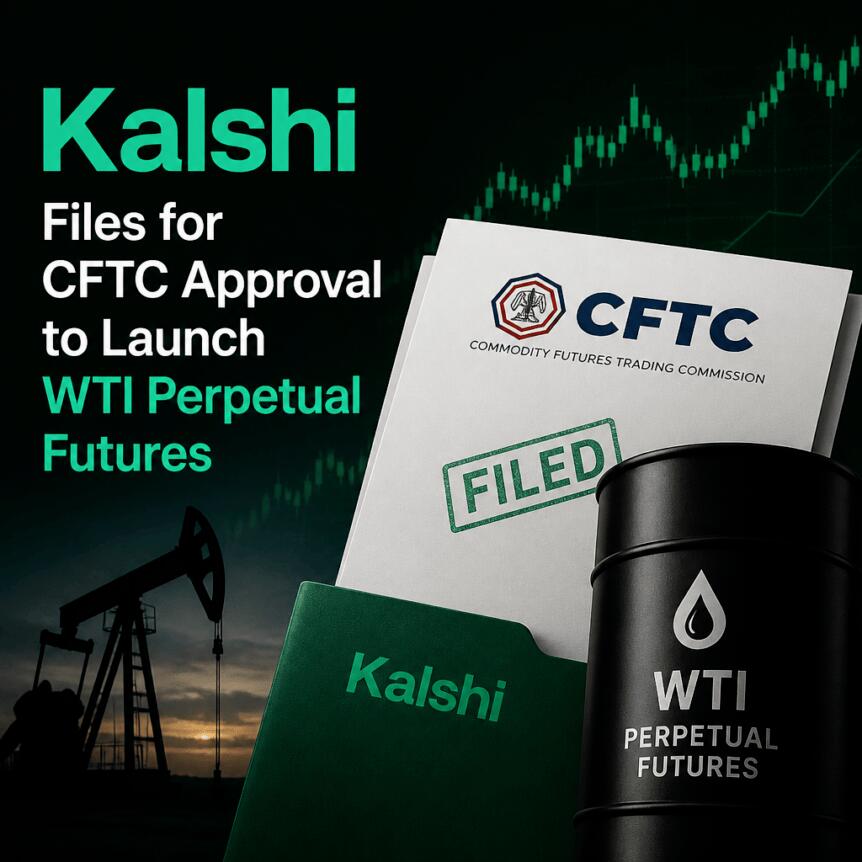
Prediction-market operator Kalshi is reportedly preparing to file with the US Commodity Futures Trading Commission (CFTC) for a new kind of energy derivative: a West Texas Intermediate (WTI) crude oil perpetual futures contract that would never expire. Bloomberg reports the filing could be made as soon as next week, while Reuters adds that the product would be available 24 hours a day, five days a week.
If regulators approve it, the contract would represent the first oil-linked perpetual futures offering to trade on a regulated US venue—an important test case for how the CFTC handles perpetual structures in markets traditionally built around fixed expiration dates.
Key takeaways
- Kalshi is reportedly seeking CFTC approval for a WTI crude oil perpetual futures contract with no expiration date.
- Bloomberg reports the CFTC filing could happen as soon as next week; Reuters says trading would run 24/5.
- The approval would mark the first oil-linked perpetual futures product to trade on a regulated US platform.
- The proposal arrives as the CFTC evaluates 24/7 trading expansion and whether perpetual contracts can be structured around physically delivered or storable energy commodities.
- Kalshi is also facing an ongoing jurisdictional fight over event contracts in state courts, creating additional regulatory friction beyond derivatives design.
A perpetual structure meets an oil market built on expiry dates
Perpetual futures—often called “perps”—differ from standard futures in that they do not have a set settlement or expiration date. In practice, this means traders can hold positions indefinitely without repeatedly rolling exposure into new contracts.
That structure is more familiar in some crypto derivatives markets, but it is still emerging in regulated commodity trading. Kalshi’s reported plan to attach the perpetual format to a benchmark like WTI is therefore notable not just for novelty, but for what it implies about regulatory comfort with perpetual mechanics in traditional commodities.
Bloomberg says Kalshi would file the contract with the CFTC, and Reuters reports it would trade 24 hours a day, five days a week. If approved, this could reshape how participants think about maintaining exposure to crude oil price risk—particularly for traders who prefer continuous participation instead of managing expiries and roll calendars.
CFTC groundwork: 24/7 trading and perpetual energy contracts
Kalshi’s oil perp push is happening against a backdrop of active CFTC consideration of market design. In June, the regulator sought public comments on extending standard futures contracts to 24/7 trading. The notice also touched on allowing perpetual contracts tied to physically delivered or storable energy commodities, including crude oil.
Later, in July, the CFTC halted the self-certified listing of a CME Group contract intended to bring 24/7 crude oil futures trading. The regulator said it was examining whether the product complied with federal commodities law, illustrating that expansions in trading hours and product structure face close scrutiny rather than automatic approval.
Now, with Kalshi reportedly pursuing a perpetual approach for WTI, the same core questions remain: how perpetual products fit within existing futures and commodities frameworks, and what guardrails are required for exchanges to operate these contracts legally.
Regulatory momentum doesn’t eliminate legal headwinds for Kalshi
While Kalshi’s derivatives ambitions focus on federal commodity regulation, the company also remains embroiled in separate legal disputes tied to its prediction-market business. Those disputes affect the operator’s broader business strategy and could influence how aggressively it expands into new asset classes or geographies.
On Tuesday, a Michigan state court issued a preliminary injunction barring Kalshi from offering sports-related event contracts in the state and requiring geofencing that blocks Michigan residents. Earlier this week, New Jersey asked the US Supreme Court to weigh in on a jurisdictional dispute after federal appeals courts reached conflicting decisions in cases involving New Jersey and Nevada. Reuters reported on the request, underscoring that the legal uncertainty is not confined to a single venue or state.
In other words, even if Kalshi secures regulatory traction in commodities derivatives, it is simultaneously managing uncertainty over whether federal commodities law preempts state gambling enforcement against event contracts traded on CFTC-regulated exchanges. That dual-track reality highlights how, for prediction-market operators, the compliance landscape can become broader than any single product filing.
Broader push for perpetual products: energy and beyond
Kalshi’s oil perpetual concept also reflects a wider industry interest in perpetual futures being brought “onshore” and aligned with US regulatory frameworks. In late August, Ondo Finance submitted comment letters to the SEC and CFTC urging regulators to bring perpetual futures tied to individual stocks onto regulated US venues.
Ondo argued that such products could potentially operate under the existing security futures framework without requiring entirely new rules. While Ondo’s proposal concerns stocks rather than crude oil, the underlying theme is consistent: market participants want perpetual-style trading to fit within established regulator-approved categories.
For investors and traders, this matters because product availability changes the mechanics of hedging, speculating, and managing liquidity. Perpetuals, if permitted and structured properly, can reduce the operational friction of rolling exposure, but they also raise regulatory expectations around risk controls, transparency, and the legal classification of these instruments.
For now, much hinges on what the CFTC decides to accept—and how it interprets the contract’s perpetual nature relative to commodities law. Readers should watch for whether Kalshi’s reported filing is submitted on schedule, how the agency responds, and whether any additional approvals or objections signal a broader shift toward perpetual derivatives for physical or storable commodities.
https://www.cryptobreaking.com/kalshi-files-for-cftc-approval/?utm_source=blogger%20&utm_medium=social_auto&utm_campaign=Kalshi%20Files%20for%20CFTC%20Approval%20to%20Launch%20WTI%20Perpetual%20Futures%20
Comments
Post a Comment