
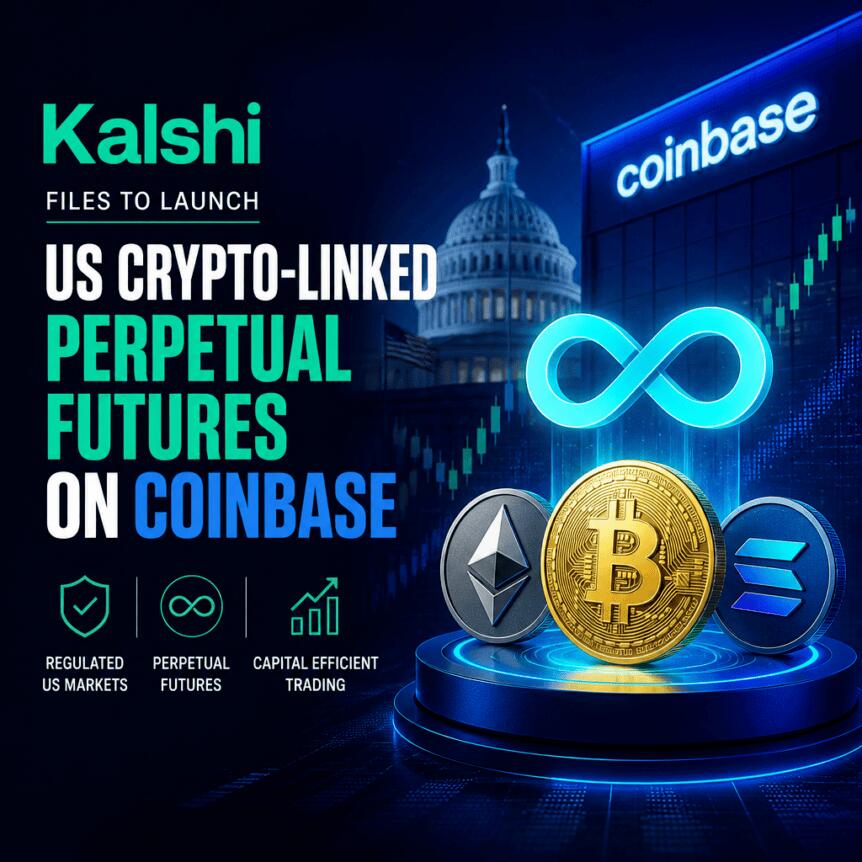
Kalshi has filed with U.S. regulators to launch perpetual futures contracts linked to individual U.S. stocks, a move that would extend a crypto-style derivatives structure into traditional equity markets. The company’s proposal was submitted to the Securities and Exchange Commission as a rule change and simultaneously sent to the Commodity Futures Trading Commission for review, according to the filing.
The development arrives as Coinbase has also put forward a separate plan to offer single-stock perpetual futures. Both efforts point to growing competition among regulated crypto derivatives venues to adapt perpetual contract mechanics—particularly the use of ongoing funding payments—to equity instruments.
Key takeaways
- Kalshi filed a proposed rule change with the SEC and submitted the related materials to the CFTC to enable perpetual futures tied to specific U.S. equities.
- The contracts would have no fixed expiration date and would use periodic funding payments between long and short positions to keep pricing aligned with the underlying stocks.
- Kalshi said the products would be treated as security futures and cleared through its CFTC-registered clearinghouse, Kalshi Klear.
- Coinbase filed a parallel proposal the same day, and Kraken’s parent company Payward also moved forward with filings through Bitnomial.
- These proposals come amid renewed uncertainty in U.S. crypto-related regulatory pathways following the Senate’s failure to advance the CLARITY Act earlier this month.
Kalshi’s SEC and CFTC filing targets stock-linked perpetuals
According to Kalshi’s rule change submission to the SEC, the company is seeking approval to list perpetual futures tied to individual U.S. stocks. The filing was made on Friday and the CFTC has not yet approved the proposal.
The key feature of Kalshi’s design is that the futures would be structured without a preset expiration date. Instead of settling at a particular maturity, the price relationship to the underlying stock would be maintained through “periodic funding payments” exchanged between long and short positions, a mechanism widely used in crypto perpetual futures.
Kalshi also indicated that the proposed contracts would be treated as security futures products and cleared using Kalshi’s CFTC-registered clearinghouse, Kalshi Klear—an element that matters for market participants because it points to an operating model built around regulated clearing rather than bespoke settlement arrangements.
The filing is available through the SEC’s website as part of Kalshi’s proposed rule change: https://www.sec.gov/files/rules/sro/kalshiex/2026/34-106422.pdf.
Coinbase moves in parallel as the “equity perp” race expands
Kalshi’s submission followed the same day as a separate announcement from Coinbase. Cointelegraph previously reported that Coinbase has also filed a proposal to bring perpetual futures tied to individual U.S. stocks to the market, using the same broad idea: perpetual exposure without a traditional expiration, balanced through periodic funding payments. The earlier Coinbase coverage is linked here: https://cointelegraph.com/news/coinbase-files-to-bring-single-stock-perpetual-futures-to-us-market.
These filings are significant not only because they replicate a familiar crypto derivatives template, but because they attempt to translate it into the equity derivatives framework—where product categorization, clearing arrangements, and regulator oversight can differ materially from crypto-native contracts.
Payward and Bitnomial also seek approval for stock perpetuals
Kalshi and Coinbase were not the only players advancing this concept. Payward—the parent company of crypto exchange Kraken—also filed to offer single-stock perpetual futures. The proposal was submitted through Payward’s Bitnomial Exchange, and Payward said it expects the products to be available to U.S. traders on Kraken.
Payward stated it plans to start with perpetual futures tied to 10 U.S. equities, including Tesla, Nvidia, Apple, Microsoft, and Amazon, and that it is working toward 24/5 trading.
The underlying SEC filing for Payward is available here: https://www.sec.gov/files/rules/sro/btnl/2026/34-106421.pdf. Payward’s public statement is referenced in a post on X: https://x.com/Payward/status/2101013602790490360.
Crypto-style funding meets a policy moment after the CLARITY Act setback
The push for single-stock perpetual futures comes after the U.S. Senate did not advance the CLARITY Act on Sept. 15, according to reporting referenced in the source. The bill failed to reach the 60-vote threshold needed to proceed.
In the immediate aftermath, SEC Chair Paul Atkins said the agency would act “decisively” within its existing statutory authority “with or without legislation,” signaling that regulators may pursue frameworks through other channels even if broader legislation stalls. The source ties this statement to an Atkins post on X: https://x.com/SECPaulSAtkins/status/2100256253645668860.
For investors and traders, these details matter because regulatory clarity is often what determines whether and how new derivative structures can be launched at scale. Perpetual futures can be attractive to market participants seeking continuous exposure, but they also shift how risk is managed over time—especially given the role of funding payments in maintaining price relationships.
Kalshi has already been operating in the perpetual futures space for crypto assets in the U.S. The source notes that Kalshi received CFTC approval for its Bitcoin perpetual contract in May and offers perpetual contracts tied to assets including Ether, Solana, and XRP.
What to watch next
With multiple exchanges now seeking permission to list stock-linked perpetual futures, the immediate focus should be on regulatory review timelines at the SEC and CFTC and whether the proposed contract structures—no fixed expiration plus funding-based pricing alignment—survive scrutiny in practice. Market participants will also want to monitor how funding mechanics and clearing arrangements are handled as these proposals move from filing to approval.
https://www.cryptobreaking.com/kalshi-files-to-launch-us/?utm_source=blogger%20&utm_medium=social_auto&utm_campaign=Kalshi%20Files%20to%20Launch%20US%20Crypto-Linked%20Perpetual%20Futures%20on%20Coinbase%20
Comments
Post a Comment