
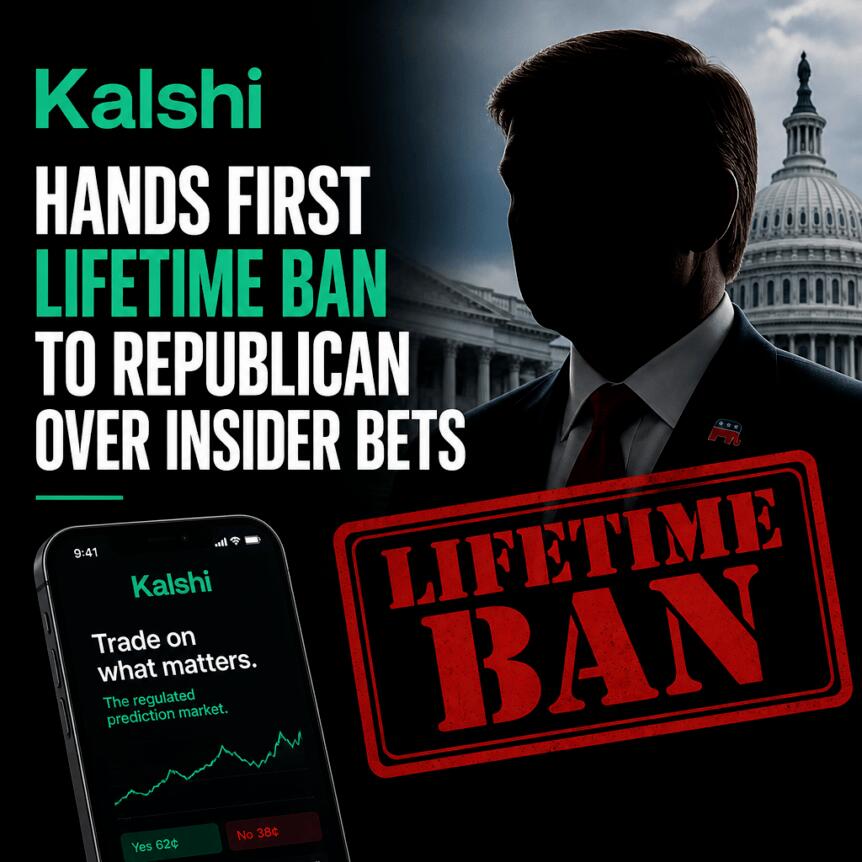
Prediction market platform Kalshi has imposed lifetime and multi-year trading bans on US House of Representatives candidates Laurie Buckhout and former Republican lawmaker George Santos, citing violations of rules that prohibit traders who can influence an event’s outcome from trading on contracts tied to that same event.
The compliance notices, announced Friday, mark one of Kalshi’s most serious enforcement actions since the platform launched in 2021. They also land amid heightened political and regulatory scrutiny of prediction markets, particularly claims that some event contracts could be manipulated.
Key takeaways
- Kalshi permanently suspended George Santos from trading on its prediction markets and imposed a $71,356 penalty, according to a settlement notice.
- Laurie Buckhout received a three-year trading suspension and a $2,590 penalty following Kalshi disciplinary action.
- Kalshi tied both restrictions to alleged rule-breaches involving event contracts that could be influenced by the candidates’ own actions.
- The moves follow broader enforcement concerns as regulators and lawmakers push back on whether prediction markets can be adequately controlled against manipulation.
Lifetime ban for George Santos after alleged event-linked trading
In its notice of settlement of disciplinary action, Kalshi said it had permanently suspended Santos from trading on the platform and assessed a $71,356 penalty. The company’s account attributes the action to investigation findings that Santos traded using event contracts connected to matters tied to his own public schedule and actions.
Kalshi said Santos “engaged in trading activity in certain markets related to his attendance at the State of the Union address” in February 2026. Under Kalshi’s rules, the platform prohibits trading on contracts where the trader is a decision maker, or has any influence—direct or indirect—over the outcome of the underlying event.
“If a Trader is a decision maker, either directly or indirectly, or has any influence, directly or indirectly, no matter the scale and importance of the influence, on the outcome of the Underlying event of any Contract, that Trader is prohibited from attempting to enter into any trade, either directly or indirectly, on the market in such Contracts,” Kalshi’s rules state.
Notably, Kalshi’s compliance notice did not say whether Santos cooperated with the investigation. Santos, however, publicly disputed Kalshi’s approach afterward, calling the platform “unserious” in a post on X.
Three-year suspension for Buckhout tied to her own candidacy
Kalshi said its investigation into Buckhout led to a three-year suspension from trading and a $2,590 penalty. In its notice of settlement, the company described Buckhout—running in North Carolina’s 1st congressional district—as having announced her candidacy and being added as a market option for a contract on the North Carolina congressional election.
In describing the conflict, Kalshi referenced its rules on influence over an event’s outcome, emphasizing that if a trader has any meaningful ability to affect the underlying result, they are barred from trading on related contracts. Kalshi’s compliance department reported that Buckhout “cooperated with the inquiry” and agreed to the trading ban and penalty.
Buckhout remains a Republican candidate for the 2026 midterm elections in North Carolina’s 1st congressional district. Reports also indicated her comment after the settlement characterized her alleged conduct as a “dumb mistake.”
Why Kalshi’s enforcement matters for prediction market trust
These settlements are significant not only for the individuals named but also for how prediction markets defend themselves against manipulation concerns. Kalshi’s argument is essentially compliance-based: once someone can plausibly affect or influence an event tied to a market—whether by office-holding, public participation, or other decision-making—the market platform draws a line between ordinary speculation and trading while holding influence over the event.
That stance comes as prediction market platforms continue to face pressure from both federal and state authorities. Kalshi has already been in the crosshairs over event-contract conduct, and the new enforcement actions can be read as part of a broader attempt to demonstrate internal policing.
The same tension has also appeared in enforcement actions involving people connected to political communications. Earlier, federal regulators fined Gabriel Perez, described as President Donald Trump’s teleprompter operator, after trading event contracts on Kalshi related to Trump’s speeches. Kalshi’s latest disciplinary actions, while involving different individuals and circumstances, reinforce the idea that regulators and lawmakers are watching whether event markets can be gamed by participants whose own actions shape outcomes.
Prediction markets still face a legal battle over jurisdiction
Beyond Kalshi’s internal discipline, the wider market faces legal uncertainty in the United States. According to the article’s referenced context, Kalshi and other prediction platforms such as Polymarket have been hit by lawsuits filed by individual US state gaming authorities. Those suits allege the platforms facilitate illegal bets on sporting events.
At the same time, the US Commodity Futures Trading Commission (CFTC) has argued that it holds “exclusive jurisdiction” over prediction markets, and the CFTC chair, Michael Selig, has said the agency will pursue legal action against state authorities that challenge that position.
Earlier this year, the CFTC used rare emergency authority in a dispute involving New York’s attempt to bar Kalshi from offering certain types of contracts tied to sports, elections, and other events. The case reflects a broader regulatory asymmetry: even when platforms claim they are operating under federal frameworks, state-level enforcement threats can still shape market access, product design, and long-term compliance strategy.
Buckhout’s market remains live despite sanctions
Even with Buckhout sanctioned, Kalshi’s contracts tied to her election outcome appear to remain listed. As of Tuesday, Kalshi still showed event contracts related to the result of Buckhout’s North Carolina race, displaying probabilities for Democratic incumbent Don Davis versus Buckhout.
That detail matters for traders and observers because it highlights a separation between disciplinary action against a participant and the ongoing availability of the underlying contract market—an important operational question for anyone evaluating liquidity, pricing accuracy, and how quickly markets reflect compliance-driven changes.
Going forward, market participants should watch whether Kalshi expands similar enforcement across other categories of politically connected events, and whether the CFTC’s jurisdiction stance continues to deter or intensify state-level lawsuits—developments that could reshape which prediction markets remain accessible in the US and under what compliance standards.
https://www.cryptobreaking.com/kalshi-hands-first-lifetime-ban/?utm_source=blogger%20&utm_medium=social_auto&utm_campaign=Kalshi%20Hands%20First%20Lifetime%20Ban%20to%20Republican%20Over%20Insider%20Bets%20
Comments
Post a Comment