
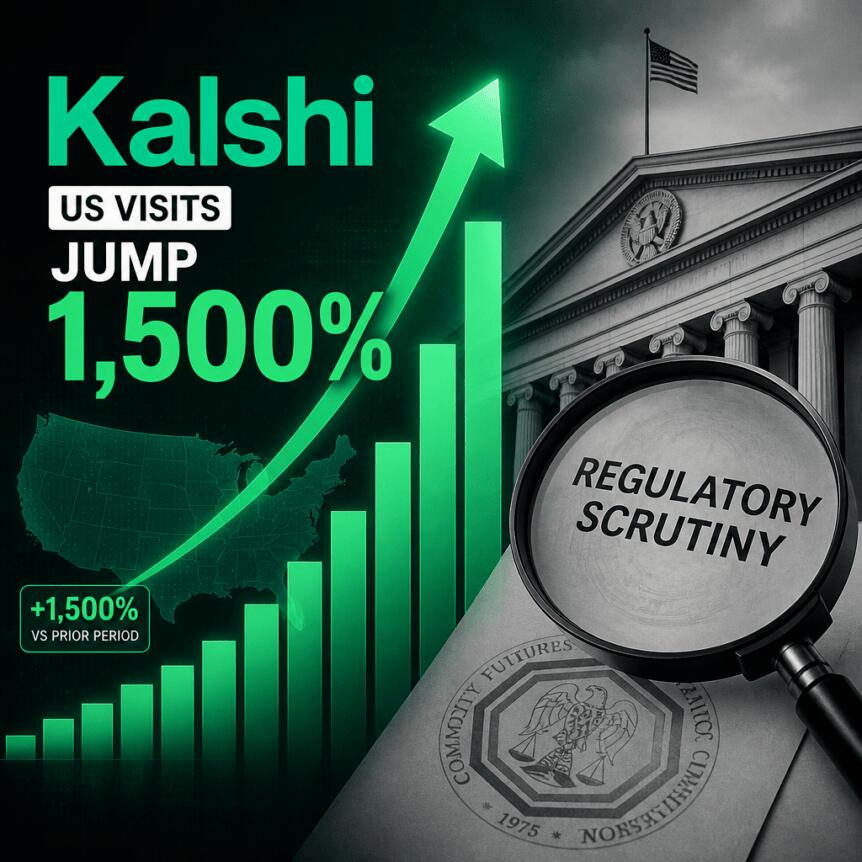
Kalshi’s prediction markets business is drawing sharply more attention from web users—at the same time as legal challenges intensify over how certain contracts should be regulated. New traffic estimates reviewed by Cointelegraph show that US visits to Kalshi surged over the past year, reflecting the platform’s rapid mainstream reach.
According to Similarweb traffic data analyzed by Cointelegraph, Kalshi logged 15.4 million visits from the United States in July, up about 1,520% from just under 1 million in August 2025. The US also remained the dominant source of site activity, accounting for nearly 80% of Kalshi’s traffic in July versus 72.8% in August 2025.
Key takeaways
- Kalshi’s US web traffic reached 15.4 million visits in July, roughly a 1,520% jump versus August 2025, based on Similarweb estimates.
- US users remained the largest share of traffic, at nearly 80% in July compared with 72.8% a year earlier.
- Trading growth appears to be outpacing traffic growth, with monthly notional volume rising to about $40 billion in August from $874 million a year earlier, per Dune Analytics.
- Sports-related contracts represented 83% of Kalshi’s trading volume in July, underscoring why regulatory scrutiny remains focused on event terms.
- Even as traffic increased, Canada and the UK—jurisdictions where Kalshi’s member agreement restricts direct access—still contributed a small share of visits.
Traffic surges as the legal fight escalates
The visibility boost comes during a period of heightened scrutiny of prediction markets in the US. Kalshi has faced legal challenges tied to whether its sports contracts should fall under federal oversight or instead be treated as state-regulated gambling. The dispute has reached the US Supreme Court, after New Jersey took the matter to the Supreme Court, according to earlier coverage.
While web traffic is not the same thing as regulatory status, the strong jump in US visits helps explain why the company’s expanding contract catalog is attracting both user interest and legal attention. The geographic concentration also matters: with the US supplying most of Kalshi’s traffic, any ruling affecting how Kalshi structures or offers certain contracts could quickly reverberate through its core customer base.
Trading volume grows faster than visits
Kalshi’s traffic gains have coincided with even larger growth in trading activity. Dune Analytics’ prediction market data dashboard, as cited by Cointelegraph, shows that Kalshi recorded about $40 billion in monthly notional trading volume in August. That compares with roughly $874 million a year earlier, an increase of around 4,500%.
Looking across the broader prediction-market sector, the same Dune Analytics dashboard indicates that monthly notional volume rose to $50.7 billion from about $2 billion over the same period. Kalshi accounted for nearly 79% of that latest total, meaning the company is not only growing but also increasingly dominant within the category.
Sports contracts were central to this activity. Barron’s reported Thursday that sports-related contracts made up 83% of Kalshi’s trading volume in July. That skew is notable because it aligns with the regulatory focus of the ongoing court dispute—raising the stakes for what happens next if courts determine that certain event contracts should be handled differently.
International interest rises, even where access is restricted
Kalshi’s audience has expanded beyond the United States, though its traffic footprint remains heavily weighted toward the US. Similarweb estimates reviewed by Cointelegraph show that Canada generated about 450,000 visits to Kalshi’s website in July, up from roughly 50,000 in August 2025. UK visits also increased, reaching 296,000 in July from 31,000 a year earlier.
However, both countries fall into a category of restricted jurisdictions under Kalshi’s member agreement, which currently prohibits users from directly accessing or trading on the platform. Kalshi previously addressed this by partnering with Canadian financial services firm Wealthsimple in June to provide access to nearly 4,000 eligible Kalshi contracts through a separate app, as described in Kalshi’s announcement.
Even with visit counts increasing, the share of traffic from these restricted jurisdictions declined over the same period. From August 2025 to July 2026, Canada’s share slipped to 2.3% from 3.8%, while the UK’s share fell to 1.5% from 2.4%—suggesting that Kalshi’s overall growth is outpacing growth in these regions or that US traffic is rising even more quickly.
Cointelegraph reached out to Kalshi for comment on traffic from restricted jurisdictions but had not received a response by publication.
What investors and users should watch next
Kalshi’s traffic and volume growth point to strong demand for event-based markets, especially sports-driven contracts, but the company’s legal situation remains the key uncertainty. With the Supreme Court dispute now in view, readers should watch how court outcomes or compliance changes affect Kalshi’s product offerings—particularly contract types that have drawn the most regulatory attention.
https://www.cryptobreaking.com/kalshi-us-visits-jump-1500/?utm_source=blogger%20&utm_medium=social_auto&utm_campaign=Kalshi%20US%20Visits%20Jump%201,500%%20as%20Regulatory%20Scrutiny%20Intensifies%20
Comments
Post a Comment