
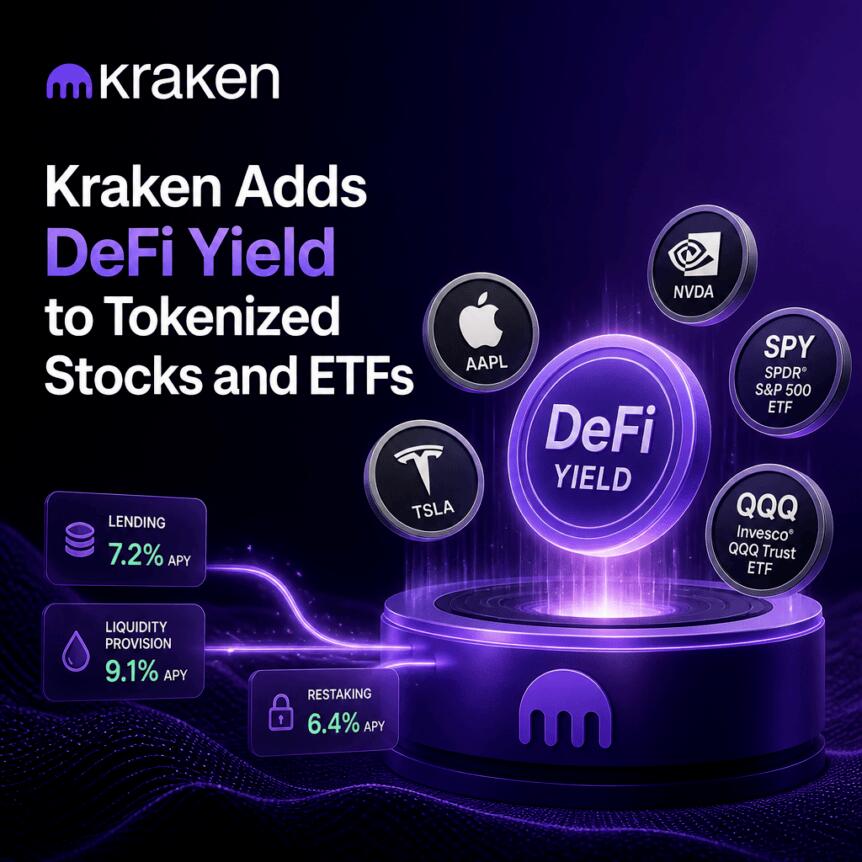
Kraken has expanded its tokenized-asset push by launching “xStocks” onchain yield vaults for select tokenized equities and ETFs. The service is designed to let eligible clients lend those tokenized holdings through decentralized finance (DeFi) protocols in order to generate yield, with returns paid in the deposited assets.
In a Monday announcement, Kraken said the vaults currently support tokenized versions of the SPDR S&P 500 ETF (SPYx), Invesco QQQ ETF (QQQx), and Nvidia (NVDAx). Clients deposit xStocks into the vaults, earn yield generated from onchain lending, and then submit withdrawal requests that Kraken processes within three days.
Key takeaways
- Kraken’s new xStocks vaults generate yield by lending tokenized stocks and ETFs through DeFi markets.
- Yield is paid in the deposited xStocks, and withdrawals are handled within three days.
- The vaults build on the same infrastructure as Kraken DeFi Earn, which reported more than $800 million in deposits since its January launch.
- Supported tokenized products include SPYx, QQQx, and NVDAx, but the service excludes several major jurisdictions including the U.S. and U.K.
- Veda powers the vaults, while Sentora designs and manages the lending strategies and sets exposure limits.
How Kraken’s xStocks vaults are structured
Kraken’s announcement frames xStocks as an “onchain yield vault” for tokenized equities and ETFs—meaning the underlying assets exist in tokenized form on public infrastructure, and the vault seeks to put those tokens to work via DeFi lending.
The company said yield is produced by lending the deposited xStocks through onchain markets. Instead of distributing yield as a separate token, Kraken pays it back to clients in the deposited xStocks themselves. That design choice matters for investors who want their position to remain denominated in the tokenized equity/ETF wrapper rather than receiving interest in a different asset class.
Operationally, Kraken noted that withdrawal requests are processed within three days. For traders and yield-focused users, the speed and predictability of exits are often just as important as the yield rate itself—particularly when liquidity conditions in DeFi lending markets can change.
Built on Kraken DeFi Earn, with Veda and Sentora in the mix
Kraken said the xStocks vaults use the same infrastructure as Kraken DeFi Earn, a service that launched in January. The company reported that DeFi Earn has since attracted more than $800 million in deposits, underscoring that Kraken is treating DeFi yield distribution as a core capability rather than a niche experiment.
For the xStocks vaults specifically, Kraken said the offering is powered by Veda. Sentora, according to the announcement, is responsible for designing and managing the lending strategies used to generate yield.
Kraken also described how risk controls are handled inside those strategies. It said Sentora lends the assets through DeFi markets—citing Kamino on Solana as an example—and that exposure limits and monitoring are based on collateral, liquidity, and oracle conditions. In practice, those components are central to how DeFi lending systems attempt to manage liquidation risk and ensure that collateral valuations and available liquidity remain coherent with onchain data.
Regulatory footprint: where xStocks is available
While Kraken is rolling out the vaults for “select” tokenized products, access is tied to geography. Kraken said xStocks vaults are available to eligible clients in the European Economic Area and other markets, but are excluded in the United States, United Kingdom, Canada, Australia, and the United Arab Emirates.
For participants outside the supported regions, this restriction limits immediate access and may affect how quickly tokenized equity yield products can scale globally. It also highlights the practical reality that tokenized securities and their related yield mechanisms face compliance requirements that differ by jurisdiction.
Tokenized equities keep accelerating—Kraken’s move lands in a bigger trend
Kraken’s xStocks vaults arrive during a broader push toward tokenized equities and ETFs. According to RWA.xyz data cited by Kraken, the distributed value of tokenized stocks and ETFs has risen to about $2.84 billion—up from roughly $540 million a year earlier.
The scale-up implied by that jump helps explain why exchange-led yield products are gaining traction: as more assets become tokenized, there is a larger universe of holdings that can be used in DeFi strategies, even if only a subset is eligible for retail or institutional lending depending on local regulations.
At the same time, the asymmetry in access—supported markets versus excluded countries—suggests that tokenized equities may develop in uneven waves, with product availability tracking regulatory clarity. Investors watching this space may want to pay attention not just to new tokenized listings, but also to how quickly yield wrappers like xStocks can expand beyond their initial geographic boundaries.
What to watch next is whether Kraken broadens the list of supported tokenized equities and ETFs, and how quickly it can add more DeFi markets or adjust its lending strategy parameters as DeFi liquidity and onchain oracle conditions evolve.
https://www.cryptobreaking.com/kraken-adds-defi-yield-to/?utm_source=blogger%20&utm_medium=social_auto&utm_campaign=Kraken%20Adds%20DeFi%20Yield%20to%20Tokenized%20Stocks%20and%20ETFs%20
Comments
Post a Comment