
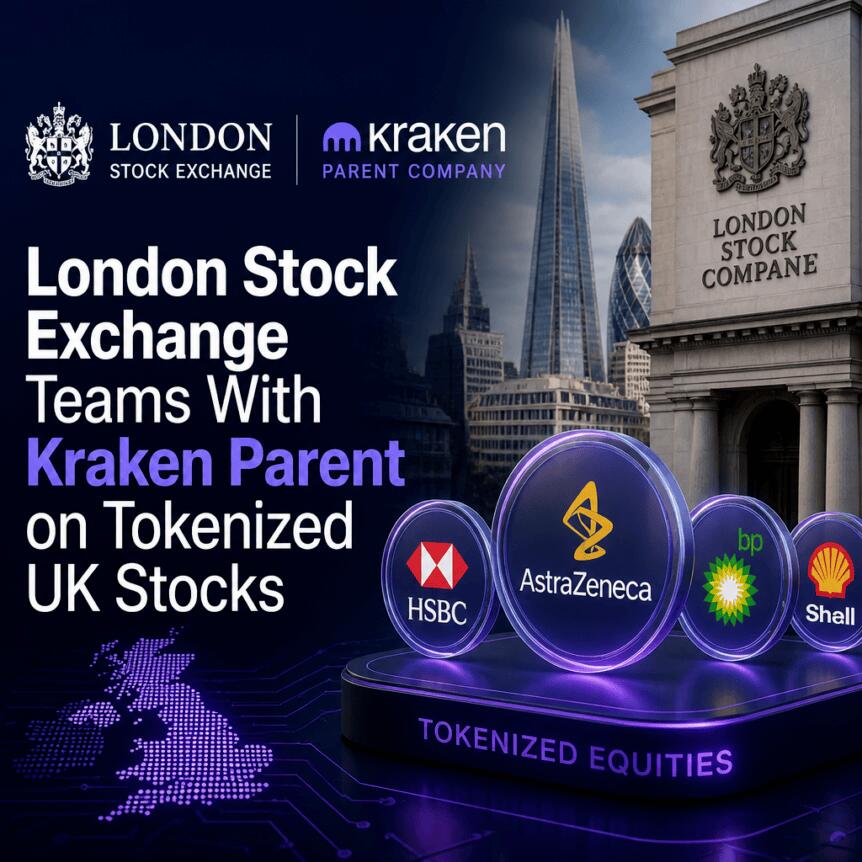
The London Stock Exchange (LSE) and crypto exchange Kraken are reportedly moving toward tokenized stock trading on a new LSE night-time venue, a bid to make parts of UK equities markets available outside traditional market hours. According to the Financial Times, LSE will work with Kraken’s parent company, Payward, to provide access to tokenized stocks that track major UK equity products starting in 2027.
The plan centers on LSE 24, the stock market operator’s proposed round-the-clock trading facility. LSE said it would begin operating Mondays through Fridays, with trading expected to run from the evening through the night window, offering 24/5 market access once launched.
Key takeaways
- LSE says tokenized stocks referencing leading UK equities would be introduced on its planned LSE 24 night-time trading venue starting in 2027.
- The effort is reported to involve Payward, Kraken’s parent company, which is expected to supply the tokenized-stocks access infrastructure.
- LSE 24 is designed for 24/5 trading, reflecting a broader industry push to reduce reliance on fixed market hours.
- This puts London among multiple global venues exploring tokenized equity products alongside Nasdaq, CME Group, and ICE.
- Onchain tokenized stocks continue to expand, with RWA.xyz data showing growth in both value and the number of holders over the last month.
What LSE’s tokenized equities push would change
Tokenized stocks are digital representations of traditional equities designed to move or settle onchain using blockchain infrastructure. In practice, that can enable fractional ownership, faster settlement workflows, and, depending on regulation and market design, trading that is less constrained by conventional market hours.
For LSE, pairing tokenized stocks with LSE 24’s extended schedule appears aimed at improving accessibility for investors who cannot participate during regular sessions. Instead of treating tokenization as a standalone experiment, the reported approach ties onchain equity access to an LSE product—its own trading venue—suggesting the exchange wants tokenized assets to become part of its mainstream market offering.
Payward’s chief commercial officer Mark Greenberg told the Financial Times that the LSE partnership would provide access to tokenized stocks tracking leading UK equity products starting in 2027. The reported timetable matters because it frames tokenization as something approaching deployment rather than long-term research—though readers should note the detail is based on reporting in the Financial Times.
LSE 24: the “24/5” venue as a catalyst
The technical and regulatory readiness of tokenized securities is only one side of the equation. The other is how and when trades can actually occur. LSE 24, which LSE announced on July 21, is positioned as a market structure that offers 24/5 trading from Mondays to Fridays.
That design echoes the core promise of tokenized markets in general: markets that can potentially run continuously, rather than being limited to standard exchange hours. By placing tokenized stocks within that extended-hours venue concept, LSE is effectively aligning its tokenization initiative with a specific liquidity and trading schedule—important for traders and liquidity providers assessing whether tokenized instruments can gain practical traction.
For investors, the benefit is straightforward: more time to trade during the week. For market operators and service providers, it creates a clearer product pathway—turning tokenization into an operational feature of a trading venue rather than an isolated offering.
Tokenization is becoming a cross-venue industry priority
LSE is not alone in exploring tokenized equity products. The broader push reflects how TradFi institutions are experimenting with blockchain-based securities, often with an eye toward fractionalization and potentially faster settlement mechanisms.
According to earlier coverage cited within the source, Nasdaq agreed in August to acquire LeveL Markets, described as the third-largest alternative trading system in the US by trading volume, as part of a move toward tokenized markets with round-the-clock trading. In March, Nasdaq was also reported to be working with Payward and Payward’s Backed subsidiary (issuer behind xStocks) to build an “equities transformation gateway.” Separately, the source references that Nasdaq had previously filed a tokenization proposal with US securities regulators in September 2025.
The pattern is similarly visible in other exchange groups. The source notes that ICE—parent of the New York Stock Exchange—received investment involvement from crypto exchange OKX to bring NYSE-listed tokenized stocks to the exchange starting from the second quarter of 2026. It also highlights that Deutsche Börse invested $200 million in Payward, tied to plans for broader access to blockchain-based securities and tokenized investment products.
Beyond equities, derivatives venues are also moving toward crypto-linked products. The source cites CME Group’s plans for futures contracts tied to Cardano, Chainlink, and Stellar and its later intention to add Avalanche and Sui futures, subject to regulatory approval. While these are different instrument types than tokenized stocks, they show that large operators are actively building infrastructure for blockchain-adjacent trading.
How fast is tokenized stock adoption progressing?
The LSE initiative arrives as tokenized stocks continue to grow. Data provider RWA.xyz, cited in the source, reported that the total value of tokenized stocks rose by 15% over the previous 30 days to $2.53 billion. Over the same period, it said the number of tokenized equity holders increased by 153% to 2.45 million.
Those figures help contextualize why exchange operators are accelerating exploration: the market for tokenized equities appears to be expanding in both capital and participant counts. Still, investors should distinguish between growth in onchain holdings and growth in regulated exchange volumes. Tokenized assets can exist across multiple venues and jurisdictions, and the level of liquidity varies widely depending on market access, settlement design, and compliance frameworks.
What to watch next is how quickly tokenized stock offerings move from pilots and partner-led deployments into standardized venue listings—and whether extended trading schedules like 24/5 materially improve execution quality for investors.
For now, the most immediate question is whether LSE’s 2027 timeline for tokenized equities on LSE 24 holds through regulatory reviews and market preparation. As other large exchanges press forward with tokenization strategies, the next signals for investors will be concrete launch details, the structure of tokenized instruments, and evidence that liquidity can follow the promise of more hours and broader access.
https://www.cryptobreaking.com/london-stock-exchange-teams-with/?utm_source=blogger%20&utm_medium=social_auto&utm_campaign=London%20Stock%20Exchange%20Teams%20With%20Kraken%20Parent%20on%20Tokenized%20UK%20Stocks%20
Comments
Post a Comment