
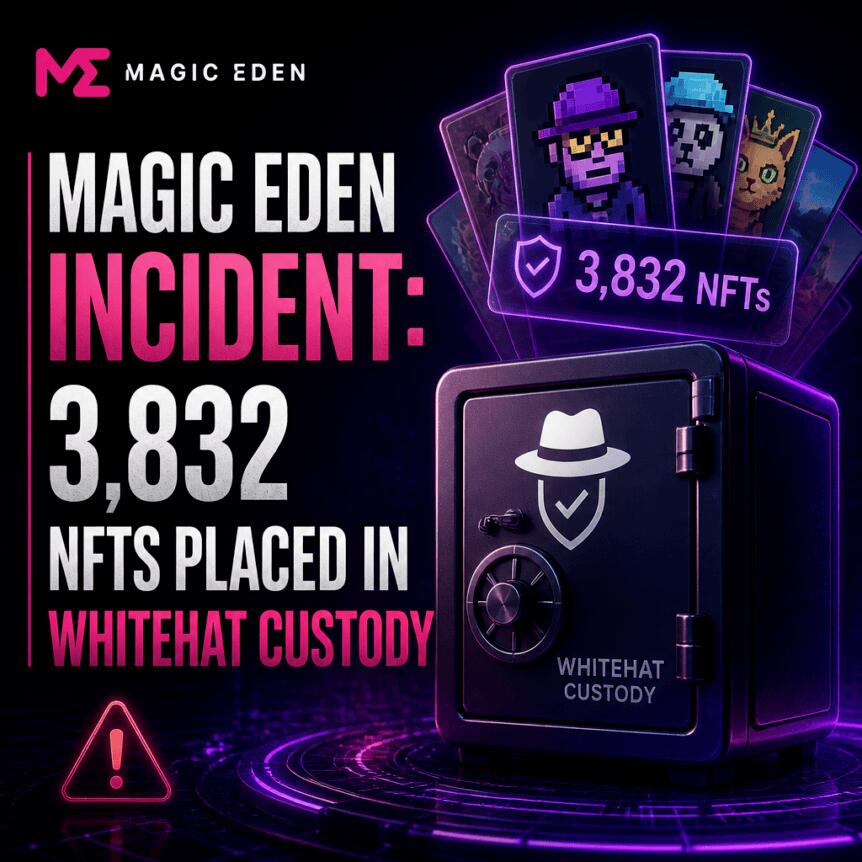
NFT holders tracking activity tied to Magic Eden reported what appeared to be a large-scale “rescue” transfer on Friday: a whitehat account moved 3,832 non-fungible tokens from hundreds of wallets after concerns surfaced about a potential vulnerability affecting the marketplace’s listings.
As questions spread across the community, Yuga Labs’ blockchain vice president, a pseudonymous account known as 0xQuit, said the movement was part of a controlled white-hat operation and that the NFTs in the destination wallet are safe and would be returned once they are no longer considered at risk. Magic Eden later narrowed the issue to a specific component connected to the Limit Break protocol and issued targeted instructions for affected former users.
Key takeaways
- A whitehat moved 3,832 NFTs from many wallets after community members flagged suspicious activity resembling Magic Eden sales.
- Yuga Labs executive 0xQuit characterized the transfers as a rescue operation, saying the assets will be returned when risk is reduced.
- Magic Eden linked the exploit to Limit Break’s Payment Processor V2 and said it stopped using the related system in October 2024.
- Magic Eden advised former users to revoke Ethereum, Polygon, and Base contract approvals, noting this will not bring back tokens already moved.
- Magic Eden said no live Magic Eden listings were impacted, while NFT listings on its EVM marketplace from roughly February to October 2024 could be affected.
Community flags transfers resembling Magic Eden sales
According to NFT community member Cirrus, activity on Friday looked like a coordinated set of transactions where a single wallet appeared to route NFTs out from many holders. In posts on X, Cirrus said the transfers involved 3,832 NFTs moved from hundreds of wallets and that the on-chain transactions appeared to be tied to trades executed through Magic Eden.
Cirrus also recommended a precautionary step: revoke token permissions/approvals to reduce exposure if the underlying issue still allowed unauthorized movement. The guidance resonated quickly within NFT circles, particularly because “approval” patterns are a common weakness when third-party contracts can move assets that owners have already authorized.
Yuga Labs describes a white-hat rescue in progress
Not long after the community’s warnings, 0xQuit—described by Yuga Labs as its pseudonymous vice president of blockchain—responded that the transfers were part of a white-hat operation. He said the NFTs held in the receiving wallet are safe and would be returned once they are no longer at risk.
0xQuit has previously participated in NFT recovery efforts. In June, coverage by Cointelegraph described a rescue after an exploit targeted Flooring Protocol, where 0xQuit helped recover 68 NFTs valued at more than $500,000. Those assets were later held with the goal of returning them to affected users.
Separately, Yuga Labs CEO Michael Figge indicated a vulnerability had been discovered earlier and that additional details would follow, signaling that the company was aware of the issue and coordinating on next steps.
Magic Eden ties the problem to Limit Break’s Payment Processor V2
Magic Eden provided its own account of what happened, stating on X that the exploit involved Limit Break’s Payment Processor V2. The marketplace said it stopped using that payment processor as part of its integration timeline, noting that it closed its EVM marketplace in the first quarter of 2026.
In Magic Eden’s framing, the key distinction for investors and collectors is that the company did not believe ongoing listings were being targeted in real time. “No live Magic Eden listings were impacted in this exploit,” Magic Eden said. However, it warned that NFTs listed on its EVM marketplace from approximately February to October 2024 could be exposed.
This time window matters because it points to which approvals and integrations were likely in place during the period when the affected payment processor could still be reachable. If a holder interacted with Magic Eden’s EVM marketplace during those months—especially if they granted blanket approvals—permissions may still linger even after a platform changes or sunsets its tooling.
Actions for former users: revoke approvals across networks
Magic Eden urged former users to revoke approvals for the relevant contract on Ethereum, Polygon, and Base. The company emphasized that revoking approvals would not reverse transfers that have already occurred, but it could help prevent additional token movement for remaining assets under the same approval setup.
In parallel, Magic Eden said it was contacting Limit Break—the protocol owner and maintainer—about further mitigations. The company specifically referenced efforts aimed at pausing transfers, suggesting that technical controls on the protocol side may still play a role in limiting harm while the rescue process unfolds.
Magic Eden also noted that it was providing guidance to those potentially affected rather than issuing a blanket alert that all users were at risk. Cointelegraph reported contacting Magic Eden for comment but did not receive a response by publication beyond the statements already posted.
What to watch next
For holders, the immediate focus is whether token approvals tied to the affected integration remain in place and whether Limit Break implements additional transfer-pausing measures. For the broader market, this episode underscores how quickly “approval-based” vulnerabilities can outlast marketplace support windows—making rescues possible, but also leaving many users to verify permissions across chains long after a protocol’s usage has changed.
https://www.cryptobreaking.com/magic-eden-incident-3832-nfts/?utm_source=blogger%20&utm_medium=social_auto&utm_campaign=Magic%20Eden%20Incident:%203,832%20NFTs%20Placed%20in%20Whitehat%20Custody%20
Comments
Post a Comment