
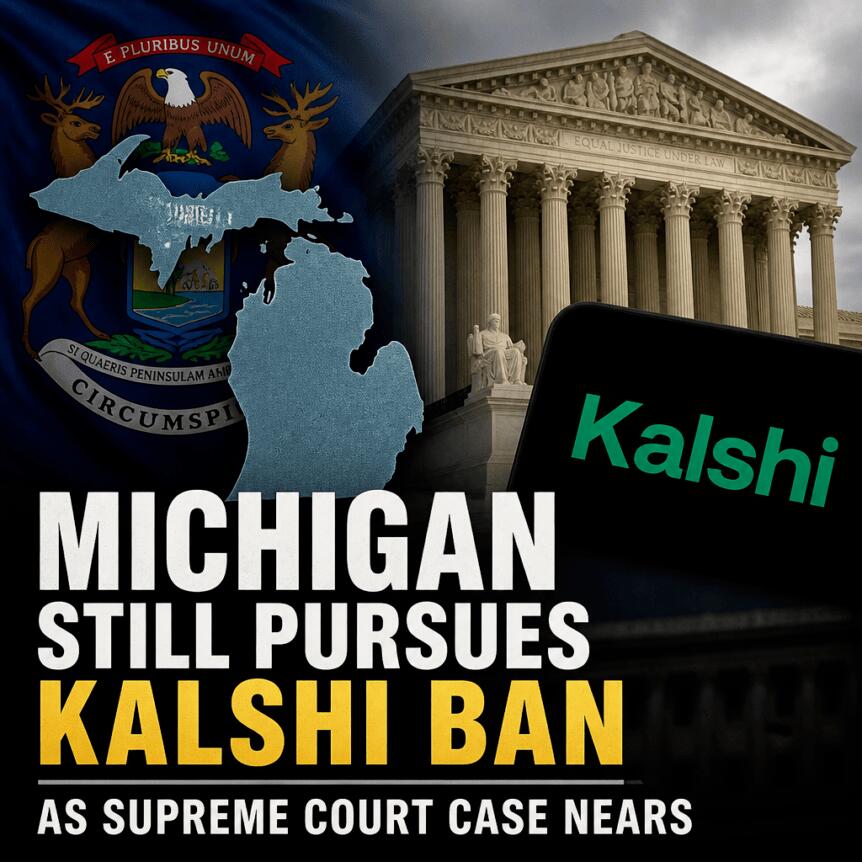
Michigan has escalated its efforts to rein in Kalshi, a prediction markets platform, by securing a preliminary injunction that blocks the company from offering event contracts to residents. The state’s attorney general said the order is meant to stop what officials described as “sports betting” operating under the guise of an investment product.
In a notice dated Wednesday, Michigan Attorney General Dana Nessel said the Circuit Court for the 30th Judicial Circuit in Ingham County approved the injunction after earlier court action. Nessel also noted that Kalshi could face penalties of up to $500,000 per day if it violates the order.
Key takeaways
- Michigan’s court issued a preliminary injunction barring Kalshi from offering event contracts to state residents.
- Attorney General Dana Nessel framed the case as “sports betting” disguised as an investment opportunity, with daily fines possible.
- The injunction follows a June temporary restraining order and comes amid an ongoing dispute over whether prediction markets fall under federal CFTC authority or state jurisdiction.
- New Jersey simultaneously moved to ask the US Supreme Court to weigh in, potentially affecting how courts resolve conflicting legal theories.
- Legislative proposals in Washington target insider trading risks in event contracts, but they may not resolve the broader jurisdictional fight on their own.
Michigan blocks Kalshi’s event contracts
According to a press release from Michigan’s attorney general, the Ingham County court order prevents Kalshi from offering “event contracts” to residents of the state. Nessel said the decision helps protect Michigan consumers from what she characterized as “predatory, unlicensed practices.”
Under the terms described by Nessel, Kalshi faces potentially steep financial exposure if it does not comply with the injunction. The attorney general’s filing is the latest step in a wider legal campaign targeting prediction market operations that state officials argue resemble sports wagering.
The Michigan litigation dates back to a lawsuit filed in March, when Nessel alleged Kalshi violated Michigan law related to sports gambling. Similar arguments have appeared in other states, reflecting how quickly prediction markets have moved from niche tools for forecasting into mainstream attention—along with intensified scrutiny from regulators.
From temporary restraining order to preliminary injunction
The preliminary injunction does not arrive in isolation. It follows a June temporary restraining order that previously barred Kalshi from offering sports betting-like products to Michigan residents.
During that earlier stage, the US Commodity Futures Trading Commission (CFTC) ordered Kalshi not to comply with Michigan’s temporary order and to continue operating. Kalshi later described the situation as placing it in an “impossible position,” according to an earlier account referenced by Cointelegraph.
After the June order, a Kalshi spokesperson told Cointelegraph that the company disagreed with Michigan’s decision and “will fight it in court,” while stating it was complying with restrictions imposed by the court.
That sequence—state court restrictions paired with federal regulator guidance—helps explain why the Michigan dispute has drawn broader attention beyond the state’s borders. The case is part of a larger effort by courts and regulators to determine what rule set governs prediction markets in the US.
New Jersey seeks Supreme Court review
Michigan’s most recent decision coincided with another development in New Jersey. State officials announced they filed a petition for a writ of certiorari with the US Supreme Court related to the Kalshi dispute.
The petition, as described in earlier coverage linked by Cointelegraph, raises the prospect that the justices could resolve competing legal theories about whether prediction markets are regulated by the CFTC or whether states retain the authority to ban and/or regulate such contracts.
In remarks provided to Cointelegraph, Melinda Roth, a visiting professor of practice at New England Law in Boston, said it would be reasonable for the Supreme Court to take up the matter. Roth also suggested the court might choose to wait until cases are decided on their merits rather than focus solely on procedural questions such as whether a preliminary injunction is appropriate.
“If and when SCOTUS takes it up, then this will likely decide whether sports event contracts are federally regulated by the CFTC or the states have the right to ban and/or regulate them as they see appropriate.”
Roth added that Congress could potentially act before Supreme Court review, either before or after any decision, which underscores how jurisdictional clarity might arrive through courts—or via legislation—depending on political and legal timelines.
Policy push targets insider information as legal battles continue
Alongside the court fights, some lawmakers have proposed legislation aimed at a different risk area: the use of insider information in event contracts. According to earlier reporting linked by Cointelegraph, Senators Adam Schiff and John Curtis introduced a bill in March that would prohibit CFTC-registered platforms from listing event contracts that “resembles a sports bet or casino-style game,” effectively channeling enforcement and jurisdiction toward states.
That proposal points to an emerging pattern in the broader prediction market debate: lawmakers and regulators are not only disputing jurisdiction, they are also trying to address market integrity concerns—particularly the potential for trading based on nonpublic information.
For participants in prediction markets, the practical takeaway is that the legal landscape may remain fragmented. Even as federal agencies and courts weigh in on authority, states like Michigan continue to pursue injunctions that can immediately affect access for residents, while Supreme Court review could later reshape the rules nationwide—if the case is taken up and decided.
Investors, traders, and developers should watch for how higher courts respond to the jurisdictional questions raised by the Michigan and New Jersey proceedings, as well as whether Congress advances a framework that addresses both integrity risks and the dividing line between state and federal oversight.
https://www.cryptobreaking.com/michigan-still-pursues-kalshi-ban/?utm_source=blogger%20&utm_medium=social_auto&utm_campaign=Michigan%20Still%20Pursues%20Kalshi%20Ban%20as%20Supreme%20Court%20Case%20Nears%20
Comments
Post a Comment