
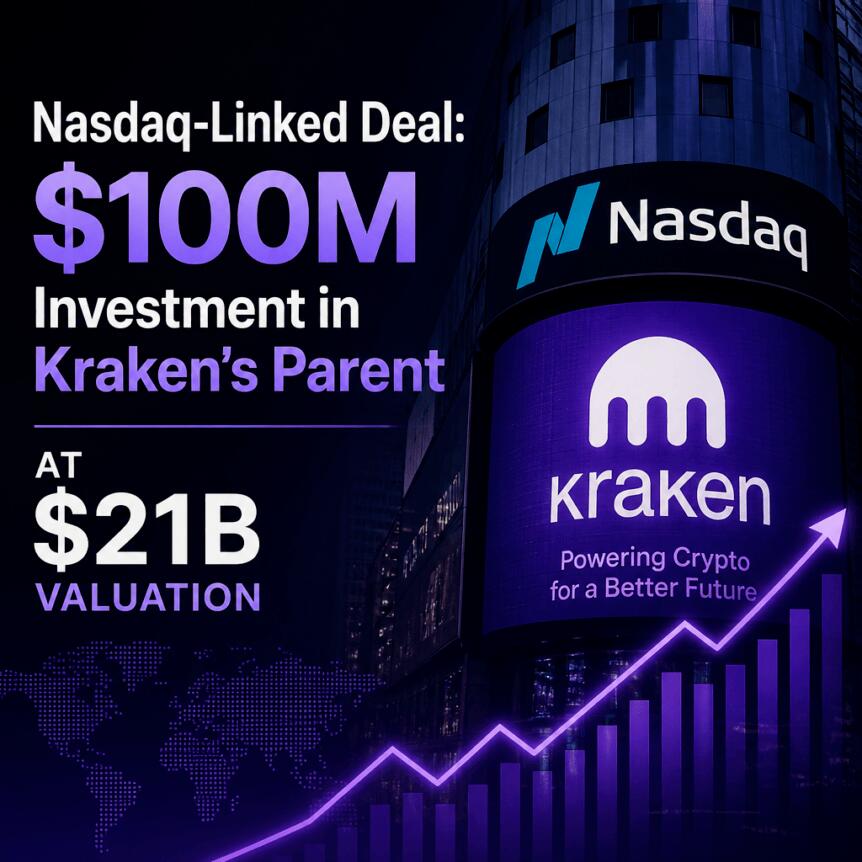
Nasdaq has put $100 million into Payward, the parent company behind the Kraken cryptocurrency exchange, as part of an expansion push into tokenized assets. The investment is positioned to connect Nasdaq-listed equities to tokenized trading through Kraken’s platform, while also bringing Nasdaq surveillance tools into Payward’s broader markets infrastructure.
The deal deepens an already existing relationship between Nasdaq and Payward. In March, Nasdaq announced its partnership with Payward to support tokenized equities, and Thursday’s announcement adds both capital and operational integration.
Key takeaways
- Nasdaq’s venture arm invested $100 million in Payward, valuing Kraken’s parent at $21 billion, according to people familiar with the matter cited by Bloomberg.
- Kraken is set to offer tokenized versions of Nasdaq-listed stocks on its own exchange platform.
- Payward will adopt Nasdaq surveillance technology across its venues spanning crypto, equities, tokenized equities, futures, and options.
- The move follows recent European expansion efforts tied to tokenized stocks from other major exchanges, including Deutsche Börse and the London Stock Exchange.
- RWA.xyz data shows tokenized stocks have a distributed value above $2.9 billion, up 7.4% over the past month.
Nasdaq invests in Kraken’s parent to scale tokenized equity offerings
Nasdaq disclosed that its venture unit made the $100 million investment in Payward. Payward is the corporate parent of Kraken, which has been positioning itself as a venue for digital-asset trading and, increasingly, tokenized versions of traditional financial instruments.
Under the terms of the announcement, Kraken will offer tokenized versions of Nasdaq-listed stocks directly on its own platform. The announcement builds on the framework Nasdaq and Payward outlined earlier, including a partnership described by Cointelegraph in March as focused on issuer-centric tokenized equities.
For investors, the practical significance is straightforward: the investment signals that tokenized equities are moving from isolated pilots toward more mainstream exchange distribution channels. Kraken’s customer base and trading infrastructure may become a larger on-ramp for investors seeking 24/5 access to equity-linked products—an approach other venues have also been testing.
Surveillance tech integration across crypto and tokenized markets
Beyond the capital infusion, Nasdaq said Payward will adopt its surveillance technology across multiple market types. According to the announcement, the coverage will extend across Payward’s crypto venues, equities venues, tokenized equity venues, futures, and options.
That matters because surveillance and monitoring are central to how regulated trading ecosystems address market integrity, compliance, and risk management. Rather than treating tokenized equities as a separate back-office experiment, the announcement describes a consolidation of tooling across asset classes and trading formats.
In effect, Nasdaq is leveraging its infrastructure and regulatory experience to support a wider deployment of tokenized products—while Payward gains access to a standardized monitoring layer that can help it scale listings and operations without reinventing compliance workflows for each new category.
What the $21 billion valuation implies for the tokenization race
Bloomberg reported that the investment valued Kraken’s parent, Payward, at $21 billion, citing people familiar with the matter. Nasdaq did not provide that valuation figure in the disclosure itself, but the reported number gives readers a benchmark for how much strategic capital major exchange operators are willing to attach to blockchain-native market infrastructure.
Cointelegraph previously noted that Nasdaq has been pushing for “always-on” markets, which includes exploring regulatory pathways for trading tokenized stocks. In the context of this latest investment, the $21 billion figure suggests tokenization is becoming a core part of Nasdaq’s growth narrative rather than a side project.
Earlier this month, Nasdaq also shared plans to acquire Level Markets as part of its always-on strategy. And a year ago, Nasdaq filed a proposal with the US Securities and Exchange Commission related to tokenization—showing that the current momentum is supported by longer-term regulatory work rather than a sudden shift.
Momentum across major exchanges: Deutsche Börse and London Stock Exchange
Nasdaq’s move arrives amid a wider flurry of exchange activity around tokenized equities.
Earlier this month, Kraken partnered with the London Stock Exchange to launch access to 24/5 trading of tokenized stocks tracking UK equity products, with the initiative expected to start in 2027. In April, Deutsche Börse invested $200 million in Payward, aligning with its own plans to broaden access to blockchain-based securities and tokenized investment products.
Taken together, these investments show that competitive pressure is no longer limited to cryptocurrency trading. Exchange groups are positioning tokenized stocks as part of the next evolution in market access—especially in markets where investors want trading flexibility outside traditional windows.
For market participants, the key question now is not just whether tokenized equities can be issued, but whether liquidity, custody, settlement, and compliance can scale across multiple issuers, venues, and jurisdictions without fragmenting the user experience.
How big is the tokenized stocks market today?
Tokenization remains a niche compared with the broader equities market, but growth is visible. Data compiled by RWA.xyz indicates the current distributed value of tokenized stocks is more than $2.9 billion, up 7.4% over the past month.
That metric doesn’t directly measure overall trading volume across all tokenized products, but it provides a useful read on how much capital is currently locked into tokenized stock representations. With Nasdaq’s $100 million bet and broader exchange partnerships around tokenized equities, the next phase to watch is whether distributed value and real trading activity rise in tandem.
As Nasdaq, Kraken, and other exchanges continue to connect tokenized stocks to mainstream trading infrastructure, investors should pay close attention to how quickly tokenized Nasdaq-listed stocks launch on Kraken, how surveillance and compliance integration affects operational rollout, and whether distributed value continues accelerating alongside new listings.
https://www.cryptobreaking.com/nasdaq-linked-deal-100m-investment/?utm_source=blogger%20&utm_medium=social_auto&utm_campaign=Nasdaq-Linked%20Deal:%20$100M%20Investment%20in%20Kraken’s%20Parent%20at%20$21B%20Valuation%20
Comments
Post a Comment