
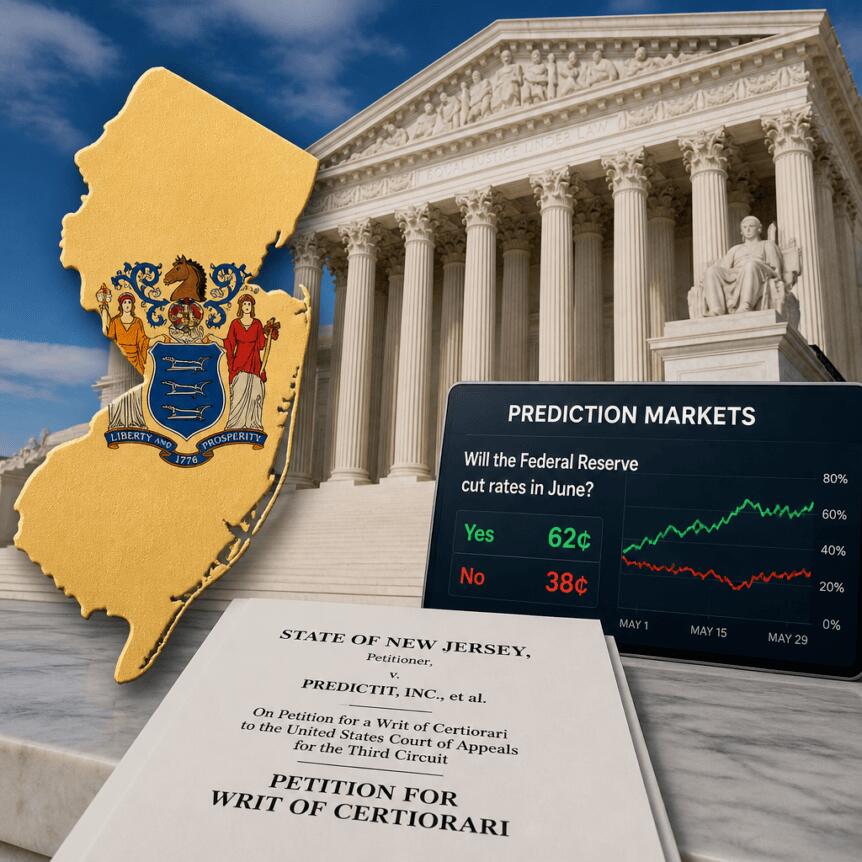
New Jersey’s Attorney General Jennifer Davenport and the state’s interim director for the Division of Gaming Enforcement, Mary Jo Flaherty, have petitioned the US Supreme Court to take up a dispute over who has the power to regulate prediction market companies.
The filing, made Wednesday, asks the nation’s highest court to decide whether federal law—specifically the 2010 Dodd-Frank Act—preempts states from enforcing their own sports betting rules against prediction market platforms that list contracts on markets registered with the Commodity Futures Trading Commission (CFTC). The case centers on New Jersey’s enforcement action against Kalshi.
Key takeaways
- New Jersey is asking the Supreme Court to rule on whether Dodd-Frank preempts state regulation of sports bets offered through CFTC-registered markets.
- The petition targets a dispute that has already been litigated through the federal courts, including an April ruling by the Third Circuit that went against New Jersey.
- New Jersey argues that if platforms can comply with the CFTC while violating state law, Congress did not intend to “immunize” the sports-betting industry from state gambling rules.
- Kalshi says it disagrees with New Jersey’s Supreme Court appeal and argues the company cannot be governed by “50 different regulators.”
- The Supreme Court’s decision—if it takes the case—could materially affect which regulators can control prediction markets in different states.
Why New Jersey wants the Supreme Court involved
In its petition, New Jersey points to its own enforcement against Kalshi over contracts tied to sporting events. According to the state’s filing, similar civil cases have been pursued by gaming authorities in “at least 20 states,” creating a patchwork of enforcement positions that New Jersey says the Supreme Court should resolve.
In a statement accompanying the move, Davenport argued that platforms like Kalshi market sports wagering as lawful across the country while refusing to follow the gambling rules of any individual state. Davenport’s remarks, as published by the New Jersey Attorney General’s office, frame the dispute as a question of whether Congress silently removed state authority from the equation.
The petition itself centers on a narrow but consequential legal question: whether the Dodd-Frank Wall Street Reform and Consumer Protection Act preempts states from regulating sports bets that fall within their jurisdictions when those bets are offered on markets registered with the CFTC.
The legal clash after the Third Circuit decision
New Jersey’s request comes after an April decision from the US Court of Appeals for the Third Circuit. In that ruling, judges voted 2-1 against New Jersey’s position, concluding that Kalshi had a “reasonable chance of success” in arguing that the CFTC’s Commodity Exchange Act preempted state law.
A key aspect of the fight described in the petition involves the CFTC’s characterization of certain prediction market contracts as “swaps,” which would place them within the agency’s regulatory scope. New Jersey’s filing disputes the idea that federal law overrides state sports-gambling rules even when markets are registered with the CFTC.
The petition also challenges the way the lower court handled the interplay between federal preemption and state enforcement, asking the Supreme Court to directly address whether states retain authority in these circumstances.
What a Supreme Court win could mean for prediction markets
New Jersey argues that the outcome could determine the legality of a wide range of sports betting activities conducted through CFTC-registered trading venues. In the Attorney General’s announcement, New Jersey highlighted the federal constraints that prohibit trading swaps off CFTC-registered markets, suggesting that if Kalshi prevails, sports wagering associated with those registered venues could be treated as illegal for any state that restricts it—even in cases where state law might otherwise allow it.
That framing reflects the broader tension at the center of the dispute: if prediction platforms are regulated under federal swap rules, then the question becomes whether states can still enforce their own licensing and gambling restrictions against them, or whether federal compliance effectively displaces state authority.
Kalshi pushes back on the appeal
Kalshi has not agreed with New Jersey’s effort to take the fight to the Supreme Court. In comments to Cointelegraph, Kalshi spokesperson Dani Lever said the company disagrees with the state’s decision to appeal and argued that prediction market platforms cannot reasonably operate under dozens of separate state regulatory regimes.
Lever said Kalshi remains confident in the lower courts’ rulings and that New Jersey’s filing does not change the company’s view of the case.
Could the Supreme Court step in soon?
Whether the Supreme Court will accept the petition is not yet known. Legal observers have speculated that justices may consider similar issues connected to prediction markets and appellate decisions in other jurisdictions, including disputes that have also reached federal courts in Nevada.
If the Supreme Court decides to take up the Kalshi dispute—or another closely related enforcement matter involving a different platform—the ruling would likely clarify which level of government can control prediction markets across state lines. Until that happens, companies and regulators may continue to face uneven enforcement, with state authorities asserting their power to apply local gambling laws and federal agencies maintaining that certain contract structures fall under CFTC oversight.
With New Jersey urging the Supreme Court to resolve the federal-versus-state regulatory question, the next key development for market participants is whether the justices grant certiorari—and, if they do, how they define the reach of Dodd-Frank preemption for CFTC-registered sports betting contracts.
https://www.cryptobreaking.com/new-jersey-asks-u-s-2/?utm_source=blogger%20&utm_medium=social_auto&utm_campaign=New%20Jersey%20Asks%20U.S.%20Supreme%20Court%20to%20Review%20Prediction%20Markets%20
Comments
Post a Comment