
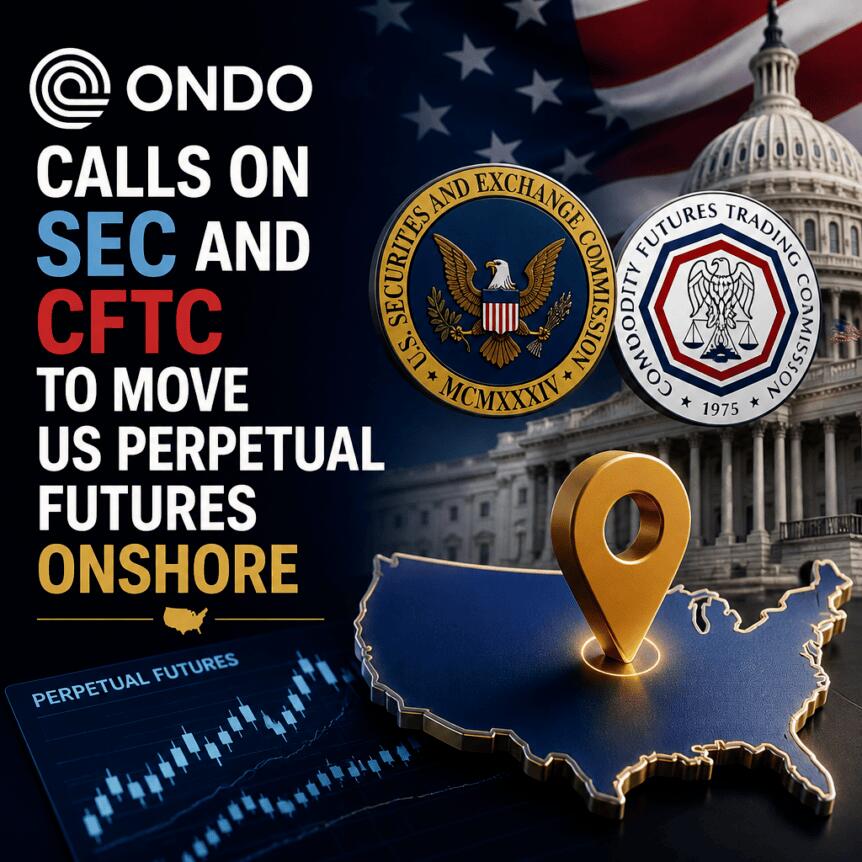
Ondo Finance is asking US regulators to bring perpetual futures tied to individual stocks onshore, arguing that the products can already fit within the country’s existing “security futures” framework rather than requiring new rulemaking. In comment letters submitted on Aug. 24 to both the Securities and Exchange Commission (SEC) and the Commodity Futures Trading Commission (CFTC), the company said that perpetual stock exposure can be structured to account for modern margining practices and the realities of onchain trading.
The proposal targets a persistent question for tokenized markets: whether crypto-linked perpetual instruments—without a traditional fixed expiration date—can still be treated as security futures products under current US definitions. Ondo’s filing also points to offshore activity as evidence that the market model is already functioning.
Key takeaways
- Ondo argues that perpetual stock futures do not need a fixed expiration date to fall under the statutory definition of a security futures product.
- According to Ondo’s filings, its stablecoin-settled perpetuals for individual US-listed stocks have already logged $8 billion in cumulative trading volume as of Aug. 14.
- Ondo says scheduled funding payments can keep perpetual contract pricing aligned with the underlying stock, serving a role comparable to expiration in traditional futures.
- The SEC and CFTC have been increasing coordination and revisiting older market rules that may not fit blockchain-native recordkeeping and tokenized securities.
Ondo’s argument: existing security futures rules can cover perpetuals
Ondo’s Aug. 24 comments were directed to the SEC and CFTC, with the company maintaining that regulators already have the tools to oversee perpetual futures tied to individual stocks within current security futures guidance. The letters argue that, with the right risk controls and market structure, the absence of a fixed expiration date should not disqualify the product from being classified as a security futures instrument.
Central to Ondo’s position is the idea that regulatory definitions for security futures do not inherently require a fixed maturity. “Nothing in the statutory definition of a security futures product requires a fixed expiration date,” Ondo wrote in its product-classification letter submitted to the SEC. The company’s filings also emphasize how margining and settlement mechanics can be adapted to modern trading environments.
Ondo further contends that funding mechanics can mimic the economic function that expiration provides in conventional futures. Instead of a contract rolling off on a specific date, scheduled funding payments are used to keep the perpetual contract’s price tied to the underlying stock—an approach commonly used in perpetual derivatives markets.
The company also highlights the operational reality that the underlying stocks for many offshore perpetual offerings are “principally traded on US exchanges.” In its view, US regulators should not treat domestic market participation as a barrier to bringing these products to regulated venues. “Bringing that activity back to the U.S. should not be an open question,” Ondo said, urging both agencies to pursue that shift.
Offshore track record is part of the compliance case
In its filings, Ondo pointed to live trading activity from a Panama-based affiliate that offers stablecoin-settled perpetual futures tied to individual US-listed stocks outside the US. Ondo said the platform recorded $8 billion in cumulative trading volume as of Aug. 14—about six weeks after the launch.
While offshore activity is not a substitute for US authorization, Ondo appears to use it as an evidentiary support for its claim that the product design can run at scale and with margining and pricing mechanisms that investors rely on. The company also provided information on its standing in tokenized real-world assets (RWA), noting that it ranks fourth among tokenized RWA managers by distributed value. According to RWA.xyz data cited in the filing, Ondo had about $2.6 billion in distributed value as of Wednesday.
Why the definition of “security futures” matters now
Ondo’s filing lands at a time when US regulators are increasingly re-examining how old market frameworks apply to onchain derivatives and tokenized securities. The SEC and CFTC have also increased public coordination on overlapping areas of oversight, including a memorandum of understanding signed in March to harmonize aspects of jurisdiction where responsibilities intersect.
On the securities side, the SEC has moved to modernize mechanisms related to tokenized markets. The agency recently proposed overhauling its transfer agent framework, citing growing demand for blockchain-native recordkeeping and tokenized securities in US markets—an acknowledgment that parts of the current infrastructure were built for traditional forms of ownership and recordkeeping.
Meanwhile, the derivatives conversation is actively evolving. In August, President Donald Trump said that CFTC Chair Michael Selig was working to bring Hyperliquid into the United States in a “fully compliant and legal fashion.” Hyperliquid is known for onchain perpetual futures, although details about how US access would be handled have not been publicly specified by the CFTC or Hyperliquid.
For Ondo, this regulatory backdrop makes its core request—bringing perpetual stock futures under a recognized oversight umbrella—more than a niche classification debate. If regulators accept Ondo’s interpretation that perpetuals can meet the statutory requirements for security futures, it could open a clearer path for other tokenized derivatives strategies to seek regulated access in the US.
What to watch next: regulatory posture and product design constraints
Ondo’s letters argue that no fundamental rewrite is required—only the application of existing security futures definitions to modern perpetual structures, including funding-based alignment to underlying assets and updated margining workflows. Still, the question for the market is whether the SEC and CFTC agree with that interpretation, and—if they do—what implementation details they will require.
Investors and builders should watch for whether regulators respond with guidance or enforcement signals that clarify classification boundaries for perpetual instruments tied to individual securities, and whether US venues will replicate or supersede offshore trading models like Ondo’s stablecoin-settled setup.
https://www.cryptobreaking.com/ondo-calls-on-sec-and/?utm_source=blogger%20&utm_medium=social_auto&utm_campaign=Ondo%20Calls%20on%20SEC%20and%20CFTC%20to%20Move%20US%20Perpetual%20Futures%20Onshore%20
Comments
Post a Comment