
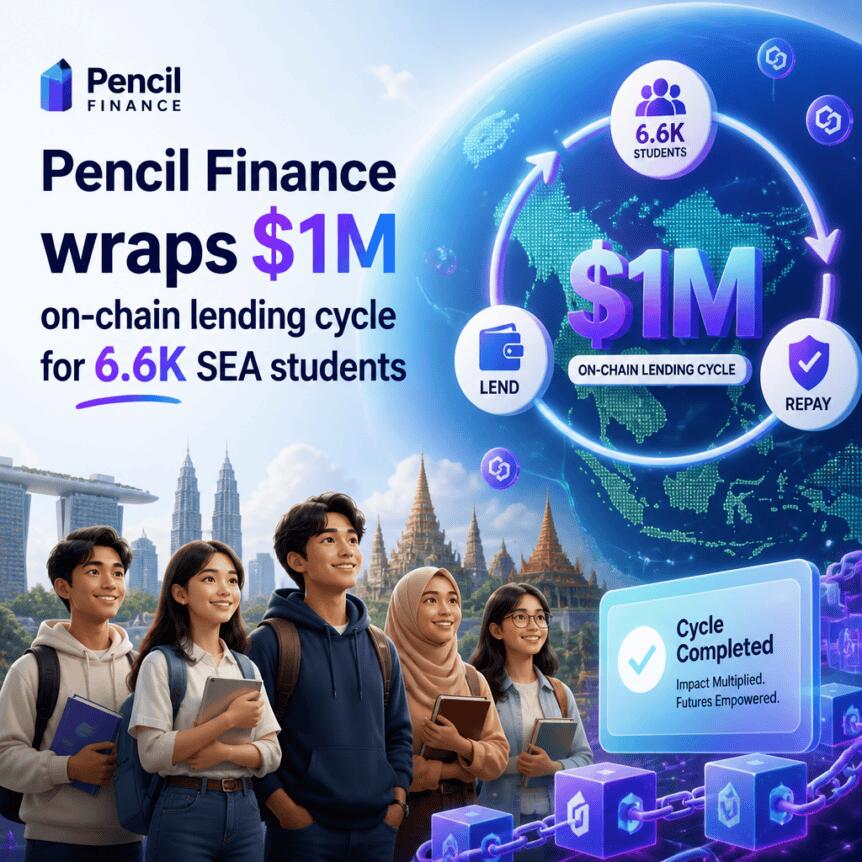
Student-loan infrastructure startup Pencil Finance says it has completed a fully onchain lending cycle worth $1 million, financing education borrowers in Southeast Asia and repaying investors via smart-contract-recorded cash flows.
In a Thursday announcement shared with Cointelegraph, Pencil described the milestone as its first “fully onchain” student loan cycle—one where the protocol deployed $1 million of lender capital on-chain and borrowers’ repayments flowed back to funders through a structured yield distribution.
Key takeaways
- Pencil Finance completed a $1 million student-loan cycle recorded on-chain, marking its first fully onchain deployment for this use case.
- The July 2025 bundle was funded by Animoca Brands, Open Campus, and New Campus, with senior fixed returns and a junior variable tranche tied to first-loss risk.
- The loans supported around 6,600 students across 118 schools and universities in Southeast Asia, with about 1,050 receiving direct funding.
- Pencil says the majority of borrowers were women (50%) and that 93% came from lower-income households—targeting students underserved by traditional lending.
- The announcement highlights growing interest in tokenized real-world assets (RWAs) for lending, including examples outside education.
How Pencil’s first onchain loan cycle worked
Pencil Finance said the protocol launched the $1 million loan cycle as an onchain bundle that functioned like a lender-to-borrower pipeline. Instead of keeping core loan accounting off-chain, the platform recorded the cycle on a blockchain network, where capital was deployed by lenders and later repaid by borrowers to distribute yield back to funders.
The project framed this as a proof point for transparency in credit: because the lending cycle is executed and tracked on-chain, investors and participants can follow the protocol’s operations through recorded transactions rather than relying entirely on traditional reporting channels.
What the tranche structure covered
According to the announcement, the $1 million bundle was funded in July 2025 by Animoca Brands, Open Campus, and New Campus. Pencil said the financing was organized into two tranches with different risk and return profiles.
The senior tranche offered fixed returns, while the junior tranche carried variable returns and bore first-loss risk. This type of waterfall structure is commonly used in tokenized and structured finance to allocate losses first to the riskiest portion of capital, potentially improving the risk profile of senior participants—while still exposing junior investors to performance variability.
Scale, eligibility, and who received support
Pencil Finance said the onchain student loan cycle financed approximately 6,600 students across 118 schools and universities in Southeast Asia. The company noted that around 1,050 of those students received direct funding under the cycle.
As for borrower demographics, Pencil reported that 50% of funded students were female and that 93% came from lower-income households. The company positioned these figures as evidence that the program is reaching applicants who are often overlooked by conventional lending, where credit access can be constrained by documentation requirements, limited credit history, or geographic and income barriers.
Notably, Pencil claimed the project is the first-ever “fully onchain” lending cycle financing student loans with transparent recording on a blockchain network—an emphasis that matters because tokenized RWA lending is still frequently debated on how transparent and auditable it truly is compared with established financial processes.
Why tokenized loans are gaining attention
Tokenized RWAs are increasingly being used to issue or collateralize loans, and Pencil’s announcement fits into a broader trend of trying to bring more of the lending lifecycle on-chain. The education-focused milestone also echoes how other markets are experimenting with onchain representations of real-world exposures.
For example, earlier coverage from Cointelegraph noted that in July, Brazil’s B3 stock exchange issued a 100,000 Brazilian reais (about $19,600) loan secured by 10 tokenized cows. In that structure, each cow was linked to a unique digital token tied to an encrypted digital identity, while AI-powered smart collars from agriculture tech company Cowmed monitored animal health.
While student loans and farm-asset-backed credit are fundamentally different, both examples point to the same underlying goal: encode key parts of credit risk and reporting into tokenized systems to improve traceability and potentially reduce the friction between traditional assets and onchain capital.
What to watch next
With Pencil Finance now pointing to a completed first fully onchain student loan cycle, the next questions for readers and potential participants are whether subsequent cycles sustain repayment performance at scale and how tranche design evolves as more borrowers—especially underserved groups—enter the system.
https://www.cryptobreaking.com/pencil-finance-wraps-1m-on/?utm_source=blogger%20&utm_medium=social_auto&utm_campaign=Pencil%20Finance%20wraps%20$1M%20on-chain%20lending%20cycle%20for%206.6K%20SEA%20students%20
Comments
Post a Comment