
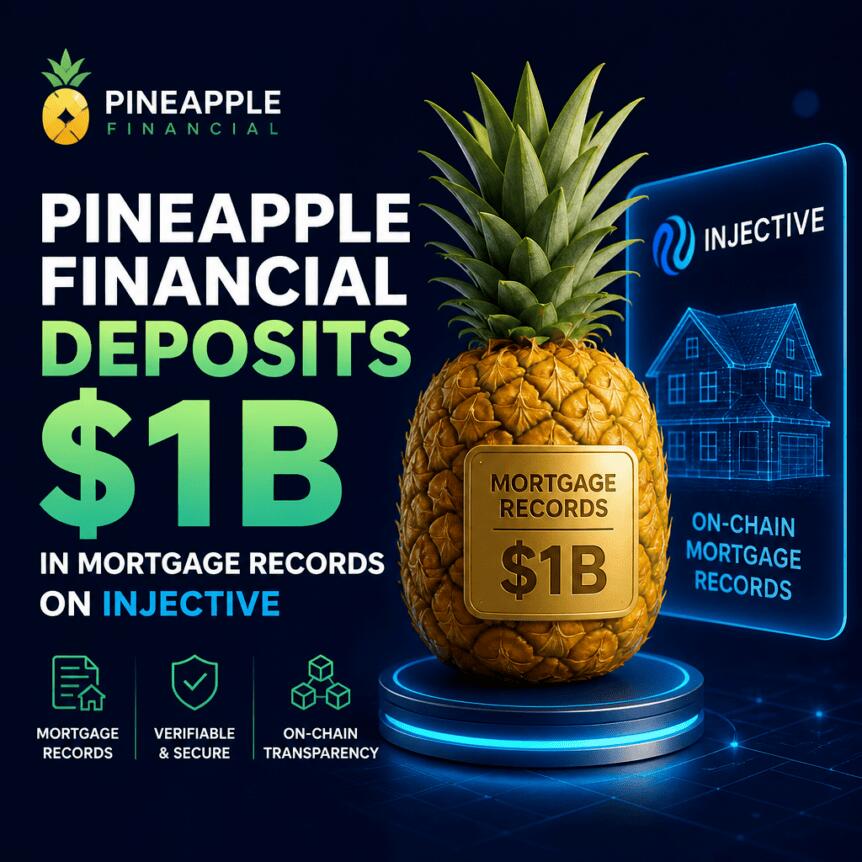
Pineapple Financial has onboarded more than $1 billion in residential mortgage records to Injective, marking a significant step in its plan to migrate a long-running mortgage portfolio onto a public blockchain network. Injective said Friday that Pineapple aims to bring more than 29,000 funded mortgages—worth over $10 billion—onto the platform over time.
Unlike many tokenization models that package loans into new securities, Pineapple’s approach centers on moving existing loan documentation into onchain “records.” Each mortgage is represented by an onchain entry linked to the underlying loan file, rather than being repackaged as a separate mortgage security.
Key takeaways
- Pineapple has migrated over $1 billion in residential mortgage records to Injective, per Injective.
- Injective says Pineapple intends to move 29,000+ funded mortgages worth $10 billion+ in total.
- Onchain mortgage records are built around 500+ loan-related data points, designed to support verification, audit trails, and risk analysis.
- PAPL0, which tracks the mortgage records on Injective, shows an asset market cap of about $1.1 billion (Token Terminal data).
- The mortgage record tokens are described as representing records, not direct ownership of the underlying loans.
How Pineapple is putting mortgages onchain
Injective framed Pineapple’s migration as part of a broader effort to move a historical loan portfolio onchain. The company said each migrated mortgage corresponds to an onchain record tied to the underlying loan file, with the structure intended to preserve the relationship between onchain data and the original loan documentation.
Injective also highlighted the data depth of the system: the records reportedly include more than 500 data points spanning loan-level information. In practical terms, that level of detail can be useful for building auditability and enabling risk analysis directly around the referenced mortgage file—capabilities that would be harder to achieve if only minimal metadata were stored onchain.
As of the latest update, Pineapple’s dashboard shows the program includes 2,079 mortgage records, compared with 1,259 when the migration initiative began in December 2025. That jump underscores that the project is not limited to a pilot dataset, but is expanding into larger portions of the mortgage book.
PAPL0 growth and what the token actually represents
On Injective, Pineapple’s onchain mortgage record tracking is associated with PAPL0. According to Token Terminal data, PAPL0 has an asset market cap of roughly $1.1 billion, up 48.2% over the past nine months.
Token Terminal’s project page describes PAPL0 as a vehicle tied to mortgage records on Injective. Importantly, the token is presented as representing the mortgage records themselves—not ownership of the underlying loans. That distinction matters for investors and counterparties evaluating what economic exposure they’re actually getting: record ownership and tokenized loan exposure are not always the same thing in real-world asset (RWA) designs.
Injective and Pineapple: beyond the migration
The mortgage records migration also sits within a broader relationship between Pineapple and Injective. Injective said the partnership includes a separate $100 million Injective (INJ) digital asset treasury. Within that arrangement, Pineapple reportedly stakes INJ from the treasury, and Kraken serves as a primary validator for the holdings.
That setup highlights a common challenge in onchain finance: moving RWAs is not only about tokenizing assets, but also about operational infrastructure such as staking, validation, and the ongoing management of blockchain-based holdings that support the tokenized system.
Real estate tokenization is widening—but remains niche
Mortgage record tokenization is part of a broader push to bring traditionally illiquid real estate and related investment interests onto blockchain networks. The central promise remains similar across projects: tokenization can make it easier to divide interests, transfer them, and provide more transparent access to certain asset-related information.
Recent coverage across the sector points to momentum in other formats as well. In June, Apex Group joined Goldman Sachs, Archax, and LRC Group on a tokenized real estate fund where shares are issued as digital tokens through Goldman Sachs’ Digital Asset Platform. In Dubai, tokenization efforts have also expanded: the Dubai Land Department launched a second phase of a pilot after about $5 million in property had been tokenized, with transactions recorded on the XRP Ledger, according to earlier reporting.
Still, the scale of tokenized real estate remains small compared with the overall RWA market. RWA.xyz data referenced in the article estimates tokenized real estate at about $226.5 million in distributed value, up 11.7% over the past 30 days, versus roughly $38.8 billion across tokenized RWAs tracked by RWA.xyz.
For market participants, this imbalance suggests a key tension in the RWA narrative: while real estate continues to attract serious experimentation, adoption and capital allocation across the broader tokenized assets space are happening faster elsewhere.
Going forward, the key question for readers is whether Pineapple’s approach—using rich loan-level records tied to underlying files, rather than repackaging mortgages into new securities—can sustain scaling beyond early migration milestones. The pace of record onboarding (2,079 currently, versus 1,259 at launch in December 2025) will likely be a close signal to watch as the project progresses toward its stated goal of 29,000+ funded mortgages.
https://www.cryptobreaking.com/pineapple-financial-deposits-1b-in/?utm_source=blogger%20&utm_medium=social_auto&utm_campaign=Pineapple%20Financial%20Deposits%20$1B%20in%20Mortgage%20Records%20on%20Injective%20
Comments
Post a Comment