
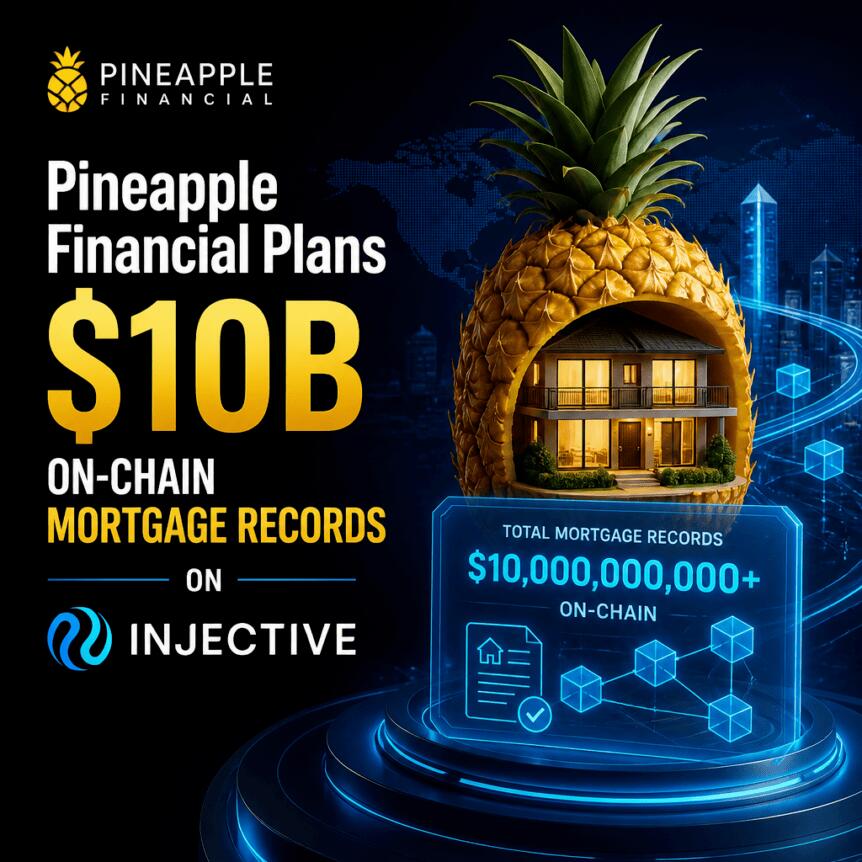
Pineapple Financial says it has migrated more than $1 billion of residential mortgage records onto Injective, marking a significant step in its plan to move a large portion of its funded loan portfolio onchain.
Injective announced Friday that Pineapple expects to eventually migrate over 29,000 funded mortgages worth more than $10 billion to the network. The approach is designed to keep each mortgage tied to its underlying loan file through an onchain record, rather than repackaging loans into a new mortgage security.
Key takeaways
- Pineapple Financial reports moving more than $1 billion in mortgage records onto Injective as part of an onchain migration of its existing portfolio.
- Injective says Pineapple plans to bring over 29,000 funded mortgages worth more than $10 billion onto the network.
- Each mortgage is represented by an onchain record with more than 500 data points to support verification, audit trails, and risk analysis.
- Token Terminal data indicates the PAPL0 asset market cap is about $1.1 billion, reflecting mortgage-record tokens rather than direct ownership of the underlying loans.
How Pineapple is tokenizing mortgages on Injective
Injective’s update frames the migration as a way to digitize and operationalize mortgage data on a layer-1 network built for financial applications. According to the company, Pineapple’s onchain records are linked to the underlying loan file, aiming to avoid creating a wholly new mortgage instrument in the process.
Each mortgage record includes more than 500 data points. Injective characterizes the dataset as intended for verification and audit workflows, as well as risk analysis that depends on having granular, loan-level information available in a consistent format.
Pineapple’s own dashboard, referenced by Injective, shows the initiative has expanded since it began in December 2025. The migration now includes 2,079 mortgage records, up from 1,259 at the time the effort launched.
What PAPL0 represents and why the structure matters
Token Terminal tracks PAPL0 as an asset associated with the mortgage records on Injective. The data cited in the announcement places PAPL0’s asset market cap at about $1.1 billion, up 48.2% over the past nine months, according to Token Terminal figures.
Crucially, Token Terminal’s project framing (as described in the original material) indicates that the tokens are meant to represent mortgage records, not ownership of the underlying loans themselves. That distinction is important for investors and counterparties trying to understand what is actually being transferred or referenced when token balances change—particularly in real-world asset (RWA) systems where legal ownership, servicing rights, and data integrity may not always map neatly onto token mechanics.
For market participants evaluating RWAs, this record-based model may also influence how due diligence is performed. Instead of relying on tokens as a proxy for the full legal construct of a mortgage, the onchain record is positioned as a structured data layer—potentially improving traceability and audit readiness.
Pineapple’s broader Injective ties and onchain treasury
The mortgage-record migration is part of a wider relationship between Pineapple and Injective. The material also points to a separate digital asset treasury connected to Injective’s native token, INJ, with Pineapple described as having a $100 million Injective treasury.
As part of that setup, Pineapple stakes INJ from the treasury. Kraken is named as a primary validator for the holdings, tying the arrangement to established institutional infrastructure for validating network activity.
Real estate tokenization continues, but remains small
The move sits within a broader push to bring real estate and other traditionally illiquid assets onto blockchains. Tokenization is often marketed as a way to divide interests, improve transferability, and broaden access—but the pace of adoption still varies widely by asset type and jurisdiction.
Earlier this year, several major finance players were highlighted in connection with tokenized real estate fund structures. In June, Apex Group joined other firms—including Goldman Sachs, Archax, and LRC Group—in a tokenized real estate fund effort where fund shares are issued as digital tokens through Goldman Sachs’ Digital Asset Platform. In that structure, blockchain-based ownership is used for the fund shares themselves, rather than simply recording property-related information onchain.
Dubai has also expanded its tokenized real estate initiatives. The reporting referenced that in February, the Dubai Land Department launched a second phase of a pilot after roughly $5 million in property had been tokenized, with transactions recorded on the XRP Ledger.
Still, despite recurring announcements, tokenized real estate appears to be only a small slice of the overall RWA ecosystem. The figures cited in the source state that the sector has about $226.5 million in distributed value, up 11.7% over the past 30 days. This is contrasted with approximately $38.8 billion across tokenized RWAs tracked by RWA.xyz.
What to watch next
With Pineapple increasing the number of onchain mortgage records and Injective targeting a scale-up to more than 29,000 mortgages worth over $10 billion, the key question for the next phase is how this record-based model performs in practice—especially around verification workflows, auditing, and how market participants interpret the relationship between tokenized records and the legal rights attached to the underlying loans.
https://www.cryptobreaking.com/pineapple-financial-plans-10b-on/?utm_source=blogger%20&utm_medium=social_auto&utm_campaign=Pineapple%20Financial%20Plans%20$10B%20On-Chain%20Mortgage%20Records%20on%20Injective%20
Comments
Post a Comment