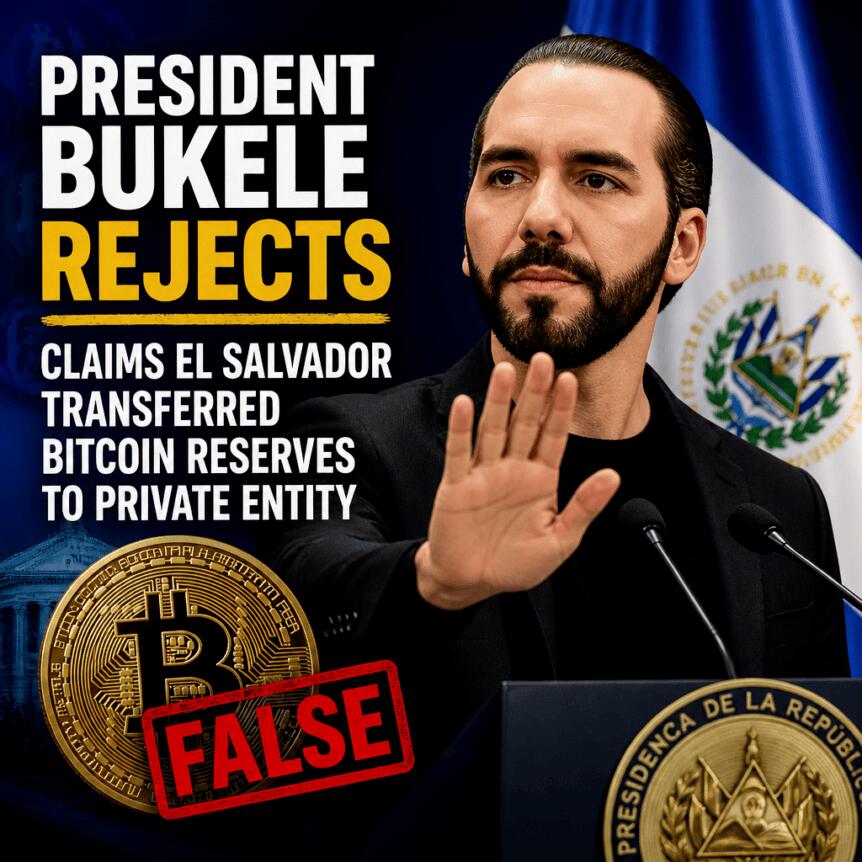
President Bukele Rejects Claims El Salvador Transferred Bitcoin Reserves To Private Entity


El Salvador President Nayib Bukele has rejected reports that the country transferred its Strategic Bitcoin Reserve to a private operator as part of its agreement with the International Monetary Fund (IMF).


The denial came after the IMF reached a preliminary agreement with El Salvador that will unlock $140 million in additional funding under a broader $1.4 billion financing program.


Bukele said the transaction involved shares in the government’s Chivo wallet rather than the country’s Bitcoin holdings, pushing back against reports that the reserve itself had been handed to a private entity.


Key Takeaways


  • Nayib Bukele says El Salvador did not transfer its Strategic Bitcoin Reserve to a private operator.

  • The president said only shares in the Chivo wallet were transferred.

  • The IMF has agreed to release another $140 million as part of its $1.4 billion program with El Salvador.

  • The country’s Bitcoin holdings have risen from about 6,224 BTC in June 2025 to more than 7,764 BTC.

  • The IMF says recent growth in the reserve came from private donations rather than government spending.


Bukele Draws a Line Between Chivo and El Salvador’s Bitcoin Reserve


Bukele responded to reports about the transfer on Friday, saying the government had not handed over control of its strategic Bitcoin holdings.


“The only thing that was transferred were Chivo’s shares ... and NOT the Strategic Bitcoin Reserve,” Bukele said in a post on X.

https://x.com/nayibbukele/status/2096018188454568034

The comments came shortly after the IMF outlined changes involving El Salvador’s state-backed Chivo wallet. The Fund said majority ownership and operational control of the wallet had been transferred to a private operator.


The government, however, continues to hold a minority stake and retains responsibility for the custody of customer assets.


The distinction is important because Chivo and the Strategic Bitcoin Reserve represent separate parts of El Salvador’s cryptocurrency strategy.


El Salvador’s Bitcoin Holdings Continue to Attract Attention


El Salvador became the first country to adopt Bitcoin as legal tender in 2021, introducing it alongside the US dollar. The policy later became a central issue in negotiations with the IMF.


The government removed Bitcoin’s legal tender status in January as part of the conditions surrounding the IMF program.


Despite the policy changes, El Salvador’s Bitcoin holdings have continued to increase. The country’s reserve stood at around 6,224 BTC at the end of June 2025 and has since risen to more than 7,764 BTC.


That represents an increase of roughly 1,540 BTC.


The size of the increase has raised questions because Salvadoran officials have continued to promote the idea of adding one Bitcoin per day to the national reserve.


IMF Says Recent Bitcoin Growth Came From Donations


Meanwhile, the
https://www.cryptobreaking.com/president-bukele-rejects-claims-el/?utm_source=blogger%20&utm_medium=social_auto&utm_campaign=President%20Bukele%20Rejects%20Claims%20El%20Salvador%20Transferred%20Bitcoin%20Reserves%20To%20Private%20Entity%20

Comments

Popular posts from this blog

Mastercard Launches AI Agent Pay System With Ripple and Solana Help

Mastercard has launched Agent Pay for Machines, a payments system built for autonomous software agents. The service allows AI agents to send and receive payments without direct human action. It brings Ripple, Coinbase, and Solana Foundation into Mastercard’s push for automated digital commerce. Ripple Brings XRPL and RLUSD to Mastercard’s Agent Pay System Mastercard introduced Agent Pay for Machines on June 10 as a tool for machine-led payments. The system targets high-volume and low-value transactions across business and consumer use cases. It also supports automated settlement between software agents and connected machines. Ripple will support the system through the XRP Ledger and its RLUSD stablecoin. The company said that settlement will become more important as automated commerce grows. It also sees blockchain rails as useful for fast and rule-based payments. RippleX senior vice president Markus Infanger said XRPL and RLUSD support enterprise-grade agent payments. He said the tool...

Top Cryptocurrencies to Watch: BTC, ETH, BNB, XRP, Solana, Dogecoin & More

Market Analysis and Price Predictions for Key Cryptocurrencies Recent market dynamics reveal a cautious sentiment across the cryptocurrency landscape, with Bitcoin struggling to maintain levels above $90,000 and many major altcoins facing downward pressure. Indicators point toward reduced participation from both institutional and retail investors, raising concerns about a potential consolidation phase after notable gains earlier in the year. Bitcoin has fallen below $87,000, reflecting waning demand at higher price points. Institutional fund flows into BTC and ETH ETFs have turned negative, indicating a period of subdued market activity. Active addresses and Binance deposit/withdrawal activities are at annual lows, suggesting market indecision. Most leading altcoins are approaching support levels, with some poised for potential breakdowns. Tickers mentioned: Bitcoin, Ethereum, Binance Coin, XRP, Solana, Dogecoin, Cardano, Bitcoin Cash, Chainlink, Hyperliquid Sentiment: Neutral to Sli...

Solana Policy Institute Calls on SEC to Safeguard DeFi Developers from Overly Strict Regulations

US Crypto Policy Innovation: Advocates Push for Clear Regulations and Developer Protections The Solana Policy Institute has urged the U.S. Securities and Exchange Commission (SEC) to differentiate between centralized crypto exchanges and non-custodial decentralized finance (DeFi) software. The nonprofit emphasizes that developers creating and publishing non-custodial code should not be classified as intermediaries, advocating for balanced regulation that fosters innovation without compromising security or legality. Key Takeaways Advocates call for regulatory clarity distinguishing between non-custodial DeFi protocols and centralized exchanges. The Institute argues that applying traditional securities laws to DeFi code risks stifling innovation and pushing activity offshore. Authorities are encouraged to adopt a custody-and-control-based framework to clarify legal liabilities. Legislation proposals aim to shield developers from legal liabilities associated with blockchain code and activ...