
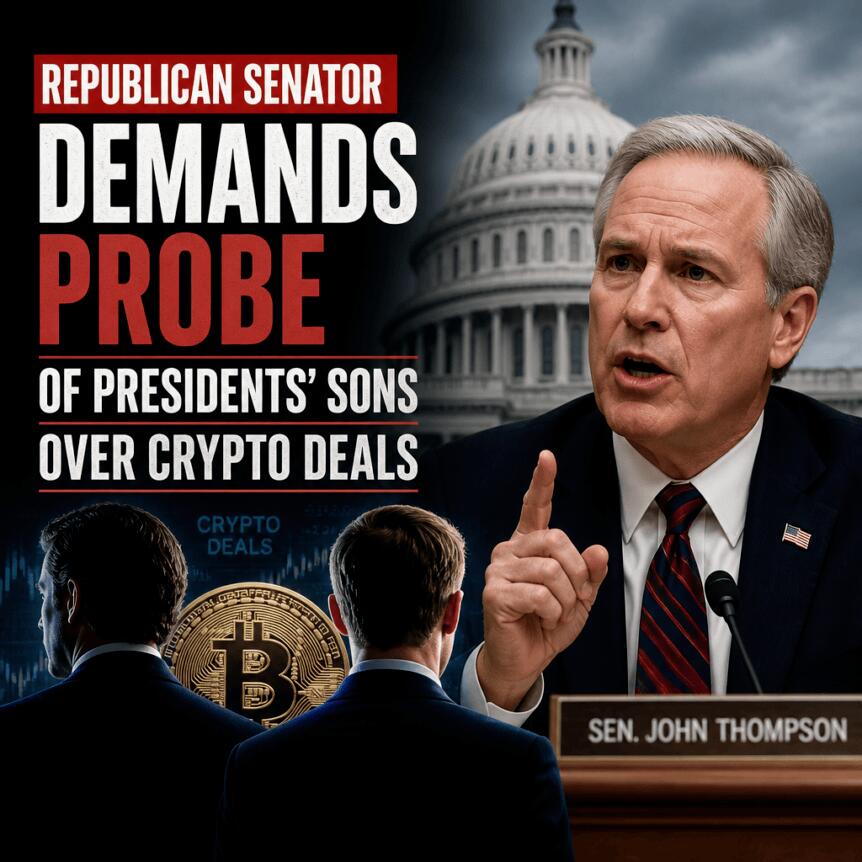
Republican Senator John Curtis of Utah has asked the U.S. Senate Judiciary Committee to investigate whether the sons of President Donald Trump and former President Joe Biden used their family ties to obtain private financial benefits—an inquiry that Curtis says should include subpoenas for Donald Trump Jr. and Hunter Biden.
In a Monday letter to Senate Judiciary Committee Chair Chuck Grassley and ranking member Dick Durbin, Curtis argued that lawmakers should probe “the use of presidential family relationships for private financial benefit, preferential treatment, or access by domestic and foreign interest.” The Utah senator’s request centers heavily on alleged cryptocurrency-related activity involving Trump Jr., while also citing Hunter Biden’s international business dealings.
Key takeaways
- Sen. John Curtis urged the Senate Judiciary Committee to investigate whether presidential family relationships were used for private financial gain.
- Curtis asked for subpoenas for Donald Trump Jr. and Hunter Biden, citing specific concerns tied to cryptocurrency ventures and foreign business.
- Trump Jr. was singled out for accepting gifts reportedly linked to Russian oligarch Umar Kremlev and for promoting family-backed crypto initiatives.
- The call for inquiry comes after Senate Republicans failed to move the Digital Asset Market Clarity Act despite Democrats’ objections.
- Democrats have tied broader crypto policy disputes to concerns that the presidency could be leveraged for profit through digital-asset businesses.
A Judiciary probe focused on family ties and crypto exposure
According to the letter, Curtis wants the committee to examine whether ethics, disclosure, or anti-corruption laws apply to conduct involving Trump Jr. and Hunter Biden. He emphasized that the objective should be to establish facts, determine legal applicability, and identify reforms needed to prevent the presidency from becoming a pathway to private enrichment.
Curtis specifically pointed to Donald Trump Jr.’s actions, including his acceptance of gifts from Umar Kremlev as part of his wedding. The senator also cited what he described as Trump Jr.’s “active promotion of family-backed cryptocurrency ventures” and advisory roles connected to prediction market platforms—entities that, according to Curtis, fall under the regulatory authority of the U.S. Commodity Futures Trading Commission.
Last week, President Trump said that his son repaid Kremlev for what Trump Jr. and his wife described as a “generous wedding gift.” Curtis’s request builds on that broader narrative by asking whether the underlying relationship and crypto involvement warrant formal scrutiny.
Hunter Biden: foreign business and the role of presidential proximity
Curtis also asked for a similar probe into Hunter Biden. His letter frames the request around “substantial business with foreign entities” and instances where, Curtis argued, either man’s relationship to the presidency was “invoked or understood to provide value.”
The letter notes that Joe Biden issued a pardon for Hunter Biden in December 2024 for crimes he “committed or may have committed or taken part in over the last decade.” Curtis also referenced Hunter Biden’s prior denials that his father was involved in his business dealings.
While Curtis’s focus is on potential misuse of access or preferential treatment, the request implicitly raises a question that extends beyond any single prosecution: whether existing rules are sufficient to address situations in which family members operate in sensitive sectors while their proximity to the White House or a former administration may influence outcomes.
Crypto regulation debate heightens as clarity legislation stalls
Curtis’s letter arrives amid an ongoing political dispute over U.S. digital-asset oversight. A week earlier, Senate Republicans failed to secure enough support from Democrats to pass the Digital Asset Market Clarity Act—legislation described as intended to establish market structure rules for the crypto industry.
In coverage cited in the article, some Democrats argued against the bill on the grounds that Trump was “using crypto to turn the presidency into a profit generating machine.” The argument references the broader concern that digital-asset activity connected to the president could raise conflict-of-interest issues that statutory ethics provisions may not adequately address.
Republicans said the president had agreed to stronger ethics provisions related to his crypto investments before the vote. Still, Democrats contended that the proposed measures did not go far enough to prevent corruption.
The tension highlights an asymmetry: while the legislation aimed to create regulatory clarity for the market, the political debate has also become a referendum on how lawmakers view the connection between crypto business activity and the presidency itself.
What to watch next
For investors and builders, the practical question is whether a Judiciary Committee inquiry will lead to new subpoenas, targeted disclosures, or recommendations for ethics enforcement—outcomes that could affect compliance planning and the perceived legitimacy of crypto-related public affairs. The scope of any investigation, and whether it meaningfully intersects with pending regulatory reforms, remains the key uncertainty.
https://www.cryptobreaking.com/republican-senator-demands-probe-of/?utm_source=blogger%20&utm_medium=social_auto&utm_campaign=Republican%20Senator%20Demands%20Probe%20of%20Presidents’%20Sons%20Over%20Crypto%20Deals%20
Comments
Post a Comment