
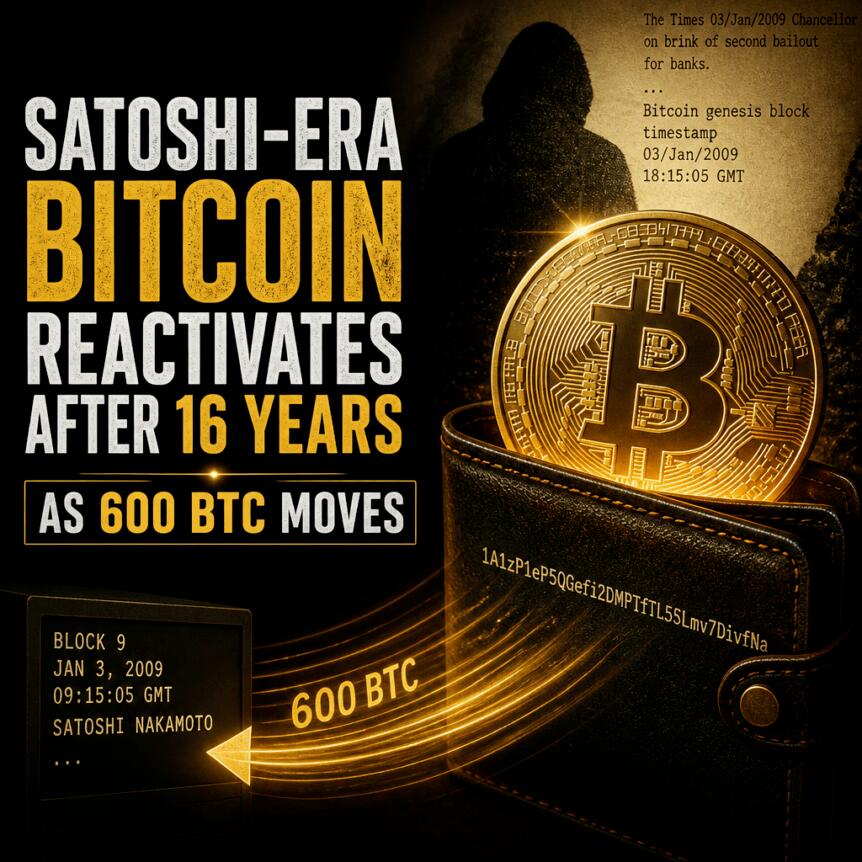
Coins mined in Bitcoin’s earliest era have finally stirred after more than 16 years of inactivity, prompting fresh speculation that they could be tied to Satoshi Nakamoto. According to on-chain analysis highlighted by Cointelegraph, 12 dormant Bitcoin addresses collectively moved 600 BTC on Saturday—an amount currently valued around $48 million.
While the timing has fueled “Satoshi-era” narratives, Whale Alert’s research claims it found no evidence linking the transactions to Nakamoto. The platform says the moved funds trace back to block rewards earned during March 2010, when Satoshi was still actively involved with the project’s early development and communications—before gradually stepping back.
Key takeaways
- On-chain data reviewed by Cointelegraph shows 12 Bitcoin addresses moved a total of 600 BTC after more than 16 years of dormancy.
- Whale Alert traced the 600 BTC to mining rewards paid across 12 Bitcoin blocks in March 2010, each originally issued as a 50 BTC subsidy.
- Whale Alert says none of those blocks can be connected to Satoshi Nakamoto based on its analysis.
- Prior work by Whale Alert covered only seven of the rewards, while Lookonchain had earlier identified seven miner wallets moving 350 BTC.
- The fact that the coins were mined while Nakamoto was still involved is driving attention—but “same era” is not the same as “same owner.”
Early blocks, long dormancy, and a sudden wake-up
The renewed activity centers on a cluster of very old wallets that had not shown movement for over a decade and a half. Cointelegraph reports that 12 addresses collectively moved 600 BTC after more than 16 years. Whale Alert, a blockchain transaction tracking platform, said the amount originated from rewards mined across 12 distinct Bitcoin blocks.
For investors and on-chain observers, these kinds of “awakening” events matter because they can create a brief narrative spike: dormant supply can look like potential future sell pressure, even when no immediate market impact is confirmed. In this case, the key question is not just that the coins moved, but where they came from—and who may have controlled them.
Whale Alert told Cointelegraph that its research did not find a link between the mined blocks and Nakamoto. This point is important: speculation often increases when activity occurs during a period associated with Nakamoto’s involvement, but attribution claims require more than chronology.
Whale Alert expands its tracing from seven to twelve rewards
Whale Alert’s updated work reportedly traces all 12 block rewards to Bitcoin blocks mined in March 2010. At that time, the protocol paid a 50 BTC block subsidy per block. Since then, the subsidy has been reduced repeatedly through halvings; the most recent reduction referenced in the report came in April 2024, when the block subsidy fell from 6.25 BTC to 3.125 BTC per block.
The analysis also builds on Whale Alert’s earlier effort. Cointelegraph notes that Whale Alert had previously examined seven of the rewards and said it identified those blocks as not mined by Nakamoto. In the updated accounting, Whale Alert now extends its tracing to cover the remaining five rewards as well.
Independent on-chain analytics had already surfaced part of the story. Cointelegraph says Lookonchain initially identified seven miner wallets that moved 350 BTC after 16.5 years of inactivity, attributing the funds to mining activity in March 2010. Taken together, the different layers of analysis underscore a consistent theme: these were mining rewards from early blocks—not some later token swap or unrelated transfer.
Why “Satoshi-era” is a tempting narrative—and a weak proof
The movement drew attention largely because March 2010 sits squarely in the period when Satoshi Nakamoto was still active in Bitcoin development and communications. Cointelegraph points to Nakamoto’s involvement continuing through 2010, with the last known communication dating to April 2011.
However, the editorial distinction here matters: “mined during the time Nakamoto was around” does not automatically mean “controlled by Nakamoto.” Whale Alert’s spokesperson emphasized that none of the blocks associated with the 12 rewards could be connected to Nakamoto based on its research.
Cointelegraph also reports a behavioral detail that further complicates simple attribution. Whale Alert said one of the rewards moved several blocks before most of the others, suggesting the early transfer pattern could align with a test transaction preceding the rest of the movements. In other words, even if multiple rewards originate from the same month and subsidy era, the way the coins were handled over time may reflect operational behavior rather than a single, easily identifiable owner.
What to watch next after these long-dormant transfers
When ancient Bitcoin moves, the immediate on-chain fact is clear—coins changed hands from addresses that had been silent for years. What remains uncertain is the economic intent behind the transfers: whether these movements represent consolidation, internal housekeeping, or preparations that could later involve liquidation.
For readers monitoring these developments, the most practical next step is to track where the 600 BTC ultimately flows after the initial movement, and whether any portion returns to new dormant addresses or heads toward exchanges. The “Satoshi” question may remain speculative without stronger evidence, but the real signal for market participants will be the downstream path of the coins and how quickly—if at all—the revived supply reaches liquidity.
https://www.cryptobreaking.com/satoshi-era-bitcoin-reactivates-after/?utm_source=blogger%20&utm_medium=social_auto&utm_campaign=Satoshi-Era%20Bitcoin%20Reactivates%20After%2016%20Years%20as%20600%20BTC%20Moves%20
Comments
Post a Comment