
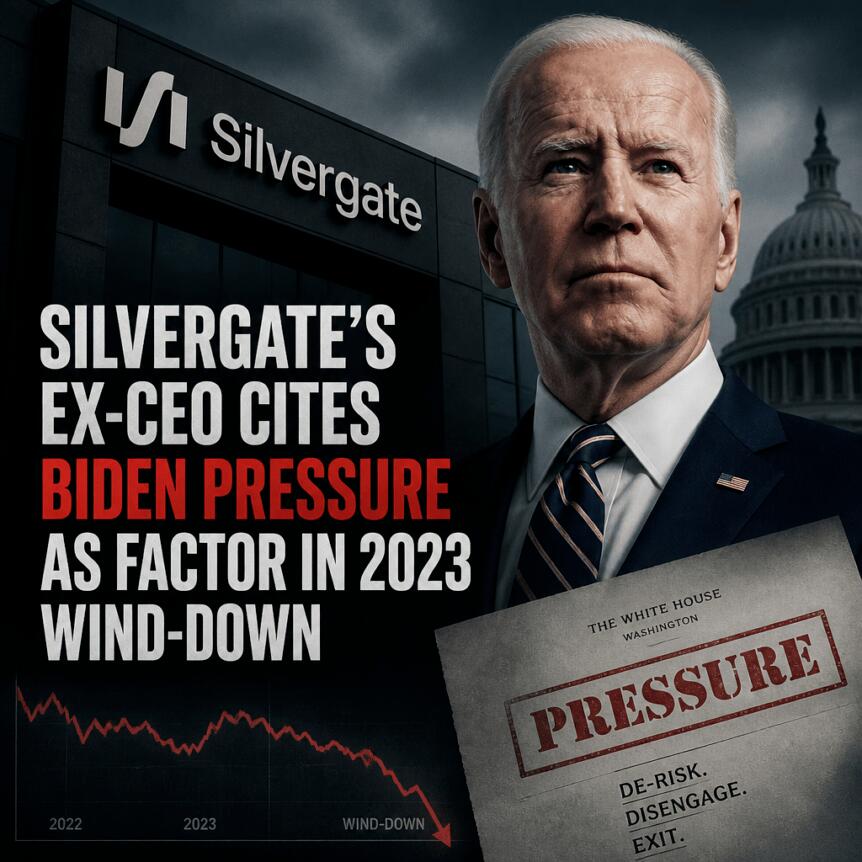
Former Silvergate Bank CEO Alan Lane says the bank’s 2023 voluntary wind-down was driven less by internal weaknesses and more by political and regulatory pressure, arguing that Silvergate remained solvent after meeting withdrawal demands in late 2022.
In an inaugural post on his Substack published Tuesday, Lane claimed Silvergate could have continued operating after satisfying withdrawals equal to 70% of its demand deposits during the fourth quarter of 2022, and he characterized the decision to liquidate as a response to “political pressure” rather than an inability to access liquidity.
Key takeaways
- Lane argues Silvergate had sufficient liquid resources to withstand heavy withdrawals in Q4 2022 and that liquidation followed political pressure.
- Federal regulators’ accounts emphasize different causes, pointing to concentrated crypto deposits, funding and governance risks, and compliance shortcomings.
- Lane disputes claims that regulators proved Silvergate’s anti-money laundering (AML) controls failed, even as enforcement actions followed.
- The SEC alleged failures in monitoring certain high-volume transaction flows tied to FTX entities; the case resulted in a settlement without admitting or denying wrongdoing.
- Regulatory guidance on crypto issued in 2023 was later withdrawn in April 2025, adding another layer to the debate over pressure versus policy.
Lane’s liquidity argument and the Q4 2022 numbers
Lane’s core claim is that Silvergate’s balance sheet gave it options even amid stress. He said the bank had held liquid assets that could be sold or pledged as collateral as withdrawals accelerated.
He also pointed to Silvergate’s own January 2023 business update, which reported a sharp contraction in digital asset-related deposits during the fourth quarter of 2022. According to the update, digital asset deposits fell 68% from $11.9 billion to $3.8 billion over the quarter.
In that same update, Silvergate said it sold $5.2 billion of debt securities and recorded a $718 million loss. The bank reported $4.6 billion in cash and equivalents at year-end. Lane’s Substack post uses these figures to support the argument that the bank had liquidity capacity and therefore did not necessarily face unavoidable collapse at that stage.
Still, Lane’s narrative directly challenges the dominant regulator view that Silvergate’s issues were structural—rooted in how quickly its funding base eroded, how its risk controls were implemented, and how governance handled the rapidly changing environment.
What regulators said instead: governance, risk management, and compliance
A September 2023 review by the Federal Reserve Board’s Office of Inspector General concluded that Silvergate’s reliance on crypto depositors, its rapid growth, and multilayered funding risks contributed to its liquidation. The review also cited weaknesses in corporate governance and risk management, and said supervisory actions could have been more aggressive and decisive.
That assessment contrasts with Lane’s position that the wind-down was not evidence of a solvency crisis driven by internal failure. Lane said he had not seen a regulator demonstrate that Silvergate’s AML program had been proven to be ineffective.
The regulatory record he referenced is more complicated. After the bank’s winding down, the SEC moved to enforce against Silvergate Capital and its leadership. In July 2024, the SEC charged Silvergate Capital, Alan Lane, and former chief risk officer Kathleen Fraher with misleading investors about the bank’s AML program and monitoring of crypto customers.
Per the SEC’s allegations, Silvergate’s automated system did not monitor more than $1 trillion in transactions, and the bank allegedly failed to detect nearly $9 billion in suspicious transfers among FTX entities.
Enforcement outcomes and the stakes for the crypto-banking debate
Lane said he settled rather than contested the SEC’s case. According to the reporting linked in the source material, Lane settled the charges without admitting or denying wrongdoing, agreeing to a $1 million penalty and a five-year officer-and-director bar.
Separately, the Federal Reserve fined Silvergate $43 million over transaction-monitoring deficiencies. Those actions, while not identical in scope to the Office of Inspector General review, reinforce the regulator emphasis on compliance and monitoring failures rather than solely on funding concentration.
For investors and market participants tracking whether banking access to crypto is shrinking due to policy pressure, the Silvergate dispute has become a proxy for a larger question: was the outcome primarily caused by crypto-adjacent funding volatility, or by how risk management and controls were applied to that business model?
Lane’s Substack intervention matters because it adds a first-person account that highlights a timeline in which the bank still had liquidity tools available and depositors withdrew only up to a point that Lane says could have been managed without liquidation.
Policy guidance, then withdrawal: did “pressure” shift bank behavior?
Lane also pointed to interagency statements about crypto risk that were issued in early 2023. He cited them as evidence that US regulators were applying pressure to banks operating in crypto-adjacent markets.
According to the source material, those statements urged banks to take a cautious approach to crypto-related activities. However, the Federal Reserve said institutions were not prohibited from serving any specific customer class and were not discouraged in a way that barred particular types of relationships.
In April 2025, government agencies withdrew the statements. That development is significant to the broader debate because it suggests the guidance—at least as originally formulated—was not meant to remain authoritative indefinitely.
Lane’s argument is therefore best understood as a claim about decision-making under regulatory uncertainty: even if regulators did not formally ban banks from serving crypto clients, he argues that the tone and direction of policy encouraged a conservative posture that became difficult to reverse as deposit pressures intensified.
As the debate continues, readers should watch whether further details emerge from Lane’s account that directly address the regulator findings on monitoring and governance, and whether regulators provide clearer guidance on how banks can balance crypto services with demonstrable controls—particularly now that the earlier 2023 crypto-risk statements have been withdrawn.
https://www.cryptobreaking.com/silvergates-ex-ceo-cites-biden/?utm_source=blogger%20&utm_medium=social_auto&utm_campaign=Silvergate’s%20ex-CEO%20cites%20Biden%20pressure%20as%20factor%20in%202023%20wind-down%20
Comments
Post a Comment