
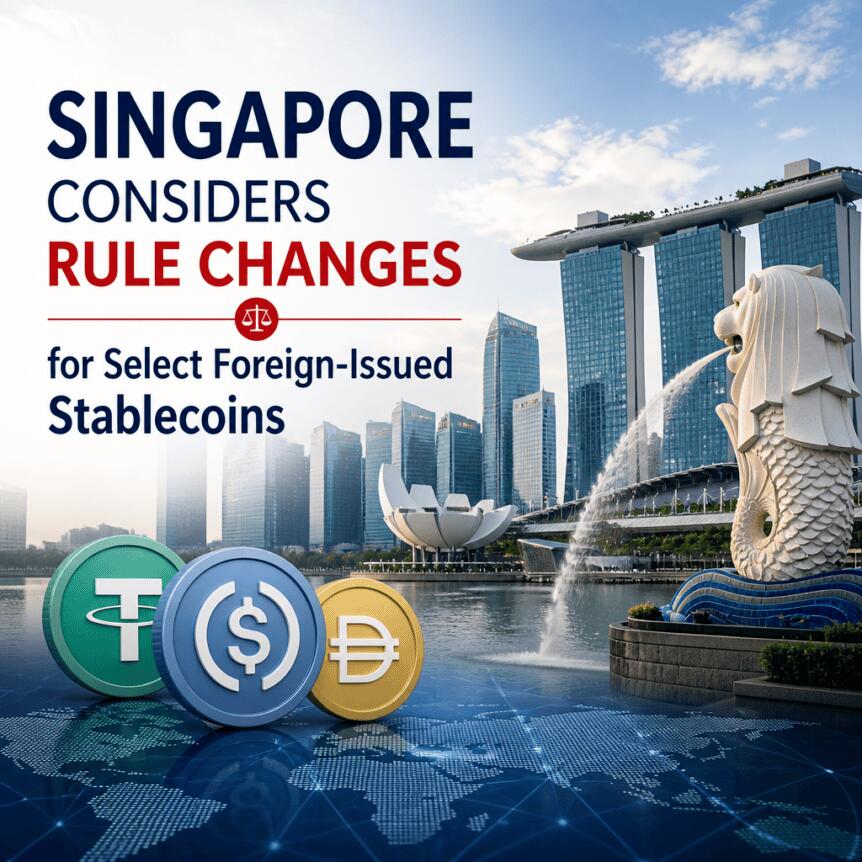
The Monetary Authority of Singapore (MAS) has moved to revisit a key element of its stablecoin regime, proposing changes that would allow some stablecoins connected to multiple jurisdictions to fall under Singapore’s regulatory framework. The development arrives through a new public consultation on amendments to the Payment Services Act (PSA) and associated policy adjustments.
In a consultation opened Tuesday, MAS said it is considering a pathway for “jointly issued” stablecoins—issued by a Singapore entity together with a foreign issuer—to qualify as “MAS-regulated stablecoins” if risks are adequately addressed. The regulator is also exploring whether a limited number of foreign-issued stablecoins could be recognized under similar overseas rules, particularly for cross-border wholesale usage.
Key takeaways
- MAS is consulting on PSA amendments to implement its stablecoin framework and reflect policy developments since 2023.
- Jointly issued stablecoins (Singapore + foreign issuer) could qualify as “MAS-regulated stablecoins” if MAS-set risk conditions are met.
- MAS is considering recognition of a limited set of foreign-issued stablecoins subject to comparable regulatory frameworks abroad.
- Proposals would tighten issuer safeguards, including reserve stability expectations, disclosure requirements, and stress-testing.
- MAS says comments are open until Oct. 16.
Why MAS is rethinking its earlier single-jurisdiction stance
MAS’s 2023 position required qualifying stablecoins to be issued solely in Singapore. MAS then finalized a framework for single-currency stablecoins issued in Singapore and pegged to the Singapore dollar or a G10 currency, under which issuers would operate with specified regulatory controls. According to MAS, the regulator’s earlier approach reflected concerns around whether equivalent regulation and effective cooperation could be secured across jurisdictions.
MAS also highlighted operational and technical issues it said would be difficult under a multi-jurisdiction model—such as establishing where commingled stablecoin reserves originated, and whether those reserves would be sufficient to meet redemption requests in practice.
The new consultation signals a shift from that restrictive baseline. While MAS did not abandon the need for risk controls, it is now proposing mechanisms meant to address those earlier concerns in cases where issuance involves both Singapore and a foreign issuer.
MAS consultation: how “MAS-regulated stablecoins” could work
At the heart of the proposal is an expanded eligibility route within the existing stablecoin framework. MAS said stablecoins jointly issued by a Singapore issuer and a foreign issuer could be regulated under the framework and marketed with the “MAS-regulated stablecoins” label, provided that associated risks are sufficiently mitigated.
MAS is pursuing legislative implementation of its approach by proposing amendments to the PSA, the main law in Singapore governing payment services and payment-service operators. The consultation outlines requirements intended to preserve the same core features of the 2023 framework, including reserve-backed value stability and controls around redemption and disclosures.
Under the proposal, only issuers licensed under the framework would be permitted to market themselves as “MAS-regulated stablecoin” issuers and use the “MAS-regulated stablecoins” designation. Outside of the dedicated framework, MAS indicated that stablecoins would continue to be treated under existing rules as digital payment tokens.
Issuer safeguards MAS wants to add or strengthen
The consultation does not limit itself to eligibility criteria. MAS is also looking to reinforce how compliant issuers must manage reserves, customer protections, and stress resilience.
MAS’s proposal would include requirements relating to reserve-backed stability, capital considerations, redemption “at par,” and issuer disclosures. It also proposes prohibitions and additional operational obligations, including a ban on issuers paying interest on regulated stablecoins.
To test survivability under adverse scenarios, MAS is also proposing that issuers conduct stress tests and maintain recovery and orderly wind-down plans. In addition, the consultation outlines consumer-facing safeguards requiring issuers to protect customer money received before the corresponding stablecoins are issued.
For market participants, these safeguards matter because they define the compliance boundaries for who can access the “MAS-regulated” label—an important distinction in a jurisdiction where regulation can influence banking relationships, distribution, and institutional onboarding.
Recognition of selected foreign-issued stablecoins for wholesale use
Beyond jointly issued products, MAS is considering another pathway: recognizing a limited number of foreign-issued stablecoins regulated under comparable overseas frameworks. MAS’s stated rationale is tied to utility in cross-border wholesale transactions, where certain stablecoins may be used as settlement or liquidity tools between professional counterparties.
The proposal stops short of opening the door broadly to all foreign stablecoins. MAS frames the idea as a controlled recognition approach limited to a small number of eligible instruments, contingent on regulatory comparability and risk mitigation—consistent with how it treated equivalence and cooperation as a key challenge in 2023.
For traders and treasury teams, this distinction could be meaningful. Wholesale settlement use typically prioritizes predictable redeemability, clear governance, and operational certainty—areas where MAS’s emphasis on redemption at par, reserve-backed stability, and stress planning are directly relevant.
What to watch during the consultation period
MAS is accepting public feedback on the proposals until Oct. 16. Market participants will likely focus on how MAS plans to operationalize “sufficiently mitigated” risk in joint issuance structures and what specific criteria may govern recognition of any foreign-issued stablecoins. The outcome could determine whether Singapore’s stablecoin framework becomes more interoperable across borders—or remains largely centered on domestic issuance.
For readers who want to review the regulatory text directly, MAS’s consultation is published here: https://www.mas.gov.sg/publications/consultations/2026/consultation-on-proposed-amendments-to-the-payment-services-act-for-stablecoin-regulation. MAS previously finalized its 2023 stablecoin framework here: https://www.mas.gov.sg/news/media-releases/2023/mas-finalises-stablecoin-regulatory-framework.
https://www.cryptobreaking.com/singapore-considers-rule-changes-for/?utm_source=blogger%20&utm_medium=social_auto&utm_campaign=Singapore%20Considers%20Rule%20Changes%20for%20Select%20Foreign-Issued%20Stablecoins%20
Comments
Post a Comment