
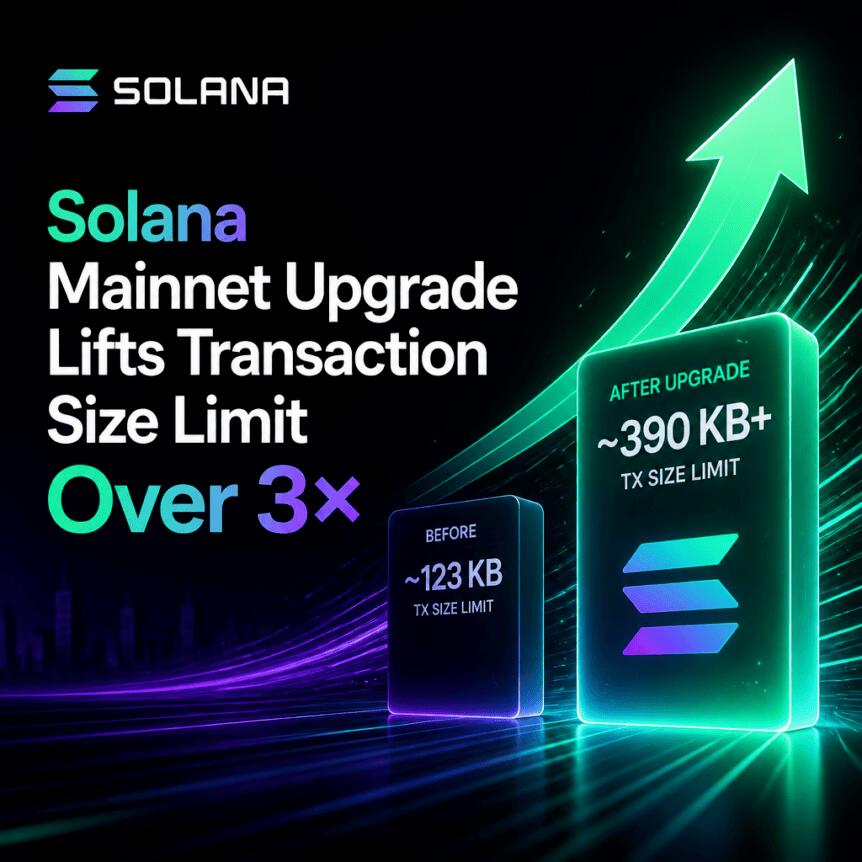
Solana has activated an upgrade on mainnet that raises the maximum size of transactions from 1,232 bytes to 4,096 bytes, giving developers more room to pack advanced logic into a single transaction. The change is designed to support workloads that can’t previously fit within Solana’s transaction limits, including zero-knowledge proofs and emerging onchain signature schemes.
According to the Solana Foundation, the update went live on Tuesday at the start of epoch 1,035 at around 1:00 a.m. UTC. Alongside the larger transaction capacity, the network introduced a new v1 transaction format intended to preserve backward compatibility with legacy transactions.
Key takeaways
- Solana increased its maximum transaction size from 1,232 bytes to 4,096 bytes to accommodate more complex onchain operations.
- The upgrade activated on mainnet at the start of epoch 1,035, as shared by the Solana Foundation.
- A new v1 transaction format was introduced; legacy transactions continue to work, but protocols need to adopt v1 to benefit.
- The Solana Foundation says the primary goal is enabling workloads such as zero-knowledge proofs and multi-signature or new signature schemes within a single transaction.
A larger transaction limit for heavier onchain workloads
For developers, transaction size limits can be a practical ceiling on what a single call can accomplish—especially for applications that require additional cryptographic data or multiple authorization elements. Solana’s upgrade expands that ceiling, allowing more content to be included before hitting the maximum transaction payload size.
The Solana Foundation frames the change as an unlock for “do more” within applications. Its stated focus includes zero-knowledge proofs, transactions that require multiple signatures, and new onchain signature schemes—categories of functionality that often demand additional data compared with simpler transfer or contract-execution flows.
From a builder’s standpoint, the main benefit is consolidation: when larger transactions are possible, teams can aim to execute more steps atomically rather than splitting work across multiple transactions. That can reduce overhead and simplify user interactions, though developers will still need to evaluate how their specific program designs fit within the new limit and what additional compute or verification costs might remain.
V1 transaction format: backward compatible, but adoption is required
The upgrade also introduces the v1 transaction format. The Solana Foundation says the approach is backward compatible, meaning existing transaction formats continue to function for applications and wallet providers.
However, the capacity increase is not automatically available to every workflow. Protocols that want to take advantage of the larger transaction size will need to update to v1 transactions. In practical terms, that puts the migration burden on protocol and tooling maintainers—wallets, SDKs, and downstream integrations that must generate or sign v1 transactions for users.
This distinction matters for users and teams watching the ecosystem: even though the network is capable of handling bigger transactions, applications may not immediately benefit unless their transaction construction logic (and any signature handling) is updated to the new format. Investors and analysts tracking Solana’s developer momentum may therefore want to watch for follow-on announcements from application teams and infrastructure providers that plan v1 support, rather than assuming the capacity jump automatically translates into new features across the board.
Built on a broader series of network throughput changes
This transaction upgrade comes after a sequence of infrastructure adjustments aimed at improving Solana’s performance and efficiency. In August, Solana reduced its slot time from 400 milliseconds to 350 milliseconds, and in June the Solana Foundation shared plans to further reduce slot times from 400ms to 200ms—positions that were justified by the expectation of better latency and faster confirmations.
Separately, Solana validators approved a proposal on Aug. 28 to double the network’s annual disinflation rate, which would reduce future issuance of SOL, the network’s native token. Those kinds of policy changes affect long-run supply dynamics, while latency and throughput upgrades primarily influence how quickly and smoothly the chain processes activity.
Viewed together, the larger transaction limit fits into a pattern: Solana has been tightening multiple parts of its performance envelope—faster timing, more capacity per transaction, and changes to economic issuance. The common theme is reducing constraints that can limit how complex applications can operate on-chain, whether those constraints are about timing or payload size.
What this could mean for zero-knowledge and signature-heavy applications
The Foundation’s specific examples point toward a segment of the ecosystem that often runs into practical limitations: cryptographic applications. Zero-knowledge proofs can involve substantial auxiliary data, and certain proof systems may require larger transaction payloads to carry proof artifacts and related inputs. Likewise, transactions involving multiple signatures and newer signature schemes can require extra bytes for authorization data.
By raising the transaction ceiling, Solana provides an additional lever for these applications. While developers will still have to account for compute budgets and the structure of their programs, the upgrade reduces one of the most immediate “hard stop” constraints: whether a complex proof or signature bundle can be packaged into a single transaction.
In the near term, the ecosystem will likely focus on tooling readiness. Because the network maintains backward compatibility, legacy flows can remain functional, but the real ecosystem effect depends on whether program developers and infrastructure providers—libraries, wallets, and aggregators—support v1 transactions well enough for users to experience the expanded capacity.
Readers should also watch for how quickly application teams start shipping features that explicitly rely on the new transaction format. The network can process larger transactions, but the value shows up when applications begin to route workloads that were previously impossible—or forced into multi-transaction patterns—into single, larger transactions.
As Solana continues iterating on network capabilities, the next signal to monitor is ecosystem migration to v1 transactions: which wallets and protocol implementations adopt the format, and whether high-complexity use cases such as zero-knowledge proof workflows begin appearing in production with fewer fragmentation steps.
https://www.cryptobreaking.com/solana-mainnet-upgrade-lifts-transaction/?utm_source=blogger%20&utm_medium=social_auto&utm_campaign=Solana%20Mainnet%20Upgrade%20Lifts%20Transaction%20Size%20Limit%20Over%203×%20
Comments
Post a Comment