
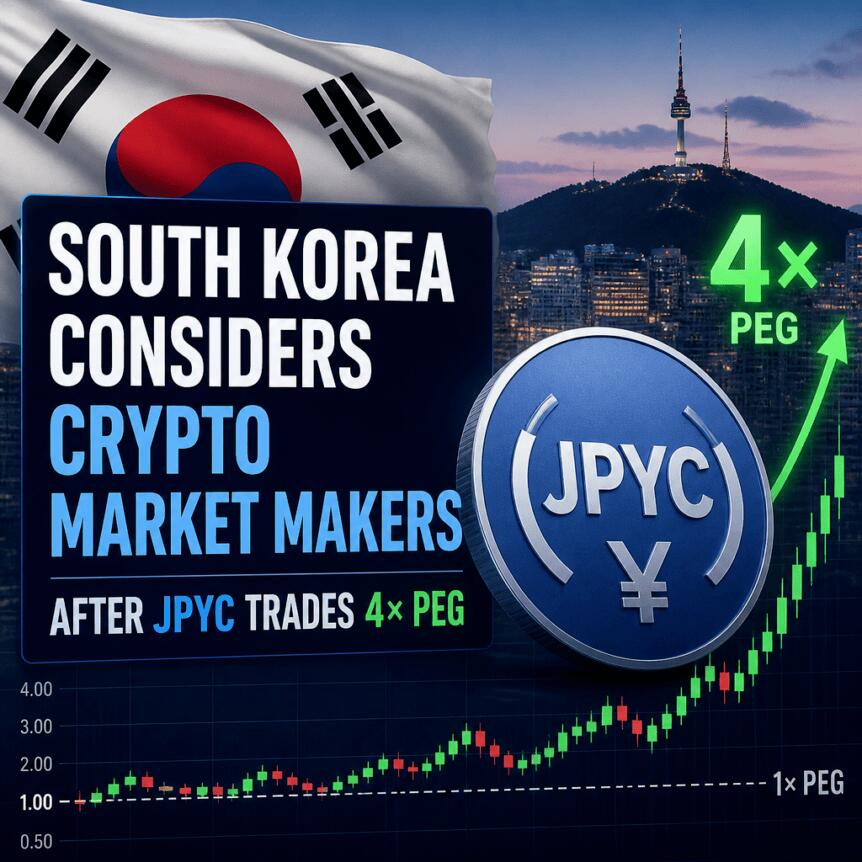
South Korea’s Financial Services Commission (FSC) says it is weighing the introduction of a regulated market-making system for digital assets after a yen-pegged stablecoin trade on Upbit swung dramatically away from its intended value earlier this month.
The development comes amid renewed scrutiny of how South Korea handles market stability and user protection in crypto, particularly given that existing law does not currently carve out market makers from market manipulation rules.
Key takeaways
- The FSC is considering whether to allow market-making activities to improve liquidity and reduce price instability in digital asset markets.
- Upbit’s JPYC listing saw a rapid move to roughly 4x its peg, with limited liquidity cited as a key driver of the spike.
- South Korea’s Virtual Asset User Protection Act currently blocks market-making exemptions, keeping market makers subject to market manipulation provisions.
- Regulatory debate around a market-maker carve-out has been ongoing in South Korean academia, including prior warnings about manipulation risks.
JPYC spike highlights liquidity and stability concerns
On Sept. 17, Upbit began trading JPYC, a stablecoin purportedly linked to the Japanese yen. Trading opened at 12 Korean won per JPYC and then surged to a high of 37.6 won within about an hour—more than four times the initial quoted level.
According to reporting on the episode, the sharp move was linked to limited liquidity on Upbit at the time, underscoring how thin order books and market depth can amplify price swings when new instruments list or liquidity lags.
FSC signals possible policy shift on market makers
At a Seoul conference earlier this week, Yoo Young-joon, director of digital finance policy at the FSC, said the commission would “also review the need to introduce systems such as market-making activities” to increase efficiency and stability in South Korea’s digital asset landscape. Yoo also pointed to criticism that users experienced losses following the JPYC price surge after the listing, adding that calls for stricter discipline in this area are growing.
While Yoo’s remarks did not outline a specific timeline or design for such a system, they suggest the FSC is actively re-examining whether the current legal framework leaves enough room for liquidity provision without increasing manipulation risk.
Legal friction: market-making not exempt from manipulation rules
A central obstacle is that South Korea’s Virtual Asset User Protection Act does not currently include an exemption that would allow market making to operate outside the law’s market manipulation provisions. In practice, that means market makers are constrained in their ability to provide liquidity, even when more consistent liquidity could help reduce the kinds of dislocations seen in the JPYC episode.
Yoo’s comments are therefore notable not only because they raise the possibility of market-making, but because they imply the FSC may reconsider how—if at all—market makers can be permitted to function while still meeting market integrity requirements.
Academics previously debated a market-maker carve-out
Debate over whether regulators should create room for market makers predates the JPYC incident. South Korean academics have discussed the issue directly, including arguments about how liquidity interventions could inadvertently resemble manipulation under certain conditions.
In a 2024 peer-reviewed paper published in the Seoul Law Review, Lee Min Jung, a KB Securities researcher, described how regulators at the time did not allow crypto market making on the grounds that it could amount to market manipulation. Lee argued that introducing market makers may have been premature while concerns remained, but suggested that a carve-out could become feasible once markets grow more stable.
Other researchers have argued that South Korea’s market structure has been weakened by the lack of formal liquidity mechanisms. A paper by Yoonyoung Choi from the Korbit Research Center described “serious liquidity problems” associated with the absence of a formal market maker system, arguing that the result has been greater price discrepancies and higher volatility. The paper cited the well-known Kimchi premium as an example of inefficient pricing dynamics in South Korea’s crypto market.
Broader regulatory overhaul still under negotiation
The FSC’s market-making discussion comes as South Korea continues work on a wider regulatory framework for crypto. Earlier this year, the commission said it planned to introduce a consolidated Digital Asset Basic Act intended to cover stablecoins and the broader digital asset industry, including rules affecting digital asset businesses, exchanges, disclosures, and internal controls.
However, lawmakers have not yet resolved several important implementation details, including how the regime should treat won-denominated stablecoin issuers. That legislative uncertainty means that even if market-making rules are revisited, the overall direction of South Korea’s stablecoin and exchange oversight may still depend on how the broader act ultimately gets finalized.
As the FSC weighs whether to open the door to market-making, investors and traders should watch for any movement on the legal status of liquidity provision—especially whether a future framework includes guardrails that target manipulation risks while addressing thin liquidity conditions. The JPYC spike offers a concrete example of what can happen when market depth is insufficient, but the key question now is how regulators can balance stability goals with user protection and market integrity in practice.
https://www.cryptobreaking.com/south-korea-considers-crypto-market/?utm_source=blogger%20&utm_medium=social_auto&utm_campaign=South%20Korea%20Considers%20Crypto%20Market%20Makers%20After%20JPYC%20Trades%204×%20Peg%20
Comments
Post a Comment