
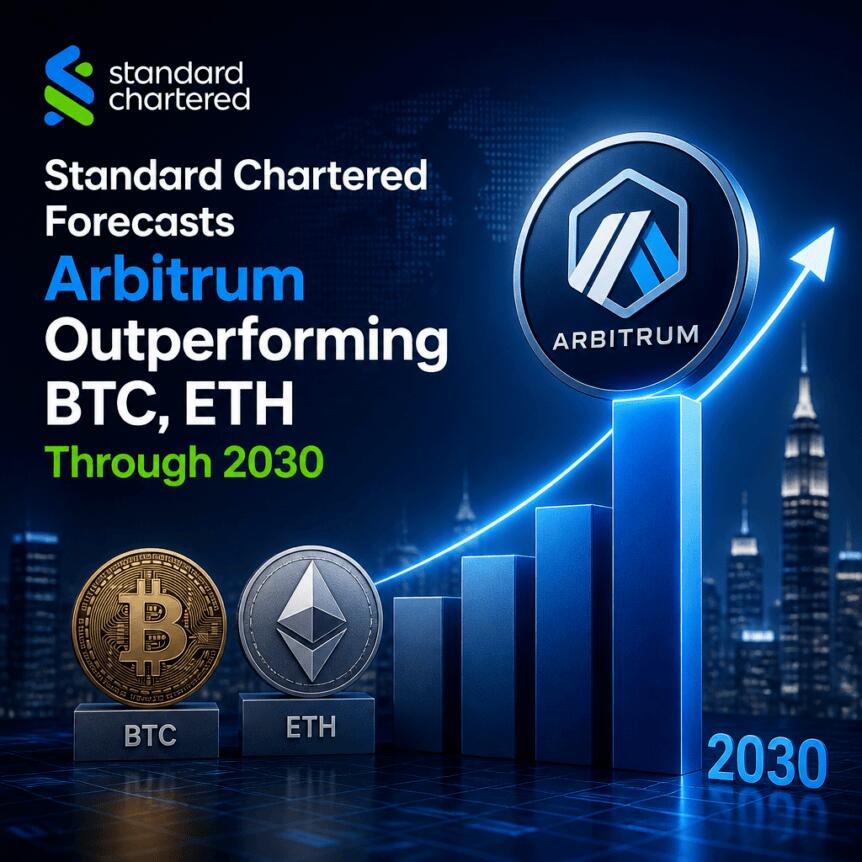
Standard Chartered is making the case that Arbitrum could become one of the strongest performers in crypto through 2030, arguing that the network’s revenue mechanics may benefit as traditional finance ramps up onchain activity. In a note shared with Cointelegraph, Geoff Kendrick, the bank’s global head of digital assets research, pointed to Arbitrum’s economic design as a potential source of growth beyond crypto-native usage.
Kendrick said Arbitrum receives 10% of the net protocol revenue generated by businesses building on the network. He highlighted Robinhood Chain—an Ethereum layer-2 initiative tied to the online brokerage Robinhood—as an early test case for how tokenization-focused applications could shift Arbitrum’s financial profile. According to Kendrick, the impact has already been visible in the network’s revenue run rate.
Key takeaways
- Standard Chartered forecasts Arbitrum’s protocol revenue share could meaningfully grow as more traditional financial assets move onchain.
- Arbitrum’s design gives it 10% of net protocol revenue from companies building on the network.
- Standard Chartered credits Robinhood Chain with materially changing Arbitrum’s economics, projecting $5 million revenue in September.
- Kendrick expects those economics could support a multi-year rise in ARB, potentially reaching $10 by 2030.
- Key risks include tokenization adoption slowing and increased competition from other chains.
Why Standard Chartered thinks Arbitrum’s revenue can scale
At the center of Standard Chartered’s bullish outlook is the idea that Arbitrum’s growth is not just about user activity, but about the network’s share of protocol revenues. Kendrick framed the pathway as follows: as regulated institutions and financial firms bring more assets onto blockchain infrastructure—especially through tokenized real-world asset (RWA) products—layer-2 networks that support these deployments could capture recurring value.
Robinhood Chain is presented as a concrete example of that dynamic. In the note, Kendrick argued that its launch has already affected Arbitrum’s economics. He stated that, at the current run rate, Arbitrum is expected to generate $5 million in revenue in September, which he said is more than five times the level it was at before Robinhood Chain launched in July.
For investors and traders, this matters because it shifts the narrative from “layer-2 usage” alone to “layer-2 monetization.” If tokenized asset workflows generate sustained protocol revenue, the token incentives and long-term demand for the network’s native asset could plausibly benefit. Standard Chartered’s framing is essentially that the token’s value proposition is tied to business adoption and network economics rather than only retail activity.
From protocol economics to ARB price assumptions
On price, Kendrick’s view is aggressive but anchored to the bank’s revenue-based logic. He expects Arbitrum’s economics to support a steady increase in ARB through the rest of the decade, forecasting that the token could reach as high as $10 by 2030. The bank’s projection implies roughly a 70-fold increase from current levels.
Standard Chartered also contrasted its outlook for Arbitrum with its expectations for Bitcoin and Ether over the same period, saying its projected returns for ARB would be far higher. While price forecasts are inherently uncertain, the bank’s stated method is noteworthy: the thesis is built around a growing revenue stream for the protocol rather than purely speculative momentum.
At the time of the note, ARB was valued at around $0.14, according to CoinGecko, after gaining 86% over the past month.
Tokenized real-world assets are the engine in the model
Standard Chartered’s argument is heavily influenced by the momentum in tokenization. Kendrick pointed to cumulative RWA tokenization nearing $39 billion, citing RWA.xyz data. The bank also reiterated its broader forecast that tokenized assets could reach $4 trillion by the end of 2028, as banks and asset managers bring more assets onchain.
In that scenario, layer-2 networks like Arbitrum are positioned as infrastructure providers. The bank’s logic is that when tokenization shifts from experiments to larger deployments, businesses building on these networks can generate net protocol revenue—part of which flows back to Arbitrum under the 10% share model.
Standard Chartered has previously tied its wider crypto views to tokenization growth, including a bullish stance toward Chainlink and the broader decentralized finance sector in the context of a growing onchain asset base. The Arbitrum note continues that through-line: as more “real-world” exposure is issued onchain, the infrastructure that supports issuance, settlement, and related services may capture more durable value.
Key uncertainties and competitive pressure
Despite its optimism, Kendrick highlighted risks that could derail the bank’s price framework. He identified two major uncertainties: a slower-than-expected pace of asset tokenization and more competition from alternate blockchains.
This is an important tension for readers to consider. Arbitrum’s potential upside depends not only on technical and adoption milestones, but also on whether tokenized assets concentrate on specific L2 ecosystems or diversify across multiple networks. If tokenization expands but spreads across competing platforms, Arbitrum’s revenue share—and therefore the earnings-to-token linkage Standard Chartered is leaning on—could be diluted.
There is also a timing element embedded in the forecast. Kendrick’s projected revenue run rate growth and the resulting ARB outlook assume that new deployments and monetization mechanisms ramp in a way that sustains protocol revenues over time. Any mismatch between “asset issuance growth” and “protocol monetization” would likely force the thesis to be recalibrated.
As the market digests this note, the next things to watch are whether tokenization activity on Ethereum layer-2s keeps accelerating and whether Robinhood Chain—or other tokenization-oriented deployments—continues to translate into measurable net protocol revenue for Arbitrum. The pace of tokenized asset adoption and the intensity of competition between alternative chains may determine how closely reality tracks Standard Chartered’s multi-year model.
https://www.cryptobreaking.com/standard-chartered-forecasts-arbitrum-outperforming/?utm_source=blogger%20&utm_medium=social_auto&utm_campaign=Standard%20Chartered%20Forecasts%20Arbitrum%20Outperforming%20BTC,%20ETH%20Through%202030%20
Comments
Post a Comment