
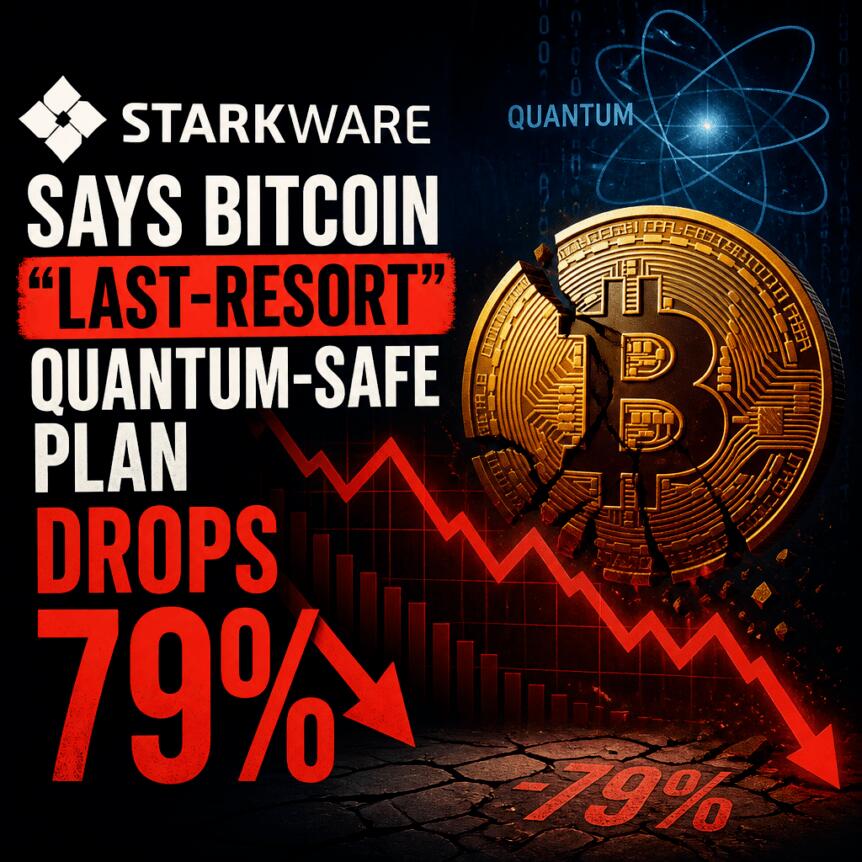
StarkWare says the estimated computing cost to construct a “quantum-safe” Bitcoin transaction has dropped sharply after a week of optimization work, falling to around $67—down from roughly $320 for the first such mainnet transaction in August.
The improvement comes from participants in the Quantum-Safe Bitcoin Optimization Challenge, which targeted the GPU-heavy steps needed to build a transaction using the Quantum-Safe Bitcoin (QSB) design. StarkWare cautions that the newest figures are based on benchmark results rather than fresh on-chain deployments, but the direction suggests the approach could become more practical for emergency use.
Key takeaways
- StarkWare reports the estimated QSB transaction preparation cost is now about $66–$67, down from about $320 in August.
- The cost reduction followed optimization contributions from the Quantum-Safe Bitcoin Optimization Challenge, which ran for about a week.
- StarkWare says the challenge produced 62 accepted improvements across two tasks needed to prepare QSB transactions.
- Despite the lower estimates, StarkWare notes the latest gains are demonstrated in benchmarks, not confirmed through additional mainnet transactions.
- QSB is presented as a quantum-resilience “emergency” measure that does not require changes to Bitcoin consensus rules—though StarkWare still favors protocol-level upgrades for long-term protection.
Cost of quantum-safe construction falls again
StarkWare said that after a week of iterative optimizations by challenge participants, the computational estimate for preparing a QSB transaction fell by roughly 79%. In its Sept. 23 update, the company argued that moving from “a few hundred dollars” toward the $60s brings the method closer to what a Bitcoin holder could consider during an urgent scenario.
StarkWare adds that the live dashboard for the QSB challenge now displays the current estimate at $66. The company previously pointed out that earlier demonstrations involved higher GPU requirements and therefore higher costs.
What QSB is—and why the network doesn’t need to change
QSB was first published by StarkWare researcher Avihu Levy in April. The design aims to provide hash-based protection intended to reduce the risk posed by future quantum attacks, while avoiding changes to Bitcoin’s consensus rules. In Levy’s earlier framing, the approach was considered a “last resort” option because of cost, complexity, and limited applicability—concerns that the new optimization work is directly addressing.
The underlying idea is to add a layer of defense without requiring the Bitcoin network to adopt new rules. That “no consensus changes” property matters for holders because it can allow quantum-resistance steps to be taken with specialized tooling rather than waiting for a widely deployed protocol upgrade. However, that same constraint can limit how broadly such a system can be used in the near term.
From the first mainnet transaction to benchmark-driven reductions
StarkWare ties the earlier baseline to the first QSB transaction mined and confirmed on Aug. 26. The company previously reported engineering work from Tomer Giladi and submission through MARA’s Slipstream service, with preparation requiring approximately 3,100 GPU-hours across roughly 100 GPUs.
StarkWare estimated the compute cost for that first mainnet transaction at about $320, excluding Bitcoin network fees. The latest update changes the picture on estimated preparation expense: StarkWare says the optimization challenge reduced the estimated computing cost based on benchmarks.
To find efficiency gains, StarkWare, Yukon Research, and Eigen Labs launched the Quantum-Safe Bitcoin Optimization Challenge on Sept. 16, inviting developers, researchers, and AI agents to improve the transaction-building pipeline. In the latest update, StarkWare said the effort resulted in 62 accepted improvements across two computational tasks needed for QSB transaction preparation.
While that work is reflected in benchmark cost estimates now shown on Yukon’s QSB dashboard, StarkWare’s update still leaves an important gap: readers should treat the new $66–$67 figure as an estimate for construction workflows, not as proof that the same cost can be reproduced for additional live on-chain transactions yet.
Why holders may care—and what remains uncertain
The renewed focus on cost comes as concern continues to grow in the crypto community that a sufficiently powerful quantum computer could eventually undermine Bitcoin’s elliptic-curve digital signature system. If attackers can exploit that weakness, coins exposed by their public keys could become vulnerable—though real-world timelines and feasibility depend on engineering breakthroughs that remain uncertain.
Against that backdrop, StarkWare positions QSB as an “emergency” measure—useful if and when quantum risks become immediate enough to justify expensive operational work. The sharper cost estimates may increase the likelihood that QSB could move from a proof-of-concept into a more realistic option for holders with a larger balance who can justify special preparation in advance.
At the same time, StarkWare reiterates a key strategic tension: the company still prefers a soft fork—meaning changes to Bitcoin’s consensus rules—as the better “long-term answer” for broad, durable quantum protection. The optimizations therefore appear to strengthen the near-term toolkit around QSB, while the longer-term debate over protocol-level defenses continues.
What to watch next is whether the benchmark-driven reductions can translate into additional on-chain QSB transactions at similar cost levels, and whether broader community attention shifts from experimental benchmarking toward practical integration and planning for quantum-era safeguards.
https://www.cryptobreaking.com/starkware-says-bitcoin-last-resort/?utm_source=blogger%20&utm_medium=social_auto&utm_campaign=StarkWare%20Says%20Bitcoin%20“Last-Resort”%20Quantum-Safe%20Plan%20Drops%2079%%20
Comments
Post a Comment