
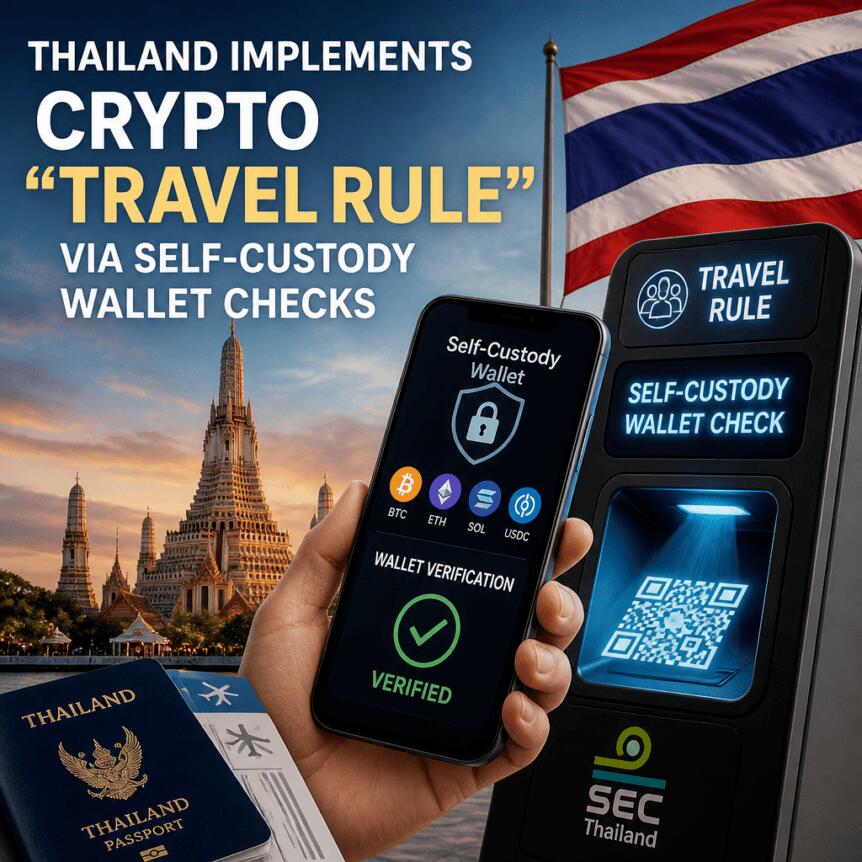
Thailand’s financial regulator has moved to formalize tighter oversight of crypto transfers, aiming to bring local rules closer to the international “Travel Rule” framework used to combat money laundering and terrorist financing. The Thailand Securities and Exchange Commission (SEC) said its new regulations require digital asset operators to collect and transmit information about parties involved in certain crypto transfers.
In an announcement made Wednesday, the SEC set Feb. 27, 2027 as the compliance start date. That timeline gives regulated crypto businesses nearly six months to build or upgrade systems needed to transmit, receive, and monitor transaction-related data.
Key takeaways
- Thailand’s SEC has issued new Travel Rule regulations covering crypto transfers handled by digital asset operators.
- The rules require operators to gather information on the parties to transactions and retain it for regulatory review.
- Self-custodial wallets will be subject to additional ownership or control verification steps when users send to or receive from them.
- Recordkeeping must cover each transaction for at least five years.
- Compliance begins Feb. 27, 2027, after consultations earlier in 2026.
Thailand’s Travel Rule push: data sharing for transfers
The SEC’s new framework requires digital asset operators in Thailand to collect information about both sides of eligible crypto transfers—effectively mirroring the core idea of the Travel Rule: tracking who sends and who receives value across financial rails. According to the SEC’s announcement, the regulations are intended to reduce the risk that crypto transfers are used to support illicit activity.
Regulators have been moving toward standardized transaction screening and information exchange for years, and Thailand’s final rules reflect that broader shift. The SEC’s move also aligns with the broader international picture: the Financial Action Task Force (FATF) estimated that 83% of surveyed jurisdictions had passed Travel Rule legislation as of 2026, per earlier coverage referencing FATF findings (see this Cointelegraph report).
For market participants, the practical significance is straightforward: compliance will require more than simple transaction monitoring. Operators will need processes to transmit and reconcile counterpart information, particularly where transfers cross different service providers or involve specific wallet types.
Self-custodial wallets will require ownership or control checks
A notable element of Thailand’s rules is how they treat self-custodial wallets—wallets where users control private keys and therefore directly control access to funds. Under the SEC’s framework, Thai digital asset operators must verify the ownership or control of self-hosted wallets when customers send crypto to or receive crypto from those addresses.
The point of friction for businesses is that self-custody reduces the usual intermediated link between user identity and on-chain activity. Centralized exchanges and custodians can typically manage onboarding and identity checks for their own users, but self-custodial transactions require operators to demonstrate that the wallet being used is genuinely under the customer’s control.
Beyond wallet verification, the SEC also requires that operators retain information that accompanies digital asset transactions for at least five years and provide the records for regulatory examination. That long retention period matters because it implies ongoing administrative and storage costs—alongside the technical effort of recording transfer metadata that regulators can later request.
The SEC also characterized the motivation behind the rules in risk terms. Pornanong Budsaratragoon, secretary-general of Thailand’s SEC, said the regulations aim to “reduce the risk of digital asset operators being used for money laundering and terrorist financing.”
From consultations to finalized rules
The Travel Rule regulations did not arrive abruptly. The SEC said the final text followed two rounds of public consultation during 2026. The process began with proposed principles in March and progressed to a draft notification in June, with the regulator indicating that most stakeholders supported the proposals.
That consultation history may help explain the compliance window. By setting an effective date in late February 2027, Thailand’s SEC effectively acknowledges that digital asset operators will need time to implement end-to-end workflows—especially around verifying self-custodial wallet control and ensuring that transaction information is systematically captured and retained.
For investors and traders, the indirect effect is that regulated service providers may tighten operational requirements around how users deposit, withdraw, and transact—particularly when interactions involve self-custodial addresses. While the rules are framed as AML measures, the on-the-ground result can be operational changes, additional documentation, and potentially more robust transaction screening before transfers are executed.
Thailand’s broader regulatory direction
Thailand’s Travel Rule finalization comes as the SEC also advances other crypto-related rulemaking. Earlier this week, the regulator proposed allowing intermediaries to offer retail investors access to certain crypto derivatives traded on regulated overseas exchanges. Days before that, it moved forward with draft rules for spot Bitcoin and Ether exchange-traded funds (ETFs), while also seeking feedback on requirements for foreign digital asset custodians used by funds investing in crypto.
Taken together, the SEC’s agenda suggests an approach focused on bringing more segments of crypto activity under formal compliance structures while maintaining a pathway for new regulated products. The emphasis on transaction-level traceability for AML purposes—now codified through the Travel Rule—fits naturally with a regulator that is simultaneously exploring how retail-facing offerings and fund structures can operate within oversight.
What remains to be seen is how Thailand will interpret and enforce the practical implementation details—particularly around self-custodial wallet verification and the technical standards for passing Travel Rule data between counterparties. Providers should watch for guidance on implementation expectations as the Feb. 27, 2027 effective date approaches, and traders should be alert for potential onboarding or transfer process changes from regulated platforms as they prepare to comply.
https://www.cryptobreaking.com/thailand-implements-crypto-travel-rule/?utm_source=blogger%20&utm_medium=social_auto&utm_campaign=Thailand%20Implements%20Crypto%20“Travel%20Rule”%20via%20Self-Custody%20Wallet%20Checks%20
Comments
Post a Comment