
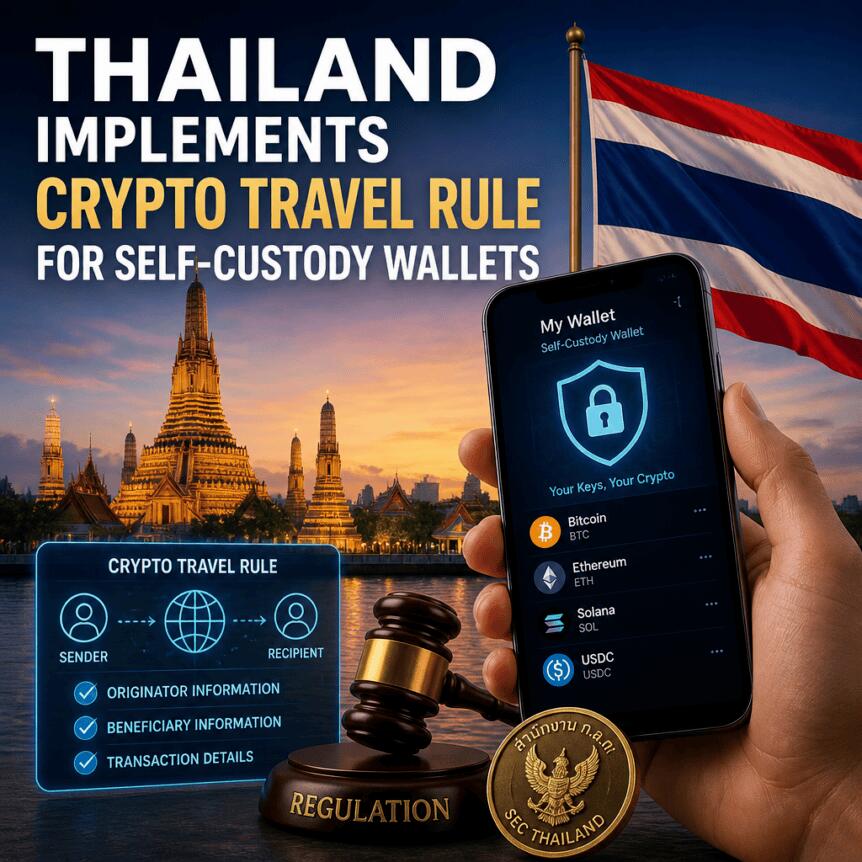
Thailand’s financial regulator has moved to tighten oversight of cryptocurrency transfers by adopting new “Travel Rule” requirements tied to global anti-money laundering expectations. The Thailand Securities and Exchange Commission (SEC) announced Wednesday that digital asset operators will be required to collect and share key information about parties involved in crypto transfers.
The regulations are set to take effect on Feb. 27, 2027, giving industry participants nearly six months to build the operational and compliance systems needed to transmit, receive, and monitor transaction-related information.
Key takeaways
- Thailand’s SEC has issued final Travel Rule regulations for digital asset operators, aligning local oversight with international AML standards.
- The rules require additional due diligence around transfers to and from self-custodial (self-hosted) wallets, including ownership or control checks.
- Operators must retain transaction-related party information for at least five years and make records available for regulatory review.
- Compliance deadlines give the market until Feb. 27, 2027, to implement systems for collecting and transmitting required information.
- Thailand’s move reflects a broader FATF push to standardize traceability of crypto transfers across jurisdictions.
Travel Rule requirements come into focus
Under Thailand’s new framework, digital asset operators must gather information about the parties to crypto transfers. The SEC’s announcement positions the update as part of a wider effort to bring crypto compliance closer to established international AML norms.
While Travel Rule obligations have been spreading globally, the key operational change for firms is the expectation that they can handle information flows tied to transactions—not just monitor funds. Regulators increasingly want operators to be able to demonstrate who sent and who received crypto, and to provide that supporting documentation when requested.
Thailand’s SEC described the implementation timeline as a way to allow the market time to prepare, with rules due to begin on Feb. 27, 2027.
Self-custodial wallets will face additional checks
A notable element of the new Thai rules is how they treat self-custodial wallets. The SEC said Thai digital asset operators must verify the ownership or control of self-hosted wallets when customers send to or receive crypto from those addresses.
This is a practical difference from transfers involving wallets controlled by centralized exchanges (CEXs) or custodians. With self-custody, users manage the private keys themselves, meaning the operator does not inherently have the same identity linkage that comes with regulated custody services. Thailand’s framework therefore pushes responsibility back onto operators to identify and verify the relevant wallet ownership or control before permitting or processing transfers involving those self-hosted addresses.
The SEC also requires operators to retain information accompanying every digital asset transaction for at least five years. Those records must be available for regulatory examination, reinforcing the idea that Travel Rule compliance is not only about real-time data exchange but also about post-transaction auditability.
From consultations to final regulations
Thailand’s Travel Rule requirements follow an earlier process of public consultation. The SEC said it ran two rounds of consultation during the year, starting with proposed principles in March and then issuing a draft notification in June. According to the regulator, most stakeholders supported the proposals.
That shift—from early input to final rules—matters for investors and service providers alike because it reduces uncertainty about what will be required. With a specific effective date now set, companies can plan compliance roadmaps around systems that can reliably capture and transmit party information associated with transfers.
It also places renewed emphasis on how Thai compliance teams will operationalize wallet verification for self-custodial activity. Firms will need processes for checking ownership or control in a way that can stand up to scrutiny, even when users hold the private keys outside a custodian’s infrastructure.
Thailand joins a broader FATF-driven trend
Thailand’s regulatory tightening lands amid a larger international push to make crypto transfers more transparent from an AML perspective. The Financial Action Task Force (FATF) estimated that 83% of surveyed jurisdictions had passed Travel Rule legislation as of 2026, reflecting how rapidly compliance requirements are becoming standardized across major markets.
For Thai market participants, the SEC’s stance signals that Travel Rule expectations will increasingly affect product design and onboarding flows—particularly anything that connects regulated entities with customer wallets, including self-custodial addresses.
Regulatory agenda extends beyond Travel Rule
Thailand’s Travel Rule update also fits into a wider agenda from the SEC to expand and refine the country’s crypto market structure. Earlier this week, the SEC proposed allowing intermediaries to offer retail investors access to certain crypto derivatives traded on regulated overseas exchanges. The regulator has also advanced draft rules for spot Bitcoin and Ether exchange-traded funds (ETFs), while seeking feedback on requirements for foreign digital asset custodians used by funds investing in crypto.
Taken together, these steps point to a regulator that is not only focusing on enforcement and AML controls, but also shaping the pathway for additional mainstream investment products—while demanding that intermediaries meet compliance expectations consistent with international standards.
As Feb. 27, 2027 approaches, the key unknown for Thailand’s market is how operators will implement self-custodial wallet ownership and control verification in practice—an area likely to determine whether compliance is smooth for users or introduces friction in everyday transfer flows. Observers should watch for detailed implementation guidance and how firms update transaction monitoring and record-keeping systems to meet the five-year retention requirement.
https://www.cryptobreaking.com/thailand-implements-crypto-travel-rule-2/?utm_source=blogger%20&utm_medium=social_auto&utm_campaign=Thailand%20Implements%20Crypto%20Travel%20Rule%20for%20Self-Custody%20Wallets%20
Comments
Post a Comment