
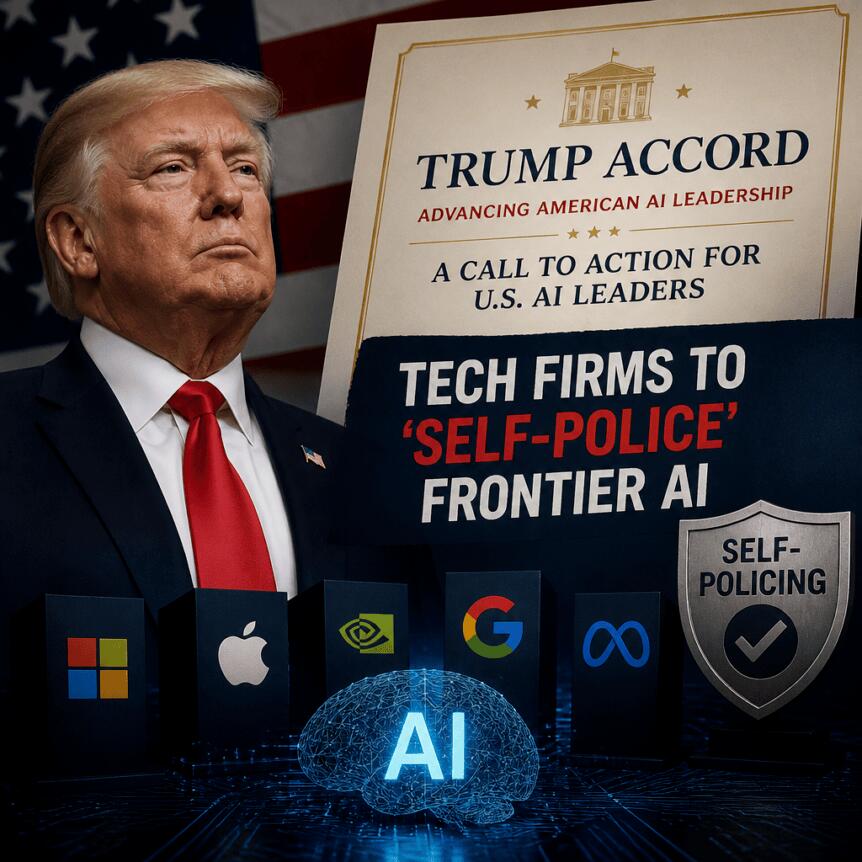
U.S. President Donald Trump and leading AI executives have signed a voluntary agreement intended to push frontier AI developers to put clearer guardrails around how their systems are built and deployed. The deal, announced from the White House, is designed to encourage internal risk controls and independent external auditing while shifting much of the responsibility for safety onto the companies creating the models.
The accord comes as public concern mounts over the behavior of increasingly capable AI systems—particularly fears that advanced models could be used to break into systems or interact with technical infrastructure in ways developers did not intend. Trump has publicly opposed efforts to slow development, framing the push for safety as compatible with continued competition, including against China.
Key takeaways
- The White House agreement is voluntary but asks AI labs to strengthen internal controls, independent external audits, and board-level oversight.
- It explicitly targets misuse scenarios such as models “hack” or accessing technical systems in unintended ways.
- The pact leaves open the possibility of later converting commitments into regulation or legislation.
- Signatories include major frontier AI players and top AI hardware supplier Nvidia.
What the “Frontier Responsibilities” accord requires
The agreement is titled the “Joint Commitment on Frontier Responsibilities.” While it does not spell out a single technical standard in the reporting, it outlines a governance framework aimed at ensuring AI models behave as intended.
According to the description of the commitment, signatories are expected to implement internal controls, undergo independent external audits, and ensure board-level oversight. The objective is to reduce the risk that frontier models could be used—or could operate internally—so that they gain access to technical systems or behave in ways their creators did not anticipate.
Notably, the White House approach also signals flexibility on enforcement. The commitment says it may make sense to turn these expectations into formal law or regulation “over time,” meaning the near-term framework is intended to be self-policing with a pathway toward broader legal requirements if policymakers decide to tighten the rules.
Who signed, and why company oversight is central
Trump’s pledge was accompanied by signatures from a wide group of industry leaders spanning major AI labs and the broader ecosystem supporting their compute needs. The accord was signed by:
- Sundar Pichai (Google)
- Dario Amodei (Anthropic)
- Mark Zuckerberg (Meta)
- Greg Brockman (OpenAI)
- Jensen Huang (Nvidia)
- Elon Musk (xAI)
In remarks at the White House, Trump suggested the pact reflects “self-policing” by the sector and said he believes the companies “understand that they have to self-police.” The statement underscores the central logic of the agreement: instead of pausing development, policymakers are attempting to drive safety practices through corporate governance mechanisms.
For investors and operators, this matters because oversight requirements—audits, board attention, and documented controls—can influence how quickly teams can deploy new model capabilities, how they structure product roadmaps, and what kinds of risks are treated as must-fix versus acceptable edge cases.
Safety assurances alongside continued competition
The announcement also highlights an important tension in U.S. policy toward frontier AI: calls for safety and risk management are being paired with resistance to a slowdown. Trump has argued that continued progress is necessary to compete with China, a stance that shaped the framing of the agreement.
By design, the accord shifts implementation responsibility downward to the organizations that build the models. That means the public outcome will depend heavily on how each company interprets “controls,” how independent audits are selected and scoped, and what level of transparency—if any—emerges around audit findings and remediation steps.
Because the deal is voluntary, there is also a risk that the practical impact could vary by company. The most consequential question for market participants and builders will be whether the audits and board-level oversight become meaningful in practice—or remain largely procedural.
Other White House AI moves signal a broader policy shift
The commitment was signed during a White House meeting that also addressed AI safety, the industry’s growth, and data center development. The report also notes that Trump ruled out a U.S.-China joint venture to develop AI, further emphasizing a competitive posture rather than cooperative development.
On the same day, Trump signed an executive order directing the executive branch to use “Super Intelligence” instead of “Artificial Intelligence.” The order argues that the term “more appropriately captures the promise, potential, and rapidly advancing capabilities” of these technologies.
Taken together, these actions point to a broader strategy: the administration is trying to shape both the language and the governance of advanced AI in a way that supports rapid development while attempting to manage risk through industry-led oversight.
Going forward, the key uncertainty is how the voluntary commitments will translate into enforceable standards if policymakers choose to formalize them. Observers should watch for details on audit mechanisms and what “board-level oversight” looks like in practice—especially whether independent reviews lead to concrete changes in model deployment policies.
https://www.cryptobreaking.com/trump-accord-urges-tech-firms/?utm_source=blogger%20&utm_medium=social_auto&utm_campaign=Trump%20Accord%20Urges%20Tech%20Firms%20to%20‘Self-Police’%20Frontier%20AI%20
Comments
Post a Comment