
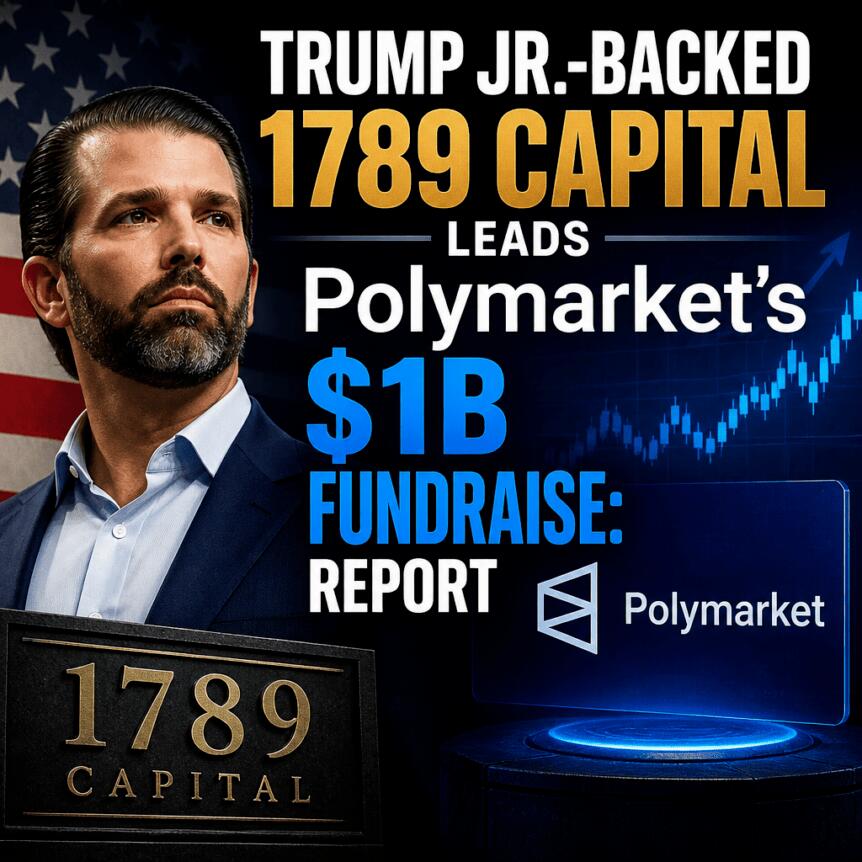
A Trump Jr.-linked investment firm is reportedly preparing to put roughly $300 million into Polymarket as part of a much larger funding effort that could value the prediction market platform at $21 billion. According to the Wall Street Journal, 1789 Capital—where Donald Trump Jr. is a partner—would participate in a $1 billion round that includes the additional $300 million commitment.
If the reported terms are accurate, the investment would lift 1789 Capital’s total disclosed exposure to Polymarket to about $500 million, potentially positioning the firm among the platform’s most significant backers.
Key takeaways
- 1789 Capital is reportedly set to invest about $300 million in Polymarket as part of a reported $1 billion fundraising round.
- The reported round could value Polymarket at $21 billion, according to information attributed to people familiar with the matter by the Wall Street Journal.
- ICE remains the largest disclosed investor, with a July 30 10-Q filing citing $1.6 billion invested and about 22% of outstanding shares on a carrying-value basis.
- Polymarket’s funding momentum is unfolding amid escalating regulatory pressure affecting prediction markets in the US and abroad.
1789 Capital’s reported entry and what it signals
For Polymarket, the reported $300 million commitment from 1789 Capital underscores continued institutional interest in prediction markets, even as the sector faces scrutiny. The Wall Street Journal report frames the investment as a portion of a broader $1 billion financing effort, with the implied valuation at $21 billion.
While Polymarket’s prior fundraising discussions have already highlighted how competitive the space has become, the latest report suggests investors are still willing to price the platform at a level that reflects expectations of growth. If 1789 Capital’s investment plan proceeds as described, it would also concentrate influence among fewer large holders—meaning future outcomes for Polymarket could be shaped by a smaller set of major investors.
ICE’s disclosed stake highlights the ownership concentration
Beyond new participation, Polymarket’s investor base already includes heavyweight capital. In a July 30 10-Q filing, ICE said it had invested a combined $1.6 billion in Polymarket preferred shares. ICE also reported that the holdings carried an approximate value of $2 billion as of June 30.
The filing further indicated ownership shares at two measurement points: about 22% of outstanding shares and about 14% on a fully diluted basis. This matters because it provides a clearer baseline for how control and economics might be distributed if Polymarket adds new investors at a high valuation.
Earlier fundraising benchmarks and the valuation race
Polymarket’s latest reported fundraising push is not happening in isolation. Earlier coverage noted that Polymarket had begun discussions to raise $400 million in fresh capital around April, at a time when it was seeking financing at a potential $15 billion valuation—an implied step up from later figures being discussed.
That earlier valuation was reportedly below the $22 billion valuation of Kalshi, Polymarket’s main competitor referenced in the prior reporting. While these figures reflect fundraising expectations rather than market trading prices, they do provide context: prediction market platforms appear to be competing not only for users and contracts, but also for investor attention and balance-sheet strength.
Regulatory pressure remains a central risk factor
One reason investors may be scrutinizing prediction markets more closely is the growing regulatory friction described in recent developments. The sector has faced mounting legal and operational challenges in the United States and other jurisdictions.
Cointelegraph reported that JPMorgan Chase ended a banking relationship with Polymarket over regulatory concerns, while also saying it would remain open to an underwriting role if Polymarket pursued a public listing. That juxtaposition—loss of a banking relationship contrasted with interest in underwriting—illustrates how regulators and compliance expectations can shape which financial services are offered to prediction market operators.
Legal actions have also broadened. More than a dozen US states have taken steps targeting Polymarket, Kalshi, or both, related to sports event contracts. Elsewhere, authorities in several countries have blocked or restricted access to Polymarket over gambling-related concerns, highlighting how regulatory boundaries differ across jurisdictions.
These pressures matter for the fundraising narrative because they can influence timelines, corporate structuring, and the practicality of certain growth plans—particularly where a company’s ability to onboard customers, settle contracts, and maintain banking relationships is at stake.
Cointelegraph has also reached out to 1789 Capital and Polymarket for comment regarding the reported investment plan, but no response is included in the available information.
Investors and market participants should watch for whether the reported $1 billion round moves forward on the cited valuation terms and how Polymarket navigates the regulatory issues affecting banking access and legal exposure. Any additional clarity on compliance, partnerships, and potential paths to public markets could determine how sustainable the current momentum is—especially as major investors like ICE already hold substantial disclosed positions.
https://www.cryptobreaking.com/trump-jr-backed-1789-capital/?utm_source=blogger%20&utm_medium=social_auto&utm_campaign=Trump%20Jr.-Backed%201789%20Capital%20Leads%20Polymarket’s%20$1B%20Fundraise:%20Report%20
Comments
Post a Comment