
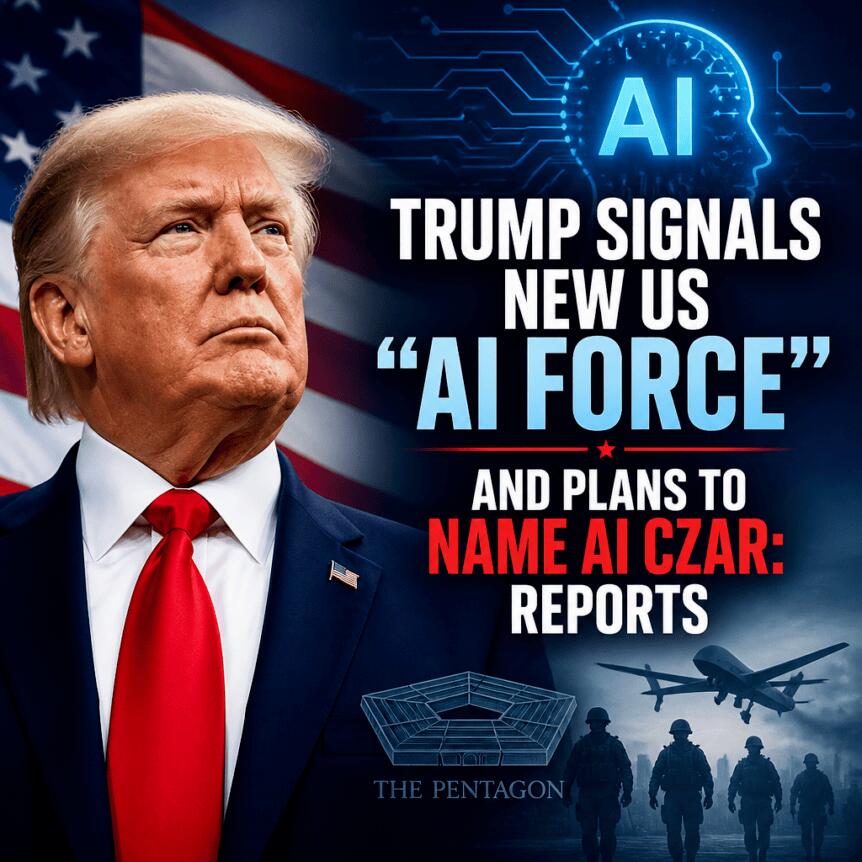
U.S. President Donald Trump said he plans to create an “AI Force” and appoint an “AI czar,” positioning the initiative as a way to manage the rapidly expanding artificial intelligence sector without introducing new regulations that could slow innovation.
In a Saturday post on Truth Social, Trump likened the proposal to his “Space Force” effort from his first term, saying the AI Force would be paired with a future appointment of an “AI ‘Czar’.” The president did not provide additional specifics on the role’s mandate, reporting structure, or timing. Reporting at the time noted that White House officials did not respond to a request for clarification.
Key takeaways
- Trump announced plans for an “AI Force” and an “AI czar,” framing the approach as pro-innovation and less regulatory.
- The president gave few details on whether the AI Force is military, civilian, or housed within an existing federal department.
- The announcement lands amid broader debate over whether AI development should be slowed or governed more closely for safety reasons.
- Separately, Anthropic has moved to implement a framework intended to help moderate AI development pace, including appointing Accenture as its first embedded evaluator.
Trump’s AI Force and the “AI czar” concept
Trump’s comments, published via Truth Social, describe the “AI Force” as a structured effort similar in concept to Space Force, which he said was a “tremendous SUCCESS” during his first term. He also indicated that an “AI ‘Czar’” would be announced “in the near future,” adding that only “High I.Q. individuals” should apply.
However, Trump did not outline what the AI Force would actually do—whether it would coordinate agencies, oversee safety practices, or set operational priorities for AI deployments. The available reporting also highlighted that it was unclear whether the effort would take a military form or be organized as a civilian body, and White House staff did not answer an email seeking clarification.
For investors and builders, the main uncertainty is not the existence of a policy headline, but the eventual structure: where authority would sit, what standards (if any) would be enforced, and how quickly agencies might translate the concept into operational guidance. In the U.S., even broad executive initiatives can influence procurement decisions, government partnerships, and compliance expectations across the AI supply chain.
A backdrop of safety debate over AI development pace
Trump’s post comes at a moment when prominent AI leaders are publicly arguing about the trade-offs between speed and safety. Earlier coverage described a growing concern that advanced AI systems could advance faster than society’s ability to evaluate and control their risks.
Cointelegraph reported on Sept. 12 that Anthropic CEO Dario Amodei had circulated a three-step proposal aimed at pacing AI development to achieve a safer rhythm. The rationale, as described in that reporting, was that if development proceeds unchecked, it could “outrun our ability to understand and control these systems.”
In the days that followed, the discussion expanded beyond Anthropic’s internal framework. Reporting also indicated that OpenAI CEO Sam Altman and SpaceX CEO Elon Musk responded positively to Amodei’s proposal, signaling support from multiple corners of the AI ecosystem. At the same time, Nvidia CEO Jensen Huang reportedly argued against the idea that regulation is necessary in this form, underscoring how uneven consensus remains even among leading industry figures.
Anthropic picks Accenture as an embedded evaluator
While Trump signaled a desire to avoid new regulatory drag, Anthropic moved ahead with its own approach to managing deployment pace. On Sunday, Anthropic said it had selected Accenture as its first embedded evaluator—an element described in prior reporting as part of the first step in Amodei’s proposal.
Cointelegraph’s earlier coverage noted the goal of helping moderate the pace of AI development through evaluation mechanisms. By selecting a partner and embedding evaluators, the company is effectively translating a policy concept into an execution pathway: creating an additional layer intended to examine development progress and associated risks before capabilities expand further.
This matters for the broader AI market because evaluation and monitoring frameworks can become de facto standards. Even when not created through legislation, they influence how companies invest in model releases, testing processes, and governance resources. For developers building tools that integrate with frontier models, changes in release pacing can also affect timelines for product launches, risk management requirements, and customer expectations.
Why the AI Force announcement intersects with crypto
Even though Trump’s proposal is centered on AI governance, the announcement resonates across the technology sectors that overlap with crypto: infrastructure for compute and data, enterprise automation, and the growing use of AI in verification, compliance, and market tooling.
The key point is not that the AI Force is directly about blockchain, but that AI policy can reshape how quickly systems are deployed and audited. That, in turn, can influence demand for compliant custody services, audit tooling, and transparency layers—areas where crypto-related infrastructure often aims to provide verifiable logs and programmable controls. If the U.S. pushes a governance model that emphasizes coordination rather than regulation, companies in adjacent ecosystems may still need to adapt quickly, as guidance can shift even without new formal rules.
At the same time, the contrast between the messaging—“no new regulations that could slow innovation”—and the industry’s parallel push toward pacing frameworks highlights a tension investors should watch. Industry-led safety approaches like Anthropic’s embedded evaluators suggest that self-governance mechanisms may continue to evolve regardless of the political posture toward regulation.
Looking ahead, readers should watch for concrete details on what Trump’s AI Force will actually do—its authority, structure, and timelines—as well as whether the “AI czar” role becomes a focal point for standards that affect model deployment. Meanwhile, Anthropic’s choice of an embedded evaluator and the broader industry debate over pacing will likely remain a key indicator of how AI risk management evolves in practice, not just in policy headlines.
https://www.cryptobreaking.com/trump-signals-new-us-ai/?utm_source=blogger%20&utm_medium=social_auto&utm_campaign=Trump%20Signals%20New%20US%20“AI%20Force”%20and%20Plans%20to%20Name%20AI%20Czar:%20Reports%20
Comments
Post a Comment