
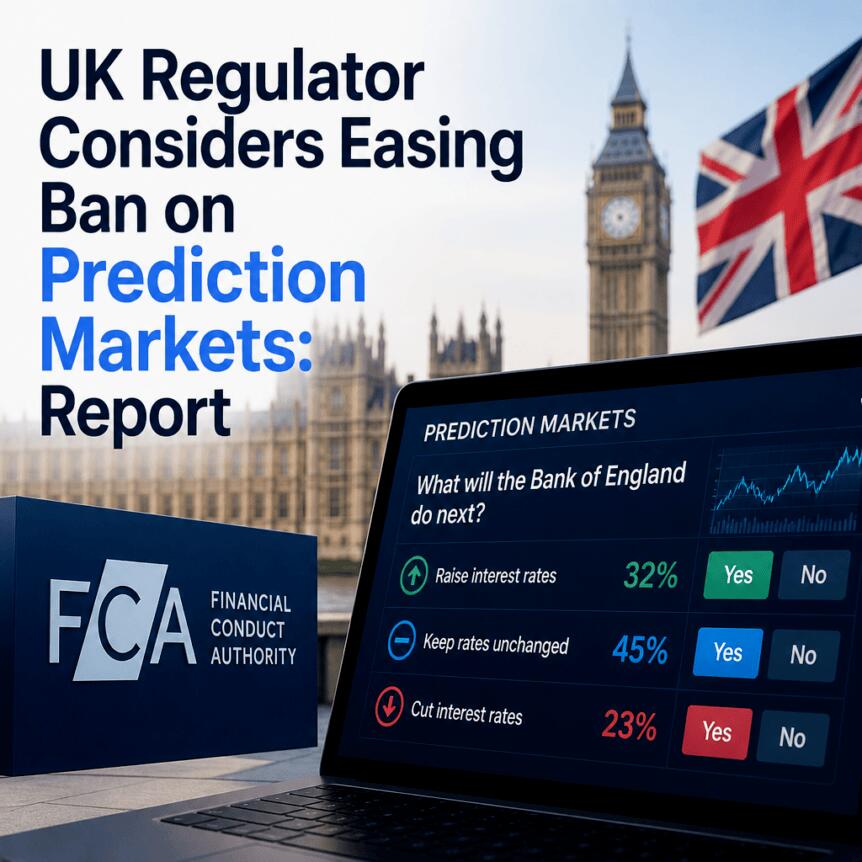
The UK’s Financial Conduct Authority (FCA) is reportedly in discussions with prediction market operators about whether it could ease a long-standing restriction on offering retail access in the country. The move, if it happens, would mark a notable shift from the regulator’s position since 2019—when it placed a permanent ban on selling, marketing, or distributing certain “binary options” to retail customers.
According to a Friday report by The Times, the FCA has been weighing lifting the prohibition for UK-based retail investors. The decision would specifically affect platforms that run event-driven markets—including contracts tied to sports, politics, and weather—where payouts are binary in nature.
Key takeaways
- The FCA’s 2019 rules effectively barred prediction market platforms from marketing binary options to retail consumers in the UK.
- The Times reports the FCA is now considering loosening that retail ban.
- UK retail traders reportedly have used VPNs to access US-based platforms such as Kalshi and Polymarket despite UK restrictions.
- If the FCA reverses course, UK operators could face regulatory questions similar to ongoing disputes in the United States.
Why the FCA’s 2019 ban mattered
The FCA’s restriction dates to April 2019. In a statement at the time, the regulator said firms were “prohibited from selling, marketing or distributing binary options to retail consumers.” The FCA framed binary options as high-risk products that should not be offered to the mass retail public in their existing form.
As noted in the original FCA reasoning from the ban, “Binary options are gambling products dressed up as financial instruments,” according to comments attributed to the regulator at the time, including statements made by the FCA’s executive director of strategy and competition, Christopher Woolard.
Prediction market platforms—particularly those built around event contracts that resolve in yes/no outcomes—often rely on that “binary” structure, even when offered as a market rather than a traditional sportsbook. That similarity is what brought them under the FCA’s broader binary options prohibition.
Reported UK retail access pressure and the VPN workaround
The backdrop to any potential change appears to be persistent retail demand and workarounds. The Times report says many UK-based users have continued trading on platforms such as Kalshi and Polymarket by using virtual private networks (VPNs) to bypass restrictions.
This matters for regulators because it signals that outright prohibition has not eliminated participation. Instead, it has pushed activity into a less transparent channel, with users potentially exposed to the risks and consumer protections—or lack thereof—of jurisdictions outside the UK.
Industry expectations for growth have also helped keep the spotlight on prediction markets. In April, Bernstein Research speculated, as reported by CNBC, that the overall prediction market sector could climb to around $240 billion in trading volume in 2026 and about $1 trillion by 2030. While such forecasts are not regulatory decisions, they shape how seriously both markets and policymakers view the category’s trajectory.
CNBC relayed Bernstein’s projections in April, giving a sense of scale that can influence how regulators evaluate whether a ban is proportionate to real-world usage.
What would change if the ban is lifted?
If the FCA moves to lift the retail ban, the most immediate implication would be legal clarity for platforms that currently operate under constraints for UK retail participants. However, it would not automatically resolve the underlying classification debate around whether event contracts should be treated as “binary options” under UK rules—or whether a more tailored regulatory framework could distinguish prediction markets from conventional binary betting.
Even with a UK relaxation, platforms would likely need to demonstrate how their products function, how they handle consumer protections, and how they address the core concerns the FCA cited in 2019.
Importantly, any UK decision would also be watched in light of disputes in the United States. In the US, state regulators and courts have been grappling with where prediction markets fit within existing gambling and securities frameworks.
US legal battles could shape expectations in the UK
Should the FCA loosen restrictions, UK platforms could face pressure to align with— or at least anticipate— the outcomes of ongoing US enforcement. The source material points to a parallel problem: in multiple US states, gaming authorities have challenged prediction market platforms over sports event contracts.
Earlier coverage highlighted that New Jersey officials petitioned the Supreme Court last week to hear its case against Kalshi, potentially leading to clearer boundaries between state and federal authority over prediction markets. That development, reported by Cointelegraph, underscores how unresolved jurisdictional questions can drive uncertainty for platforms—even when they are operating commercially.
While the UK and US legal environments are not the same, regulatory bodies typically consider international enforcement trends when reassessing product classification and risk. For retail users, any UK shift could also reduce the incentive to use VPNs, if lawful access becomes possible under an FCA-approved structure.
For now, readers should watch for whether the FCA’s reported discussions lead to formal rule changes or guidance—and, just as importantly, whether the regulator’s approach focuses on redefining prediction markets, imposing new consumer safeguards, or simply carving out an exception for retail access. The practical impact will depend on how the FCA draws the line between event-driven prediction and what it considers retail “binary options.”
https://www.cryptobreaking.com/uk-regulator-considers-easing-ban/?utm_source=blogger%20&utm_medium=social_auto&utm_campaign=UK%20Regulator%20Considers%20Easing%20Ban%20on%20Prediction%20Markets:%20Report%20
Comments
Post a Comment