
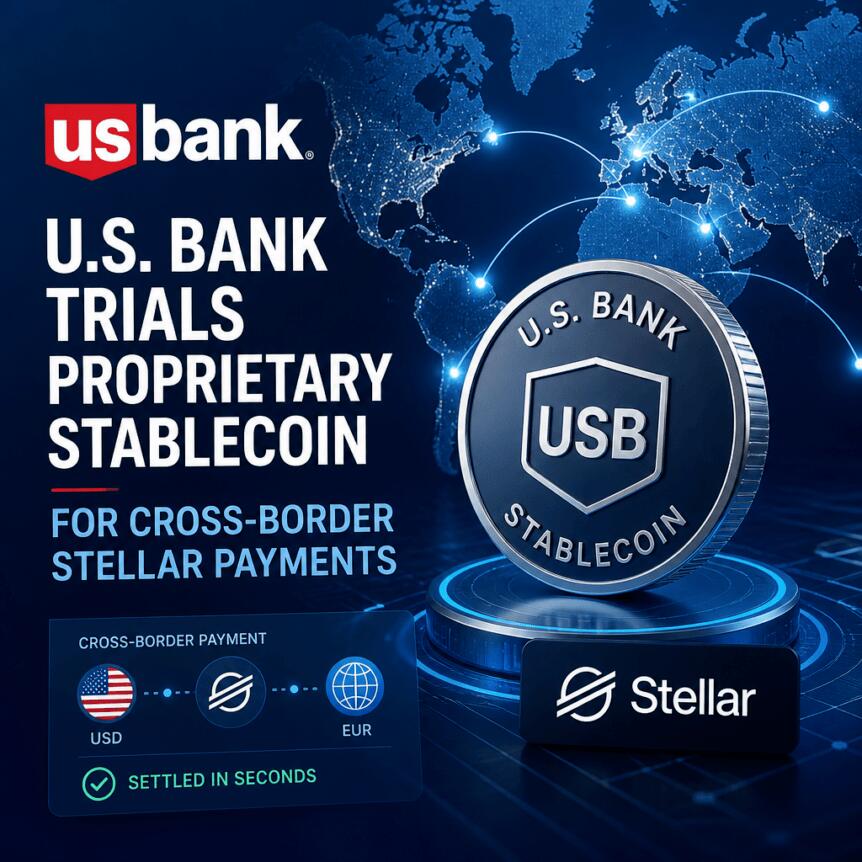
U.S. Bank has completed a live cross-border payment that uses its proprietary USBDC stablecoin on the Stellar blockchain, the bank announced this week. The pilot transferred funds between U.S. Bank entities in North America and Europe, with USBDC issued and moved on Stellar’s public network.
Beyond the transfer itself, U.S. Bank says the exercise also tested core stablecoin capabilities—minting, redemption, and administrative controls such as freezing and clawback—while connecting the process to the bank’s existing risk management, compliance, and operational systems. The goal is to validate whether a stablecoin-based rail can support regulated banking workflows for cross-border treasury and settlement activity.
Key takeaways
- U.S. Bank executed a live cross-border payment using USBDC, a proprietary stablecoin issued and transferred on Stellar.
- The pilot also covered operational features: minting, redemption, freezing, and clawback, integrated with the bank’s risk and compliance infrastructure.
- The bank frames the test as proof of concept for its Digital Asset Platform, which is designed to bridge tokenized assets and traditional banking systems.
- U.S. Bank is building toward additional use cases such as cross-border treasury operations, liquidity management, and onchain collateral movement.
A live test of stablecoin rails across regions
According to U.S. Bank, the transaction involved moving value between bank entities located in North America and Europe. Instead of relying solely on conventional payment systems, the pilot used USBDC on the public Stellar network to effect the transfer.
The significance here is less about the fact that stablecoins can move value—many demonstrations have done that in various contexts—and more about whether a major bank can operationalize that movement under regulated controls. U.S. Bank says it validated the stablecoin’s end-to-end lifecycle functions, including minting and redemption, and exercised administrative mechanisms tied to compliance and risk needs, such as freezing and clawback.
In practical terms, these controls are often central to how financial institutions manage tokenized assets. By testing them alongside risk, compliance, and internal operational systems, U.S. Bank is positioning the pilot as closer to a production-grade workflow than a purely technical experiment.
Digital Asset Platform becomes the bridge to banking systems
U.S. Bank linked the pilot to its internally developed Digital Asset Platform. The platform, the bank says, is intended to connect tokenized assets with its traditional banking infrastructure, allowing stablecoin activity to fit within established procedures rather than operating as an isolated blockchain application.
That integration matters because banks typically face constraints that don’t apply to consumer-oriented crypto services: auditability requirements, operational controls, and governance processes that must connect to legacy systems. U.S. Bank’s announcement also points to the platform as a foundation for future expansion, including cross-border treasury operations, liquidity management, and moving collateral onchain.
From organizational focus to ongoing Stellar testing
This announcement follows U.S. Bank’s broader institutional push into digital assets. In October 2025, the bank created a dedicated Digital Assets and Money Movement unit focused on stablecoin issuance, crypto custody, asset tokenization, and digital money movement, according to the bank’s prior disclosure.
Separately, U.S. Bank has been testing custom stablecoin issuance on Stellar since at least November 2025. The bank said it worked alongside PwC and the Stellar Development Foundation during this testing phase, indicating that the current live payment is part of a longer-running effort rather than a one-off trial.
For investors and market observers, continuity is an important signal. Testing custom issuance and then moving into a live cross-border transaction suggests the project is progressing from design and experimentation toward operational validation.
Broader banking momentum in stablecoins
U.S. Bank’s move sits within a wider industry trend. While some parts of the U.S. banking and crypto ecosystem have raised concerns—particularly around stablecoin issuers and crypto platforms offering yield or rewards—large financial institutions continue to pursue stablecoin strategies of their own.
In early September, reports highlighted an effort by 21 major financial institutions, including names such as Bank of America, Citi, Goldman Sachs, Deutsche Bank, and UBS, to form a company intended to issue stablecoins. That initiative aimed to enable a U.S. dollar-denominated stablecoin in the first half of 2027, with plans to expand to other G7 currencies afterward. The intended focus included wholesale, institutional, and retail use cases, such as cross-border payments and digital asset settlement.
Meanwhile, other mainstream financial firms have already launched token products aimed at specific market segments. Fidelity, for example, entered the stablecoin market in February with Fidelity Digital Dollar (FIDD), issued through Fidelity Digital Assets and available to both retail and institutional investors. Data cited at the time referenced FIDD’s circulating supply of about $50 million, according to DefiLlama.
Taken together, these developments suggest banks are pursuing stablecoin infrastructure not only for settlement efficiency, but also as a regulated extension of existing money movement capabilities. U.S. Bank’s emphasis on compliance-driven features—minting/redemption and freeze/clawback—aligns with what many institutions will likely consider essential before scaling any onchain dollar representation.
What to watch next for USBDC and institutional stablecoins
U.S. Bank’s next steps, as described in its announcement, center on additional applications like cross-border treasury, liquidity management, and moving collateral onchain. The key question for the market is how quickly the bank can translate pilot controls and integrations into repeatable volumes and broader operational coverage, especially as institutional stablecoin efforts across the industry move from planning into deployment.
https://www.cryptobreaking.com/u-s-bank-trials-proprietary/?utm_source=blogger%20&utm_medium=social_auto&utm_campaign=U.S.%20Bank%20Trials%20Proprietary%20Stablecoin%20for%20Cross-Border%20Stellar%20Payments%20
Comments
Post a Comment