
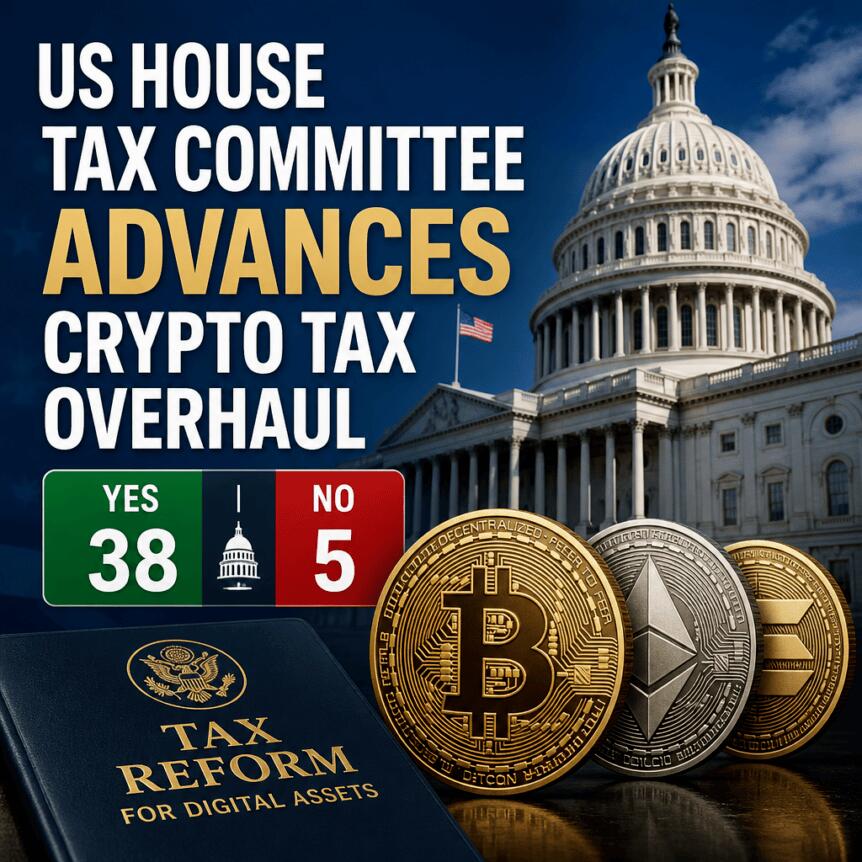
The U.S. House Ways and Means Committee has advanced the “Digital Asset Tax Certainty Act,” a bipartisan bill designed to overhaul how federal taxes apply to a range of crypto activities. The measure moves next to the full House after clearing committee by a 38–5 vote on Wednesday, with provisions aimed at stablecoins, crypto lending, wash-sale treatment, and tax rules for mining and staking.
At the committee level, the legislation covers stablecoins, mining and staking, digital asset lending, transaction fees, and other related activity. Its core goal is to reduce uncertainty for taxpayers by defining clearer tax outcomes—an issue that has been a persistent pressure point for individuals and firms building and using crypto in the U.S.
Key takeaways
- The House Ways and Means Committee approved the Digital Asset Tax Certainty Act on a 38–5 vote, advancing it to the full House.
- The bill would create special tax treatment for qualifying dollar-pegged stablecoins and certain crypto lending agreements.
- It would extend wash-sale rules to widely traded digital assets.
- The legislation proposes new tax rules for mining and staking income.
- A de minimis exemption would allow taxpayers to avoid recognizing gains or losses when paying qualifying network or transaction fees of $10 or less.
What the House bill would change for crypto taxation
According to the bill text linked by the Ways and Means Committee, the “Digital Asset Tax Certainty Act” targets several areas where crypto users and intermediaries have faced uneven guidance or administrative complexity. The measure would establish special tax treatment for qualifying dollar-pegged stablecoins, as well as for certain crypto lending agreements—two categories that often involve recurring transactions and evolving business models.
The committee’s draft also addresses how crypto losses and sales are treated. In particular, it would extend wash-sale rules to “widely traded” digital assets, potentially affecting strategies that rely on selling an asset at a loss and repurchasing it to maintain exposure while offsetting taxes.
On income from securing or validating networks, the bill includes new rules covering mining and staking. For taxpayers, these provisions matter not just for annual tax filing, but for how to characterize rewards, calculate income, and structure recordkeeping around participation in network activity.
A targeted approach to transaction fees and compliance
One of the more operational provisions in the committee-approved bill is a de minimis exemption for certain crypto transaction fees. Under the described framework, taxpayers could avoid recognizing gains or losses when digital assets are used to pay qualifying network or transaction fees of $10 or less.
That type of rule is especially relevant for day-to-day users who may make frequent transactions where fee amounts are typically small. Without a carve-out, even modest fee-related spending can create additional tax events—an outcome that can be difficult to reconcile with normal consumer behavior and can drive disproportionate compliance burden.
Still, the bill’s impact will ultimately depend on how “qualifying” fees are defined and how the exemption interacts with existing tax principles. Readers should watch for follow-up details as the bill moves through the House, including any technical clarifications that could determine whether the carve-out covers common real-world use cases.
Moving through the House while the Senate stalls on market-structure law
The Ways and Means Committee’s approval comes at a politically sensitive moment for crypto legislation. The committee vote landed one day after the U.S. Senate failed to advance the CLARITY Act, a separate effort focused on establishing a federal regulatory framework for digital assets and clarifying the respective roles of the SEC and CFTC.
As earlier coverage noted, the Senate’s cloture motion on CLARITY failed 49–50 on Tuesday, falling short of the 60 votes required to move to debate on the Senate floor. That setback shifted attention toward regulators rather than comprehensive legislation on market structure.
In comments tied to the Senate vote, Senator Cynthia Lummis—chair of the Senate Banking Subcommittee on Digital Assets and a lead sponsor of the CLARITY Act—attributed the failure to Democratic obstruction. In a post on X, Lummis said Democrats “presented demands,” and then “made new demands” as the process continued, while also claiming the party voted against proposed consumer protections and restrictions on politicians’ personal crypto investments.
Even with the Senate stuck, the House can still move the tax bill forward on its own track. That separation is important: tax clarity and regulatory market-structure clarity are distinct problems, and Congress appears to be tackling them through different legislative lanes.
Regulators signal they will proceed without new laws
With the CLARITY Act not advancing, SEC Chair Paul Atkins signaled Wednesday that the agency would continue regulating crypto under its existing statutory authority. In a post on X, Atkins said, “With or without legislation,” the SEC would act decisively to deliver certainty for investors and entrepreneurs, adding “Stay tuned.”
CFTC Chair Michael Selig echoed the same posture. In a Wednesday message on X, Selig said the CFTC is “locked in and ready to ship its rules for the new frontier of finance,” and argued that Americans “deserve regulatory clarity, legal certainty, and consumer protections” in crypto markets.
The practical tension here is that businesses and investors may face two timelines at once: a legislative process for tax rules in the House, and an administrative rulemaking trajectory that continues even when broader market-structure legislation fails in the Senate.
For participants in crypto markets, this means compliance planning may increasingly rely on a combination of (1) incremental legislation for taxes and (2) ongoing regulatory interpretation through agencies’ existing powers. Until Congress delivers the broader framework that lawmakers discussed through CLARITY, firms will likely continue preparing for regulatory outcomes through SEC and CFTC rulemaking and enforcement guidance rather than a single consolidated statutory regime.
What to watch next
As the Digital Asset Tax Certainty Act heads to the full House, the key question will be how the chamber refines and interprets the bill’s technical details—especially the scope of the stablecoin and lending provisions, how wash-sale rules would be defined for digital assets, and what “qualifying” transaction fees cover under the de minimis exemption. Meanwhile, the SEC and CFTC’s next steps will be crucial for understanding how regulatory clarity evolves even without the Senate’s CLARITY Act progress.
https://www.cryptobreaking.com/us-house-tax-committee-advances/?utm_source=blogger%20&utm_medium=social_auto&utm_campaign=US%20House%20Tax%20Committee%20Advances%20Crypto%20Tax%20Overhaul%20by%2038–5%20
Comments
Post a Comment