
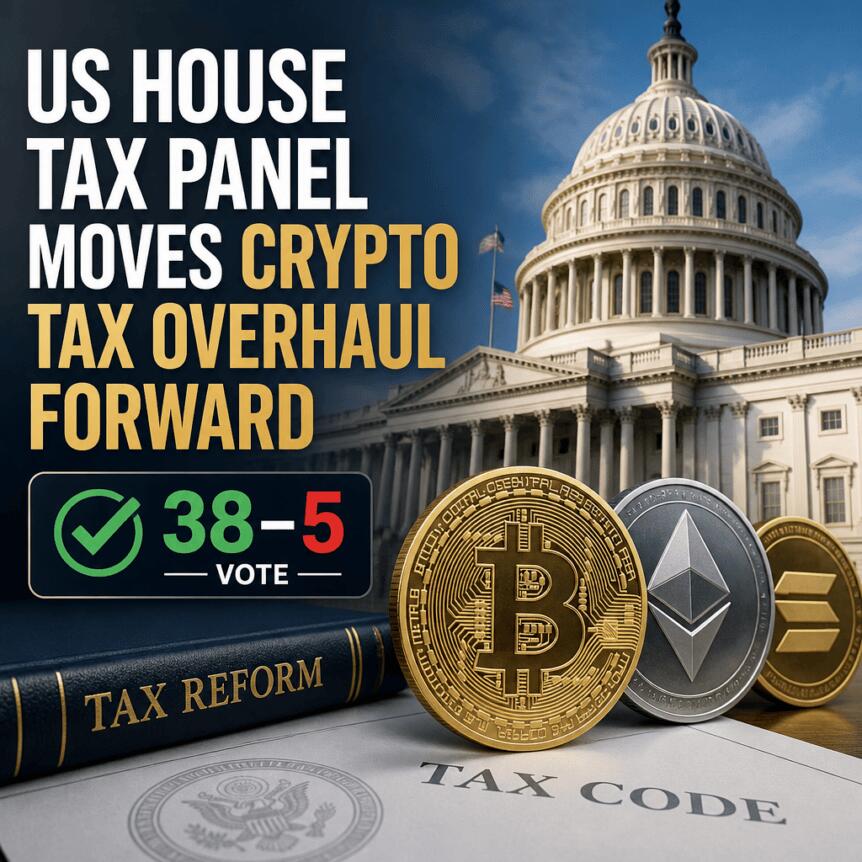
The U.S. House Ways and Means Committee has advanced the Digital Asset Tax Certainty Act, a bipartisan effort intended to overhaul how federal taxes apply to a range of crypto activities. The measure moved forward on Wednesday in a 38–5 vote and now heads to the full House for consideration.
The bill would address the tax treatment of stablecoins, crypto lending, mining and staking, and also includes provisions affecting transaction fees and how certain losses are treated through the tax code’s wash-sale framework.
Key takeaways
- The act passed the House Ways and Means Committee on a 38–5 vote, signaling strong support before broader House consideration.
- It would create special tax treatment for qualifying dollar-pegged stablecoins and certain crypto lending agreements.
- It would extend wash-sale rules to widely traded digital assets.
- A proposed de minimis exemption could allow taxpayers to ignore recognition of gains or losses when paying qualifying network or transaction fees of $10 or less.
- The push comes just a day after the Senate failed to advance the broader CLARITY Act, leaving regulators to continue rulemaking under existing authority.
What the Digital Asset Tax Certainty Act would change
According to the committee text, the bill is designed to bring more predictability to taxpayers involved in crypto-related activity. It covers several areas where current tax treatment has often been difficult for market participants to apply consistently.
Stablecoins: One of the central proposals would establish a special tax approach for qualifying dollar-pegged stablecoins. The committee also ties related rules to particular forms of crypto lending, aiming to reduce ambiguity around when and how taxable events occur.
Crypto lending: The bill would provide special tax treatment for certain crypto lending agreements, a category that can involve complex questions about income recognition and the character of gains or losses.
Wash sales: Another major feature is the extension of wash-sale rules to widely traded digital assets. Wash-sale rules are intended to limit the ability to claim tax losses while effectively maintaining exposure to the same asset—an issue that has become more prominent as digital assets have gained liquidity.
Mining and staking: The act would also establish new rules for mining and staking income, addressing longstanding uncertainty about how these activities should be treated for federal tax purposes.
De minimis treatment for small transaction fees
The bill would introduce a de minimis exemption for certain crypto-related transaction fees. Under the proposal, taxpayers could avoid recognizing gains or losses when digital assets are used to pay qualifying network or transaction fees of $10 or less.
From an investor and day-to-day user perspective, this kind of threshold matters because routine trading and transfers can generate many small, taxable “events” under current interpretations. While the bill’s details would ultimately determine eligibility and scope, the committee’s approach suggests lawmakers are targeting friction points that can make compliance burdensome for regular participants.
House action contrasts with a Senate setback for market-structure regulation
Wednesday’s tax-focused progress comes after the Senate failed to advance the CLARITY Act the day before. Earlier coverage of the Senate outcome noted that the proposal—aimed at creating a federal framework for crypto regulation and clarifying the roles of the SEC and CFTC—did not reach the threshold needed to move forward.
In that Senate vote, a cloture motion failed 49–50 on Tuesday, falling short of the 60 votes required to bring the bill to the floor for debate. As a result, attention shifts back to how existing regulatory authorities will be applied in the absence of new legislation.
Senator Cynthia Lummis, chair of the Senate Banking Subcommittee on Digital Assets and a lead sponsor of CLARITY, blamed Democrats for the bill’s failure. In a post on X, Lummis said negotiations involved shifting demands and referenced objections to proposed consumer protections and restrictions tied to politicians’ personal crypto holdings.
SEC and CFTC signal continued rulemaking under existing authority
With CLARITY stalled in the Senate, the SEC’s leadership signaled continued action within current legal frameworks. SEC Chair Paul Atkins said Wednesday that, whether or not new legislation passes, the agency would continue acting decisively within its statutory authority, adding that investors and entrepreneurs should “stay tuned.”
The CFTC also indicated it would move forward with its own regulatory plans. In a Wednesday post on X, Chair Michael Selig said the CFTC is prepared to “ship” rules for crypto markets and emphasized the need for regulatory clarity, legal certainty, and consumer protections.
For market participants, the juxtaposition is significant: the House is pushing a clearer tax pathway, while the Senate has not yet produced a comprehensive market-structure regulatory framework. This split means firms may see progress on compliance burdens related to taxes, even as the broader rules governing oversight and market operations remain in flux.
What happens next in Congress
The committee’s vote sends the Digital Asset Tax Certainty Act to the full House of Representatives. Investors and crypto businesses will likely watch closely for whether the bill’s provisions—particularly those governing stablecoins, wash sales, and small transaction fees—are retained, modified, or narrowed as it moves through the next legislative stages.
https://www.cryptobreaking.com/us-house-tax-panel-moves/?utm_source=blogger%20&utm_medium=social_auto&utm_campaign=US%20House%20Tax%20Panel%20Moves%20Crypto%20Tax%20Overhaul%20Forward,%2038–5%20Vote%20
Comments
Post a Comment