
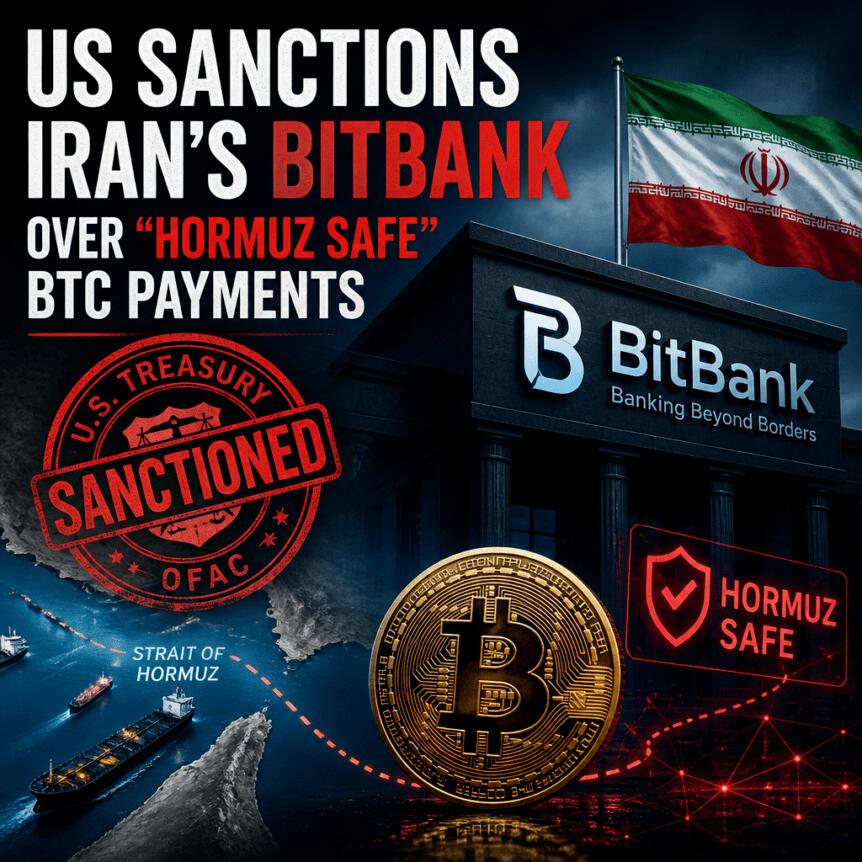
U.S. authorities have announced new sanctions targeting an Iranian crypto exchange known as BitBank, accusing it of helping move Bitcoin payments tied to maritime traffic through the Strait of Hormuz. The U.S. Treasury says the exchange was used to transfer funds received through a Hormuz-related payments authority to the Islamic Revolutionary Guard Corps (IRGC).
In a press release issued by the U.S. Department of the Treasury’s Office of Foreign Assets Control (OFAC), the government described BitBank as part of an alleged sanctions-evasion “infrastructure” associated with Iranian financier Babak Zanjani. OFAC’s action forms part of a broader effort to restrict Iran’s access to the global financial system, including through targeting digital asset service providers.
Key takeaways
- OFAC sanctioned Iranian crypto exchange BitBank, alleging it processed Bitcoin payments connected to ships transiting the Strait of Hormuz.
- The Treasury alleges BitBank transferred funds received by the Hormuz Safe Marine Services Authority to the IRGC.
- OFAC also designated BitBank’s developer, Pishtaz Simorgh Electronic Trade Company, along with three Zanjani associates.
- The U.S. has repeatedly expanded crypto-related Iran sanctions, including actions against exchanges and steps involving USDt-linked wallets.
- There is potential for confusion between the sanctioned BitBank entity and a separate Japan-based exchange, “bitbank, inc,” that was acquired by SBI Holdings in June.
OFAC ties BitBank to payments around Hormuz
OFAC’s announcement states that, as of June, the Hormuz Safe Marine Services Authority used BitBank to transfer payments it received to the Islamic Revolutionary Guard Corps. The implication, according to the Treasury, is that crypto rails were integrated into a system that supports financial flows tied to passage through a strategic chokepoint.
The U.S. also previously alleged that Hormuz Safe is connected to an IRGC-backed scheme involving maritime insurance arrangements for vessel transit—specifically coverage that, in the Treasury’s account, includes risks related to seizures by Iran itself. By linking BitBank to this payments chain, the Treasury is effectively arguing that an Iranian digital asset exchange can function as a conduit for regime-linked funding.
U.S. Treasury Secretary Scott Bessent said the designations underscore that “efforts to finance the Iranian regime using cryptocurrencies” are not beyond OFAC’s enforcement reach.
Why the Treasury’s “digital asset infrastructure” framing matters
OFAC did not only target a single exchange; it also designated BitBank’s developer—Pishtaz Simorgh Electronic Trade Company—and three associates connected to Babak Zanjani. In the filing and related announcement, OFAC described these entities as “key components of the Iranian regime’s digital assets-based sanctions evasion infrastructure.”
For investors, traders, and on-chain analysts, this matters because it reinforces how regulators are moving from broad “crypto used for illicit finance” messaging toward mapping specific operational roles within alleged networks. Instead of treating activity as incidental to sanctions evasion, the U.S. is characterizing certain digital service providers and corporate developers as integral nodes—potentially affecting counterparties, compliance workflows, and the risk assessments of exchanges and custodians that may interact with such entities.
OFAC’s approach also suggests that enforcement risk is not limited to Iranian individuals, addresses, or token transfers alone. It can extend to software vendors, exchange operators, and associates—depending on how the U.S. describes their involvement in the flow of value.
Sanctions pressure aligns with earlier U.S. actions
The BitBank designation comes after a sequence of U.S. measures aimed at tightening Iran’s access to financial tools, including digital assets. In earlier actions, OFAC sanctioned two exchanges—Shelbit and Aban Tether—accusing them of assisting the Iranian regime in sanctions evasion. The Treasury also sanctioned four crypto exchanges in June, including Nobitex, which the U.S. identified as Iran’s largest exchange.
Beyond exchange designations, the U.S. also ordered the freezing of more than $130 million in USDt held in wallets linked to Iran. Taken together, these steps show a multi-pronged strategy: identifying exchange infrastructure, restricting stablecoin-linked funds, and isolating sanctioned entities from activity that could enable cross-border value movement.
The broader political goal remains consistent across these actions—isolating Iran from the international financial system. In the Treasury’s view, digital assets are now part of the mechanism by which the regime can sustain transactions and payments despite increasingly tight constraints.
Entity confusion: sanctioned BitBank vs. “bitbank, inc”
One potential point of misunderstanding for readers is that the sanctioned entity is “BitBank,” which OFAC’s designation reportedly describes as established in 2024. This is separate from “bitbank, inc,” a fully licensed crypto exchange founded in 2014 in Japan and acquired by SBI Holdings in June.
The similarity in names has practical implications: compliance teams, journalists, and market participants should avoid assuming that the Japanese exchange is implicated in the U.S. sanctions simply because of the branding overlap. The U.S. action appears to concern a different organization tied to the Treasury’s alleged Hormuz payment architecture.
Cointelegraph reached out to BitBank for comment, though no response is included in the provided material.
What to watch next
As OFAC continues building out sanctions lists around Iranian crypto infrastructure, market participants should monitor whether related wallets, service providers, and stablecoin pathways are further targeted—especially those connected to maritime-linked payment systems described in the Treasury’s case. The immediate uncertainty is how quickly designated entities can be circumvented and whether enforcement will expand to additional components of the broader network OFAC alleges BitBank helped power.
https://www.cryptobreaking.com/us-sanctions-irans-bitbank-over/?utm_source=blogger%20&utm_medium=social_auto&utm_campaign=US%20Sanctions%20Iran’s%20BitBank%20Over%20“Hormuz%20Safe”%20BTC%20Payments%20
Comments
Post a Comment